Some mornings start with a rush and a spill. Matcha mornings start with a whisk: a bamboo chasen stirring green powder into water, the foam rising like a tiny green ocean, and the whole kitchen smelling faintly of grass and honey. It is Japan’s gift to slow mornings — stone-ground tea leaves, drunk in a bowl, built for calm energy instead of a racing heart. This collection gives you more than 200 original matcha puns and one-liners, written fresh for this page and sorted by where you plan to use them.
Why do matcha jokes land so well? Because matcha life comes with a built-in audience: everyone has seen the bright green latte on a café menu, watched a tea bowl get whisked into foam at a tea house, or learned that this powdered tea carries its own calm alertness in every sip. Once you see how the wordplay works in the next section, every joke below lands a little warmer.
⚡ Quick Answer: Matcha is shade-grown green tea, stone-ground into a fine powder and whisked with hot water into a frothy bowl. Its built-in vocabulary — whisk, froth, bowl, calm energy — is why matcha puns practically write themselves.
The Science & Wordplay Behind Matcha Humor
Matcha is powdered green tea — and that is not café poetry. A few weeks before harvest, tea plants in Japan are shaded with covers, which raises the leaves’ chlorophyll and the amino acid L-theanine. The picked leaves, called tencha, are steamed, dried, de-stemmed, and then slowly ground between granite stones into a powder fine enough to whisk into water. That is the whole recipe: leaves, shade, stone, bowl.
Start with the color fact that surprises everyone. That bright green is chlorophyll at work. The shading forces the leaf to make extra chlorophyll, so real matcha glows an almost electric green. A dull, yellowish powder is the easiest sign of a low-grade matcha — and one of the most common reasons a first homemade bowl tastes like a bad decision.
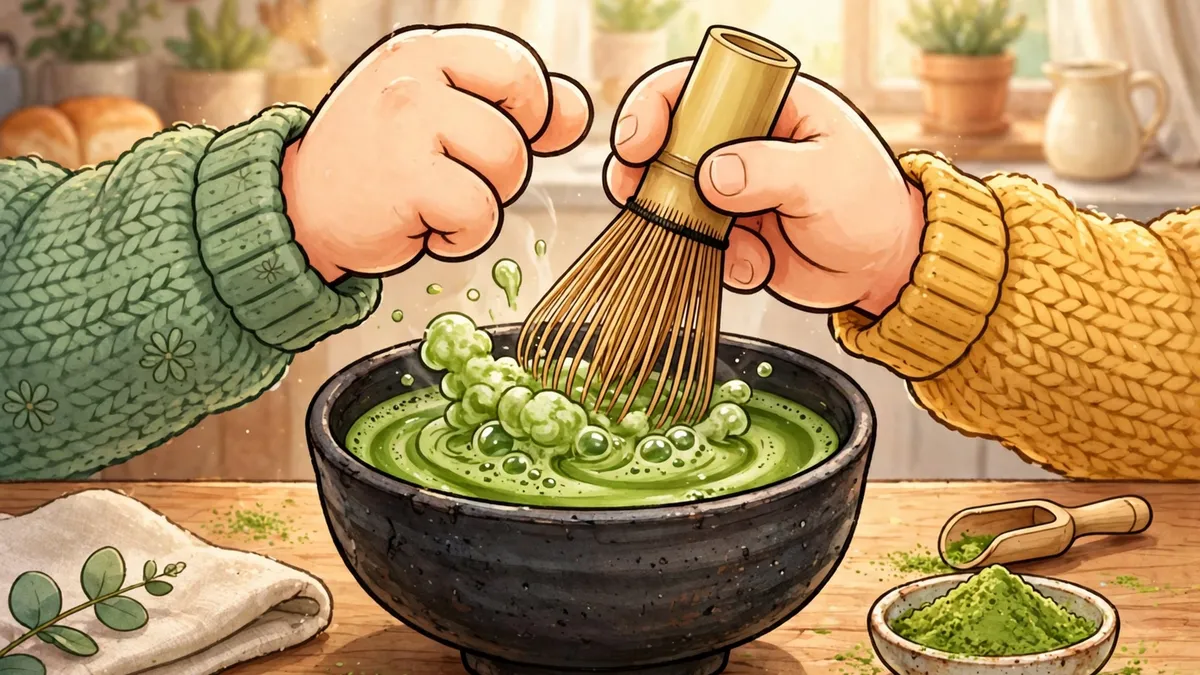
The whisk is where the magic happens. A bamboo chasen — carved from a single piece of bamboo into dozens of fine tines — beats the powder and hot water into a smooth froth, no steeping involved. Matcha is not brewed like tea bags and then strained out; the whole leaf goes into the cup, whisked to foam and drunk, powder and all.
Then there is the calm-energy story. Matcha carries caffeine, yes — but alongside it sits L-theanine, an amino acid that slows the caffeine’s rush and smooths it into steady focus. Monks reportedly drank it to stay alert through long meditation, which makes matcha the original study drink: awake without the jitters, calm without the nap.
Matcha wears two outfits, and the bowl knows the difference. Usucha is thin tea: about two grams whisked with more water into a light, frothy drink. Koicha is thick tea: a double dose of the finest powder mixed with just enough water into a slow, rich paste — the ceremonial heavyweight, reserved for formal tea gatherings and sipped in shared ritual.
Grades matter more here than almost anywhere in tea. Ceremonial grade is made from the youngest first-harvest leaves: smoother, sweeter, less bitter, meant to be whisked with water alone. Culinary grade comes from later harvests: stronger, more bitter, perfect for lattes, smoothies, and baking — where milk and sugar do the smoothing the leaves skipped.
The birthplace sets the bar. Uji, a small city near Kyoto, is matcha’s historic home, and its misty river fields still produce some of the most prized tencha in the world. Matcha is made in other places now — and fine matcha, too — but “Uji matcha” on the tin remains the name that makes tea lovers sit up straighter.
Taste it once and you will find the umami. Alongside fresh green sweetness, good matcha has a savory depth — the same flavor family as broth and roasted vegetables — which is why a well-made bowl needs no sugar. That savory note, plus antioxidant compounds called catechins, is the leaf’s full résumé in one sip.
Now the wordplay engine — the sound pairs that power almost every matcha joke:
Matcha — the powdered green tea itself, Japan’s whisked morning ritual in a bowl
Whisk — the zigzag motion of the chasen that turns powder and water into foam
Chasen — the carved bamboo whisk, thin as a starburst and central to the whole craft
Chawan — the tea bowl: wide, warm, and shaped for whisking, not sipping from a lip
Chashaku — the bamboo scoop that measures out the perfect two grams of powder
Froth — the fine foam on top of a well-whisked bowl, the mark of a steady hand
Usucha — thin tea: light, frothy, and the everyday bowl of the tea world
Koicha — thick tea: the rich, ceremonial paste, sipped slowly and shared
Tencha — the shade-grown leaves that become matcha only after the stone grinds them
Chanoyu — the Japanese tea ceremony, built on harmony, respect, purity, and calm
Uji — the Kyoto-side city where matcha’s reputation was born and still stands
Umami — the savory depth in a good bowl, the flavor that makes sugar optional
L-theanine — the calm-focus compound that turns caffeine into smooth energy
Ceremonial grade — the sweetest, smoothest powder, whisked with water alone
Stone-ground — the slow granite grinding that keeps the powder fine and the flavor fresh
Green — the color of the leaf, the bowl, the mood, and half the jokes on this page
Keep those pairs in mind — nearly every line below is built on one of them.
The Bowl, the Latte, the Treat: A Quick Matcha Guide
Every matcha beginner started as a person staring at a green menu, wondering which of these is the real thing and which is dessert wearing a tea costume. Here is the friendly, honest guide:
The Ceremonial Bowl — the whisked original. Ceremonial-grade powder, hot water, bamboo chasen, one steady wrist: this is matcha as the tea ceremony serves it — bright green, lightly frothy, sipped straight from the chawan. No milk, no sugar, no straw. When the menu says just “matcha,” this is what it means, and it is the standard every other version is measured against.
The Thick Koicha — the formal heavyweight. Twice the powder, a splash of water, and a kneading motion instead of a whisk — koicha arrives as a rich, slow paste shared at formal gatherings. It is made from the finest leaves of the year, tastes deeper and less bitter than its thin cousin, and is drunk in small shared sips. Think of it as the concert version of the bowl: rare, rich, and unforgettable.
The Iced Latte — the crowd favorite. Culinary-grade matcha shaken with cold milk and ice is the green drink on every café board, and it is delicious in its own right. The milk softens the stronger flavor of later-harvest leaves, the ice keeps it bright, and the layered look makes it the most photographed drink in the café. Just know it is a cousin of the bowl, not the bowl itself.
The Baking Tin — matcha goes to the kitchen. Culinary grade earns its keep in cookies, cakes, and ice cream, where its bold flavor survives sugar and heat. Green tea shortbread, matcha pound cake, and swirled soft-serve all owe their color and their earthy sweetness to this grade. If it is sweet and green and served on a plate, culinary grade did the work.
The Morning Ritual — the daily whisk. Many matcha fans keep a small home setup: tin of powder, chashaku scoop, chasen whisk, chawan bowl. Two scoops, warm water, thirty seconds of whisking, and the day starts with foam instead of noise. It is a small ceremony for one person — and the cheapest good habit a morning can have.
Classic Matcha One-Liners
These are the all-rounders — the lines that work anywhere matcha shows up: the café counter, the tea house floor, the family group chat. They lean on the classic sound pairs from the science section, so they land even with people who have whisked a bowl every morning for years and have heard every “green” joke twice. Keep a few in your pocket; the first morning whisk will give you a reason to use one within the hour.
Grandma checks her tea tin before she checks the weather, because a well-kept matcha tin already knows exactly what kind of morning it is going to be.
The first bowl of spring whisked up so green that the whole tea house went quiet for a full minute just to look at it.
Some people need a whole alarm system; the matcha drinker needs one good bowl, one steady whisk, and the meeting is adjourned.
The oldest chasen in the tea house has whisked a thousand bowls, and the younger whisks are treated the way apprentices treat a master’s tools.
A matcha tin’s calendar has three seasons: first-harvest season, latte season, and the short sweet week when the spring powder arrives.
Dad says the tea corner is not a corner — it is a small morning airport, and every bowl is a smooth takeoff.
The tea journal for Tuesday reads, in full: “Whisked. Sipped. Whisked again. Excellent day.”
There is a particular hush that falls over the café when the barista starts the whisk, and twenty strangers become a quiet audience without saying a word.
The barista’s first perfect froth was thirty seconds of wrist work and straight to the regulars’ table, which everyone agreed was sound project management.
A matcha bowl does not hurry, and neither should you — every calm morning on this street started as two grams of green powder.
The café manager measures the day’s success differently: full powder tins, warm bowls, and one chasen retired with honors to the display shelf.
Uncle swears the foam on his bowl formed a tiny green mountain range. The family has decided to allow it, because the morning light agreed with him.
The tea house’s best moment costs nothing: a fresh bowl set down on the tatami, one curl of steam, and the whole room breathing slower together.
Never trust a person who says they will “just try one sip” of ceremonial matcha; nobody in recorded tea history has stopped at one bowl.
The shelves by the window are spoken for in a system older than the café itself: one tin for ceremony, one for lattes, and everybody respects the seating plan.
On the coldest mornings the whisk feels like a warm-up exercise for the wrist, and the whole kitchen looks like it invented comfort out of pure patience.
The morning class counted eleven froth bubbles in the demonstration bowl; the quiet kid at the back found the twelfth, because he was the only one counting slowly.
Every good bowl has two rewards: the foam on top, and the warm weight of the chawan in both hands.
The tea master says a matcha morning’s idea of a wild start is switching from usucha to koicha — and some regulars will not even commit to that until spring.
Out on the tea farm, time runs at leaf speed: shading lasts for weeks, grinding takes hours, and nobody has ever once been late for the whisk.
The first harvest announcement rolled down the Uji valley like good news in a small town, and every tea house in three streets sat up straighter.
Visitors ask what the tea master is dreaming about, and the apprentice answers, “Froth,” with the certainty of a man who has checked.
A morning ritual of whisk and sip is the café’s best free entertainment: one steady wrist, one bright bowl, and a calm taken immediately, on principle.
The corner table under the window is unofficially reserved for early risers, poets, and anyone having the kind of day only a slow drink can fix.
The new barista spent the whole lunch rush whisking perfect bowls, and came out the other side looking like the queue had been somebody else’s problem.
In matcha country, “rush hour” is the twenty minutes at dawn when everybody wakes up, thinks about tea, and commits to one good bowl.
The spring tea festival is the sweetest address in town: tins open, whisks flying, and a whole new class learning the family business.
Dad tried to explain the tea ceremony to the cat. The cat looked at the bowl, looked back at Dad, and sat down to supervise.
The best seats in the tea house are not seats at all — they are the three low cushions where you can watch the whisking without earning a sore back.
A tea traveler once called matcha “the mayor of calm.” The tea master accepted the title by whisking one more bowl.
The twins shared a bowl before story time, and the teacher marked the tea house down as an approved influence.
Somewhere in Kyoto tonight there is a chasen drying in the exact spot it has dried for twenty years, and the whole shelf stands a little prouder for it.
Cute Matcha Puns
“Cute” in matcha country means warm: the lines you would write in a card for the person who keeps your mornings bright. These are sweet, gentle, and safe for anyone — pass them along with a shared box of green cookies, a saved seat by the window, or a photo of the first spring bowl that simply has to be shared.
I saved you the sunny side of the table — the one with the clear view of the whisk station and no glare on your book.
You are the person I would share my last scoop of ceremonial powder with, and around here that is a legally binding statement.
Some people leave a porch light on; our family leaves the kettle warm for anyone coming home past the tea hour.
Consider this card a warm bowl in your hands: hold it as long as you like, the froth is on me.
Grandpa and the old tea master have the same morning ritual: a slow whisk, a look around to confirm the world kept its promises, then breakfast.
If today feels heavy, borrow the matcha method: warm water, steady hands, one sip at a time, and no rushing the good part.
The first bowl of the day gets the best greeting: the whole kitchen learned its name by lunchtime.
You have a matcha kind of kindness — quiet, steady, and there for the whole long morning without any fuss being made.
The café regular made the new apprentice a welcome sign. It reads “Foam Department — Junior Manager,” and honestly it is accurate.
Sending you a photo instead of flowers, because the foam art in it is mid-swirl and it has fixed worse days than this one.
Love, around here, is someone learning your bowl — which tea you like, which hour you whisk, and never once rushing your morning.
The two oldest friends in the tea house meet at the window table every Saturday: one talks, one sips, and the chasen supervises both arrangements.
A first spring leaf spends weeks under shade before its big day, and somehow it still arrives looking fresh and unhurried.
Your friendship is like a favorite tea house: I always know where to find it, and it has never once been the wrong season to visit.
The new dad at the tea festival held his baby up to see the whisking, and two kinds of wonder were on display at the one table.
Some gifts you carry in a bag; the best ones you carry like a warm chawan — close, safe, and steaming through the boring parts.
Mum keeps one rule for hard weeks: one green bowl, early stars, and no decisions made before your second sip.
The old chawan on the high shelf is the tea house’s grandmother — every bowl on the counter has learned something from her shape.
If you ever need proof that slow is a complete strategy, the tea ceremony has been running this exact program for centuries.
The class made the tea master a card with forty-one signatures; the tea master bowed twice, which everyone agreed was in character.
You are my favorite tea bowl: the warm one, in the good light, that I always meant to reach for first.
The couple’s wedding favors were tiny tins of matcha under the plum trees, and the guests still talk about the green toast at sunset.
Matcha Q&A Jokes
Question-and-answer jokes are the easiest kind to perform: you ask, they guess, you land the punchline. This set is built for tea houses, café counters, and school culture days, where one good Q&A starts a whole round of everyone trying their own. The chasen, the chawan, and one very proud tea master do most of the heavy lifting — and the first fourteen answers teach a real matcha fact on the way to the laugh.
Q: What is matcha? A: Powdered green tea from Japan, made from shade-grown tea leaves called tencha that are steamed, dried, and slowly ground between granite stones. The powder is whisked with water into a bright green, frothy drink — the whole leaf goes into the cup.
Q: What is a chasen? A: The bamboo whisk used to mix matcha — carved from one piece of bamboo into dozens of fine tines. You move it in a quick zigzag to whip the powder and water into smooth foam.
Q: What is a chawan? A: The wide tea bowl matcha is whisked and drunk from. It is broad and low, shaped so the chasen can move freely, and it warms your hands while you hold it with both of them.
Q: What is a chashaku? A: The slim bamboo scoop that measures matcha powder. Two scoops is about two grams — the standard measure for one bowl of usucha, thin tea.
Q: What is chanoyu? A: The Japanese tea ceremony, built on four principles: harmony, respect, purity, and tranquility. It is a formal, graceful way of preparing and sharing matcha that has been practiced for centuries.
Q: What is the difference between usucha and koicha? A: Usucha is thin tea — two grams of powder whisked with more water into a light, frothy bowl. Koicha is thick tea — double the powder with just a little water, kneaded into a rich, slow paste and shared at formal gatherings.
Q: What is the difference between ceremonial and culinary grade matcha? A: Ceremonial grade comes from the youngest first-harvest leaves: smoother, sweeter, and meant to be whisked with water alone. Culinary grade comes from later harvests: stronger and more bitter, and perfect for lattes, smoothies, and baking.
Q: Why does matcha give calm energy instead of jitters? A: Matcha contains caffeine plus an amino acid called L-theanine, which slows the caffeine’s rush and smooths it into steady, calm focus. Monks used it to stay alert through long meditation — awake without the buzz, calm without the nap.
Q: Where does matcha come from? A: Japan — and the most famous home is Uji, a small city near Kyoto, where misty river fields have grown prized tea for centuries. Good matcha is made in other countries now, but Uji is still the name that sets the standard.
Q: What is tencha? A: The shade-grown green tea leaves that become matcha. The plants are covered for weeks before harvest to boost chlorophyll and L-theanine, then the picked leaves are steamed, dried, and de-stemmed — only after stone grinding does tencha become matcha.
Q: What does matcha taste like? A: Fresh, grassy, and a little sweet, with a savory depth called umami. Good ceremonial matcha tastes smooth and almost creamy; lower grades taste stronger and more bitter — which is why they go into lattes and baking instead of the plain bowl.
Q: Is matcha stronger than coffee? A: A bowl of matcha has less caffeine than a cup of brewed coffee — roughly a third to a half. But because the whole leaf is drunk and the L-theanine stretches the effect, it feels steadier and longer, like a slow hill instead of a sharp spike.
Q: Why is matcha so green? A: Shade-growing. The covers over the tea plants force the leaves to make extra chlorophyll, and that chlorophyll is what gives good matcha its bright, almost glowing green color. Dull powder means a weaker leaf — or a weaker harvest.
Q: Is matcha whisked or brewed? A: Whisked, never steeped. Tea bags are soaked and removed, but matcha powder is beaten straight into hot water with the chasen and drunk foam and all. No straining, no waiting — the leaf itself goes into the bowl.
Q: What did the chasen say to the tea bowl? A: “Keep the water warm — I will be in my usual zigzag, and I brought the whole wrist.”
Q: Why did the powder stay in the tin? A: The tin is a cool, dark little apartment — matcha that naps well keeps its color first and its flavor best.
Q: What did the tea master say to the sunrise? A: “You’re late to my first whisk again — I started the warming-up process twelve minutes ago.”
Q: Why did the barista sift the powder twice? A: Standards. A bowl of this reputation does not settle for yesterday’s lumps.
Q: What is a tea bowl’s favorite meeting style? A: Short, seated, and held in both hands — with froth provided and the minutes taken by whoever sips last.
Q: Why do families love the morning tea watch? A: It is the only news broadcast that also confirms the kettle is on, the powder is fresh, and calm is officially a household activity.
Q: What did the froth say on its first bright morning? A: “Big bowl, warm hands, excellent whisk — I accept this position.”
Q: Why did the tea master visit the far tea field at noon? A: A second look never hurt anyone — the new shade covers deserve inspection, and they deserve an audience.
Q: What is a tea house’s busiest hour? A: Dawn — the last bowl needs whisking, the tins need checking, and every whisk has one last story from the quiet shift.
Q: Why did the apprentice lead the guest to the sunny table? A: Whisk hour is a house tradition, and they teach it the way they were taught: scoop, pour, whisk, repeat.
Q: What did the old chawan say to the new bowl? A: “We have reviewed your glaze and tested the lower curve for a week. You’re in.”
Q: Why do matcha jokes always land? A: They arrive with a story from the tea bowl, they are built on real foam, and there is something in the chawan for everybody.
Q: What did the tea master say to the watcher at the counter? A: “Same time tomorrow — you bring the questions, I will bring the whisk.”
Q: Why does the tea house go quiet at first light? A: The morning whisking has begun, and even the loudest regular respects a whole room settling in for the calm shift.
Matcha Captions & Texts
Captions live or die in the first few words, so these stay short and warm. The Instagram set is written for photos and clips — green bowls, café layers, and froth close-ups — while the texting set works as quick replies and everyday updates you can send in seconds.
Matcha Instagram Captions
First photo goes to whoever spots the froth swirl before the barista does.
Bowl status: one chasen, two scoops, and a green that no filter can take credit for.
This whisk lineup required both a slow morning and a short pep talk with the tea tin.
Café rule one: the person holding the camera names the first bowl; the person holding the tin names the second.
My morning route — kettle, tin, bowl, window — has more planning in it than my weekend does.
Calm level: ceremonial. Two grams whisked, and the diary is full till Thursday.
This bowl took all week to earn. Photographing it slowly, from a respectful distance.
Green day today: same bowl, fancier froth.
Six tea tins along the shelf, finished in shades of green and gold.
Grandpa’s kettle, Dad’s tea tray, my turn at the whisk: three generations of teamwork.
Some people collect stamps. I collect morning photos with a green bowl in them.
One tiny scoop for the tea log, one deep whisk line for the red notebook.
That first-sip quiet right after says more than this caption can.
Kettle on, shoes off, window glowing: Saturday, complete.
My tea haul reached the size nobody wanted to queue behind. Diplomacy, extended.
The rain moved in an hour after the last photo was taken. The tea house accepts the compliment and glistens.
One tin for this week, one tin for the next. Green season, in chapters.
Notebook update: the corner café remains froth champion of the month.
Tea-house day. The window table has never looked so popular.
The last whisk mark fit the foam like it was made for it — because the wrist arranged it, twice.
Short Matcha Texts to Send
Tea corner is open in twenty. Your spot by the kettle is saved and non-negotiable.
First spring tin’s open. Repeat: first spring tin’s open. The kitchen is receiving visitors again.
I saved your seat exactly your way — window end, best light, nothing written down.
Froth emergency: the new apprentice just nailed the zigzag. The watching crew is being promoted.
Grandpa named the old chawan at dawn and bowed to it out loud. It is a whole thing here.
First tea-house weekend of the season is this weekend. This message is my entire personality until then.
Saved you the warm side of the table. It comes with a shortbread and the good cushion.
The shop by the crossroads stocks the wide tea bowls in your size this year. We have plans now.
Rain check on the errands — tea house instead, same crew, better company.
Grandma says the kettle is on and the matcha cookies are cooling. Bring your appetite for stories at eight.
I watched your tea corner while you were away and only emotionally adopted one chasen.
Sending a photo instead of a bowl because the mail is cruel. The froth was enormous. You’re welcome, and I’m sorry.
Tea Ceremony & Calm Matcha Puns
This is the section matcha was born for: low tables at first light, whisks moving in quiet zigzags, and the small rituals that turn one green bowl into the calmest room in the house. These lines come straight from ceremony life, so they land with tea-house regulars, morning people, and anyone who has ever been handed a warm chawan like a baton.
The tea house seating chart is unwritten but strict: the master takes the head mat, the guests keep the low cushions, and the newest bowl gets whichever spot faces the garden.
Tea masters share a secret language in the quiet room: one slow nod means “all good in here,” and two means “fresh powder — everybody sit a little taller, now.”
The first good whisk of the season starts at the low table, and shoulders start dropping at the edges of three cushions.
Saturday in the tea room ends with a warm bowl and a deep breath, every single time, like a parade route in reverse.
The neighbour who “never drinks green tea” has strong opinions about our master’s froth and brings his own cushion along to supervise.
A slow morning with a full tin and nowhere to be is the richest feeling I know.
Ceremony life’s real schedule is not the clock — it is “first whisk,” “sip o’clock,” and “who folds the cloths tonight.”
The smell of fresh whisked matcha down the hall is the house’s reset button; two rooms over, tired shoulders start dropping by themselves.
There is a regular at our tea house who has said “I’ll just watch one bowl” for six seasons and has never once left with fewer than three.
The hush of the quiet room plus a whole row of guests holding warm bowls is the cosiest sound-and-picture combination known to science.
Early risers get the quiet kitchen; the first bowl gets the golden hour — the best tea photos belong to the morning light.
The garden light comes on, the last bowl is rinsed warm, and the tea room becomes the calmest corner in the house — the one without noise.
Café & Morning Matcha Puns
This is matcha’s front door: bright counters at opening time, baristas at the long shift, and the warm layered glass where every café regular’s day starts. These lines are for commuters, students, and anyone whose own mornings could field a small, devoted, slightly sleepy team.
The barista inspects three powder tins every morning like a captain with a clipboard, and the tin she finally picks gets talked about all week.
Café rule at our counter: the latte layers stay pretty only if nobody shakes the glass, and the last one in gets the window seat.
The old café around the corner has not changed in years, but the welcome performed inside it runs all week long.
A cool morning beside a bright green latte in full layers feels better than anywhere else on Earth — established science at our table.
A café crew’s group chat is a steam-and-sip message service: everybody hears the special, and the oldest barista replies first — tomorrow.
Grandma writes “scoop twice, whisk steady, ice last” on the season’s plan like it is a classified recipe, and we respect the secrecy.
Baristas read a coming rush without a single window check, a magic trick performed with a lifetime of watching the door.
The mid-morning latte art is a whole event at the corner table: one green swirl, one white heart, and straight to the photo before the first sip.
The voice from the front of the counter knows the regulars so well that “the usual glass, please” is now a full sentence here.
A latte that arrives in layers, ice clear and green glowing, beats most breakfasts that take reservations.
The spare whisk behind the counter is not clutter — it is the reserve chasen, and the head barista’s first choice outranks it anyway.
Somewhere between the first pour and the last long sip, every great café morning earns one legendary golden hour.
Sarcastic & Clever Matcha Puns
Not every tea morning is golden. The sarcastic set is for the 5 a.m. kettle whistle, the lumps that survived a confident whisk, and the perfect café table that hid one more queue over — dry laughs aimed at situations, never at people, and always kind to the tea. The clever half follows with the facts and wordplay from the top of this page, bent into lines that make people say, “Okay, that one was good.”
Sarcastic Matcha Puns
Oh sure, the kettle respects weekends — said nobody whose whistle screams at 5:04 on a Sunday, ever.
Wonderful: the lumps arrived the very minute I finished my confident whisk. Perfect timing, as always.
I love how the café called it “a quiet morning” while the queue outside has filed for parade status.
Yes, I bought the bigger tea tin. No, the small one did not feel sufficient as a storage system.
The café charged me for a seat facing one solid wall of morning glare for four visits. One. The view is inspiring.
Somebody left the powder tin open by exactly one scoop’s width. The investigation is ongoing; the suspect list is the entire kitchen.
The hot milk scorched the whole latte again. I have adjusted the steam twice this week, and now we are both just pretending this is a lesson.
The menu calls it a “small matcha.” It is one bucket wearing a leaf logo, but sure.
The old chasen sat through the whole morning rush and contributed more calm than the actual playlist did.
Sure, the good tin costs more — as if the cheap powder was going to out-froth the ceremony grade out of pride by Saturday.
The tea party took all morning to set up and one dropped bowl to redecorate. Record instruction, terrible management.
No, I do not need a tidier tea corner. I need a shorter Monday, and that is not happening.
Clever Matcha Puns
A row of whisk lines is a hundred small facts agreeing to travel in a zigzag: same bowl, one very determined arrangement.
Keeping a froth steady is applied patience — ten quiet wrist turns on the rough side now, ten honest sips in the smooth calm later.
A tea photo is just editing you can feel: a whole morning of green life, revised into one bright frame.
The old chawan is the shelf’s full stop with a warm glaze — set it at the head of the table, and every sentence of the morning after it reads calm.
The kettle writes in steam, the garden asks for its reflections on schedule, and the first bowl was built for exactly the front row — because it was.
The shade cloth is the tea field’s punctuation: one long cover that tells every leaf where the story goes.
The sun gave the leaves, the stones gave the powder, and a quiet tea room is credited with the result — a truly local committee.
Scoop, pour, whisk: the tea house speaks three small verbs of matcha life, and every morning family is fluent.
The tea tin is the unsung furniture of the whole kitchen — it holds the powder, the color, and most of the mornings.
The lumps always settle eventually — usually one whisk at a time, starting the minute you praised your own technique.
The first whisk is the tea master’s polite signature: one steady zigzag down the bowl, and the whole sleepy house reads easier behind it.
Every bowl is a texture argument — silky from the fine grind, warm from the chawan, bright from the fresh leaves — and the evening calm settles the debate.
Matcha Puns for Kids, School & Parties
Everything in this part of the page is clean, simple, and built for the toughest crowd there is: children. Teachers get classroom and culture-day lines, families get the party set, and the little green bowl itself stays the star of every section — the jokes are for everybody.
Kid-Friendly Matcha Puns
Why did the little whisk wear a tiny hat to the tea party? Because the sun was coming close and the cookies were almost ready.
Our class counted the tea bowls on the shelf and cheered like it was a sports final — there were twenty-three!
What do young tea fans call the tea master? The warmest teacher in the world — she keeps the whole tea house and tells the tallest tales.
I drew our tea corner as a row of green bowls guarding the kettle, and the teacher hung it by the classroom door.
Why did the chawan bring a camera to the tea house? It heard the whisking was going to be bright and a little bit splendid.
Grandpa let me carry exactly four green tea cookies to the picnic blanket, which makes me an official junior keeper of the tea tray.
What is a tea fan’s favourite school subject? Geography — it loves hearing how the Uji fields were mapped in the old days.
The morning mist rolled off the garden in one long white ribbon, and my little sister wore it as a scarf for exactly one photograph.
Why did the young whisk join the school parade? Somebody had to lead the tea line, and it was already standing up straight.
Our class built one paper tea house so tall that Dad says it was clearly raised to wave at the tea fields.
What do tea bowls dream about? A sunny shelf, a tin of bright powder, and first place in the Great Whisk.
The tiniest tea drawing in the contest went to my stuffed toy frog, who attends every tea party and never complains.
Matcha School Jokes
Our science teacher explained chlorophyll with one poster, one green leaf, and a bowl of matcha, and it remains the most-watched lesson of the year.
Culture week at school runs on one tea chart, two teachers, and forty very focused young whiskers.
The school culture fundraiser sent the whole class to the spring tea fair, proving painted tea bowls raise money and morale.
My culture report covered matcha from the first shade cover to the last whisk, and the teacher asked for the ceremony section twice.
The spelling bee word was “chasen,” and half the class tried to sneak an extra “h” into “chawan.”
Snack math problem: if the shelf has twelve tea bowls and thirteen cousins coming for the fair, the answer is still “find one more bowl.”
The school fair’s longest line was at the name-the-whisk game, and the principal took the voting personally.
Our class spring vote ended in a tie between the tea-house trip and the bowl-painting art contest, and the matcha won either way.
The school rule for field day is simple: the tea talk stays cheerful and complete, because the teacher can hear everything.
Geography quiz answer of the year: misty fields near Kyoto, bright sun from the east coast — the class’s favourite map ever.
The teacher’s cap says “chief whisker,” and on tea days the whole school salutes the garden.
Our book club’s summer chapter ended with green cookies on the library steps and a vote to hold every meeting facing the tea corner.
Matcha Party Puns
The tea-photo line at our green party had six aunts in a row and a queue that outlasted the birthday song.
A backyard tea party with a borrowed speaker and unlimited green cookies beats a fancy venue every single time.
The host labeled every tea jar, and the shortbread tray needed a refill before the guests finished arriving.
Party rule: the birthday kid gets the first whisked bowl and the last green cookie, by law of the house.
The paint-your-own tea bowl table ended with more admiring than painting, and nobody filed a complaint.
Game night runs better with the garden string lights on under a clear sky; even the sore losers stay for one more tea story.
Our graduation tea party served green lemonade in jars with the year printed on them — drinkable diplomas, one guest called them.
The snack table’s tea-pot-shaped cake lasted eleven minutes, a new record the host is quietly proud of.
Costume party verdict: the toddler dressed as a tiny whisk with a paper-tine hat won before judging was even invented.
The farewell party’s gift was a framed tea-house photo for the guest’s own wall, and it got more applause than the speech.
Sleepover law: the kettle gets checked twice during the scariest story, purely for the warm kitchen glow.
Every guest left with a tin of the host’s green tea cookies, still cool from the pantry at the first star.
Knock-Knock Matcha Jokes
Knock-knock jokes are the oldest trick in the book, and the tea house was born for them — a door that opens for every guest, every whisk, and every morning bowl all year long was made for this game. Perform them at the gate, over text, or with a kid who will demand all twelve in a row. Fair warning: that kid will then invent a thirteenth.
Knock, knock. Who is there? Matcha. Matcha who? Matcha your calendar — the tea house is open and the first bowl is ready!
Knock, knock. Who is there? Whisk. Whisk who? Whisk your worries goodbye — the kettle is on and the bowl is warm!
Knock, knock. Who is there? Froth. Froth who? Froth the record — the finest foam in town is served right here!
Knock, knock. Who is there? Chasen. Chasen who? Chasen your dreams — the tea master is whisking and the day is young!
Knock, knock. Who is there? Bowl. Bowl who? Bowl over backwards — the spring powder just arrived and it is glowing!
Knock, knock. Who is there? Chawan. Chawan who? Chawan to try a sip — the new bowl is whisked and waiting!
Knock, knock. Who is there? Latte. Latte who? Latte than never — the café saved you the sunny table and the green layers!
Knock, knock. Who is there? Uji. Uji who? Uji believe it — the first harvest sold out before breakfast!
Knock, knock. Who is there? Tea. Tea who? Tea-rrific morning — the tin is open and the whisk is warmed up!
Knock, knock. Who is there? Green. Green who? Green with good cheer — the whole tea house is glowing today!
Knock, knock. Who is there? Sip. Sip who? Sip and settle in — the bowl is warm and the morning is young!
Knock, knock. Who is there? Umami. Umami who? Umami glad you came — the savory bowl is ready and the cookies are cooling!
Matcha Terms & What Makes Them Funny
Matcha talk comes with its own vocabulary — and half of it already sounds like a joke waiting to happen. Here is the cheat sheet:
Term
Quick Fact
Why It Is Funny
Matcha
Powdered green tea from Japan, whisked with water into a bright, frothy bowl
The only tea that arrives as powder, leaves as foam, and never once needs a tea bag
Chasen
The bamboo whisk carved from one piece into dozens of fine tines
A starburst you drink from the work of — the busiest hundred fingers in the kitchen
Chawan
The wide tea bowl built for whisking, held with both hands
A cup that refuses the handle and insists on a full two-handed hug
Chashaku
The bamboo scoop that measures about two grams of powder per bowl
The tiniest tool with the biggest opinions about how much green is enough
Usucha
Thin tea: two grams whisked with more water into a light, frothy bowl
The everyday bowl that still gets a ceremony’s manners and a foam worth photographing
Koicha
Thick tea: double powder kneaded with a little water into a rich shared paste
The heavyweight bowl — twice the tea, half the water, all of the occasion
Tencha
The shade-grown leaves that become matcha only after stone grinding
A leaf with a secret identity: not matcha yet, just matcha in training under the covers
Chanoyu
The Japanese tea ceremony, founded on harmony, respect, purity, and calm
Four centuries of politeness built around one green bowl and a very quiet room
Matcha Grades
Ceremonial grade from young first-harvest leaves; culinary grade from later harvests
The family with two jobs: one whisked with water alone, one holding down the latte shift
L-Theanine
The amino acid that smooths matcha’s caffeine into calm, steady focus
Nature’s volume knob — it turns the caffeine buzz down and the calm clarity up
Matcha Puns for Different Moments
The same pun can flop or fly depending on the moment you use it in. Here is a quick guide to matching the line to the occasion, with pointers to the right section of this page:
Café posts and latte captions: this is where the Captions section earns its keep. A perfect layered glass deserves a line like “First photo goes to whoever spots the froth swirl before the barista does,” and the Café & Morning set covers the bigger scenes — opening-time rushes, latte art, and the window table every regular treats like a second office.
Classroom culture lessons: keep it clean, short, and proud. The Kids and School sets were built for teachers — culture weeks, spelling-bee warnings, and chlorophyll lessons — and the Q&A jokes double as quiz material, since the first fourteen of them teach a real matcha fact on the way to the punchline.
Tea-party invites: the Kids, School & Parties section was written at the low table, not at a desk. Drop one line in the group chat when the kettle goes on, save another for the golden-hour photograph of the painted bowls, and let the Party set handle the “best seat in the whole tea house” debate.
Encouragement cards for slow starters: lead with the matcha’s own lesson, not the paperwork. A tea leaf spends weeks under shade before its big day, and the Cute set is full of lines that fit an exam week, a new job, or a long recovery — one steady line about one sip at a time tells the reader exactly what kind of quiet confidence you are cheering for.
Thank-you notes for hosts and baristas: the tea master who whisked your first bowl, showed you the zigzag, and sent you home with a warm story deserves more than a plain thanks. A Cute line about saving someone the sunny side of the table makes a fine closer for a card, and it tells that host their whole morning ritual was noticed.
How to Deliver a Matcha Pun
A good matcha pun is like a good bowl: whisked at the right hour, timed to the audience waking up, and never forced on a crew that is still finding the kettle. Three small rules from the tea master’s handbook will keep your timing straight and your audience grinning.
1. Match the pun to the setting
Matcha puns land best in tea company. Drop one as the kettle clicks off in the morning, when the first bowl foams up at the tea house, or at the café counter as the barista starts the shake. The setting does half the work, and the same line sounds twice as good with green powder in the air.
2. Keep it kind, keep it tea-room warm
The best matcha jokes laugh at lumpy whisking, ambitious morning plans, and our own three-layer scarves — never at a person’s technique, drawings, or latte luck. Every bowl is the right bowl on its own shelf. Aim for the laugh that makes the whole table grin, not the one person squint.
3. Timing beats quantity
One well-timed “first bowl, full house” as the tea house wakes up beats ten puns before the kettle is even warm. Say it, let it land, then pass the shortbread. Tea people understand this rule — it is why the best matcha story gets told once, properly, over the second bowl.
Ethan Parker is the Lead Humor Strategist at Easy Puns, where he writes and fact-checks pun collections for readers of all ages. Every line on this page was written originally for Easy Puns — researched against top-ranking pages for topic coverage, then written from scratch so no joke is copied from anywhere. The matcha facts above reflect widely shared tea knowledge — how shade-grown tencha becomes stone-ground powder, how the chasen, chawan, and chashaku run the bowl, why usucha and koicha differ, how ceremonial and culinary grades split the work, and why L-theanine turns caffeine into calm energy — and the collection is kept family-friendly.
Matcha Puns FAQs
What are the most popular matcha puns?
The favourites grow from a few sound pairs: whisk, chasen, froth, bowl, and the calm green morning every matcha day is built around. Fresh versions of each run through this page — start with the Classic One-Liners and pick your favourites for the caption, the card, and the tea-house group chat.
What is the difference between ceremonial and culinary grade matcha?
Ceremonial grade comes from the youngest first-harvest leaves: it is smoother, sweeter, and less bitter, and it is meant to be whisked with water alone. Culinary grade comes from later harvests: stronger and more bitter, and it earns its keep in lattes, smoothies, cookies, and cakes, where milk and sugar smooth it out.
Is matcha stronger than coffee?
A bowl of matcha has less caffeine than a cup of brewed coffee — roughly a third to a half. The difference is the L-theanine, an amino acid that stretches the caffeine’s effect into calm, steady focus, so matcha feels like a slow hill where coffee feels like a sharp spike.
How do you whisk matcha?
Sift two grams of powder into a warm chawan, add a little hot water — not boiling — and move the chasen in a quick zigzag, as if drawing the letter W, until a fine foam forms on top. Thirty seconds of steady wrist work is the whole technique; lumps mean the powder wanted sifting first.
Does matcha have caffeine?
Yes — about a third to a half of a cup of brewed coffee per bowl. But matcha also carries L-theanine, which smooths the caffeine into calm alertness, so most drinkers feel focused rather than buzzy. It is the tea monks used to stay awake through long meditation.
How can I write my own matcha puns?
Start with a real tea detail — the chasen that whisked its thousandth bowl, the froth that formed a tiny green mountain, the tin opened with more ceremony than most letters — then bend a matching everyday word toward it: a whisk becomes a morning alarm, and a tea bowl becomes a warm hug. Short, kind, and built on a true detail is the whole recipe.