Last updated: October 29, 2026
Search “voozon.com” and you get five different answers. A blog. An app. A software company. A guest-post marketplace. This voozon.com review sorts out which of those is real, using a live check from October 2026 and every major review published about the site this year.
Voozon.com audit snapshot — October 2026
Everything below is either observed directly in this review or attributed to the named audit it came from. No single number here is taken on faith.
| Audit metric | Finding (October 2026) |
|---|---|
| What it is | Multi-niche article blog + guest-post marketplace. Not an app, not software, not a social network. |
| Platform | WordPress with Elementor page builder; Cloudflare in front (bot-check observed Oct 29, 2026) |
| Content footprint | 24 categories, ~1,500 category assignments; archive March 2019 – September 2026 |
| Accounts / login | None — no registration, dashboard, or advertiser portal exists |
| Revenue model | Display ads + paid guest posts (placements look like the bigger line) |
| Guest-post price | £95 (Aug 2026) → £30 (Sep 2026), as tracked by MostlyBlogging |
| Traffic trend | ~98% estimated drop Sep 14–24, 2026; cause unconfirmed; third-party estimates conflict |
| Security | HTTPS active; clean Google Safe Browsing record (per Sep 2026 audit) |
| Ownership | No named publisher, company, or address disclosed |
| The app | Separate Android app, same name, no verified connection to the site |
| Bottom line | Safe to browse; weak on trust; poor value for paid placements right now |
What’s inside this review
- What is voozon.com? The short answer
- Where the confusion comes from
- Is there a Voozon app?
- What you can actually do on the site
- How the site makes money
- What happened to its traffic in September 2026
- Voozon.com timeline: 2019 to 2026
- Inside the 24 categories: what it actually publishes
- Who voozon.com is for — and who should stay away
- Red flags and green flags
- Is voozon.com safe? The honest trust checklist
- Voozon.com next to a real publication
- Thinking of paying for a guest post?
- How to vet any guest-post site in 10 minutes
- Alternatives to voozon.com
- How this review was put together
- Frequently asked questions
What is voozon.com? The short answer
Voozon.com is an ad-supported, multi-niche blog that publishes articles across roughly two dozen categories, from finance and business to health, tech, travel, and law. Its visible business model is display advertising plus paid guest posts sold to site owners who want backlinks. It is not a mobile app, not a social network, not a SaaS tool, and not a knowledge platform in any meaningful sense — there is no Q&A system, no course library, no wiki, and no expert directory anywhere on it.
A detailed audit published September 20, 2026 counted 24 categories and about 1,500 category assignments (a single post can sit in several categories at once). The archive stretches back to March 2019, with steady output through September 2026. The stack is WordPress with the Elementor page builder, which is ordinary for a content site and tells you nothing good or bad on its own.
Honestly, the one-line version is this: a general-interest article site that makes its money from marketers, not readers. Everything else attached to the name is noise, and most of that noise comes from the site’s own contradictory copy and from automated directories repeating it.
Where the confusion comes from
The site describes itself four different ways, and a September 2026 audit documented each one. The title tag frames the homepage as a legitimacy check (“Is Voozon.com Legit?”), which matches what people type into Google but describes nothing about the business. The meta description pitches it as a multi-niche blog and guest-posting platform for backlinks. The body copy calls it a digital media platform and culture hub, complete with talk of reader discussions and future podcasts and video. The footer calls it an independent digital media publication and online magazine.
Then the scrapers arrive. Automated “is it legit” directories crawl the homepage, swallow all four descriptions at once, and republish them with a trust badge. That is how “software SaaS tool” and “mobile social app” end up attached to a WordPress blog. Many of those directories exist to rank for the same “is X legit” queries, so both sides are fishing in the same pond.
The name itself helps nobody. “Voozon” is a coined word with no hint like “News” or “Blog” in it, so there is nothing to anchor a classifier. And the category structure gives automated systems nothing clean to hold onto either: “General” is the biggest bucket at 247 posts, followed by Finance (213), Business (197), Tech (197), and Health (190) — but “Sport” (2 posts) and “Sports” (64) exist as separate categories, “News” holds a single post, and 19 posts sit in “Uncategorized.” A site with no topical center produces no clean label, and classifiers guess.
[ADD YOUR OWN RESULT / SCREENSHOT HERE — suggested: screenshot of the homepage showing the four contradictory self-descriptions side by side]

Is there a Voozon app? The app question, settled
Yes, an Android app called Voozon exists on Google Play — and no, there is no verified connection between it and voozon.com. Treat them as two separate products that happen to share a name.
Here is what reviewers found on the listing. The app appeared around June 2026 and was last updated June 4, 2026. It describes itself as a social platform: personal feeds, photo and video sharing, instant messaging, follower counts, dark and light themes. The listed developer is “Sana ullah tech,” on a Pakistan-based developer account. Download counts sit at 10 or more — a rounding error next to any real social app.
The website, meanwhile, does not prominently promote any app on its official pages. No app-store badge, no download page, no “get our app” banner in the audit’s walkthrough. Multiple independent reviews (Ranktracker, MostlyBlogging, TopErNews, MagazinePanda) all reached the same conclusion: same name, no demonstrated link. Do not hand the app your data on the assumption that the blog vouches for it, and do not judge the blog by the app’s reviews. They are strangers with the same surname.
[ADD YOUR OWN RESULT / SCREENSHOT HERE — suggested: Google Play listing screenshot showing developer name and download count]
What you can actually do on voozon.com
Less than the marketing implies. You can read articles, browse categories, and use the search box. That is the full feature list. The September audit found no login link, no registration page, no user dashboard, and no advertiser portal anywhere in the navigation, footer, or page body. Guest-post inquiries go through a contact form or an obfuscated email address, not an account system.
When I tried to load the homepage directly on October 29, 2026, I landed on a Cloudflare bot-verification page (“One moment, please…”) instead of the site itself. That tells you Cloudflare sits in front of the domain — consistent with the audit’s finding of Cloudflare-style email-obfuscation paths in the page code. It is a normal, even sensible, layer of protection. It also means automated checks of the site sometimes see the bouncer instead of the bar.
Each post carries a public view counter. The audit’s snapshot showed recent posts (previous two weeks) between 4 and 59 views, June–August 2026 posts between 68 and 304, and a homepage counter reading 44,690 total visits with 171 for the day. Those are self-reported numbers from the site’s own counters, unaudited and easy to inflate. Read them as decoration, not data.
[ADD YOUR OWN RESULT / SCREENSHOT HERE — suggested: screenshot of the Cloudflare verification page vs. the loaded homepage]
How the site makes money
Two revenue lines are visible: third-party display ads and paid guest posts. The guest posts are almost certainly the bigger line, and the evidence is not subtle.
The homepage meta description sells guest posting and backlinks directly — that is the site pitching marketers in its own search snippet. The content pattern fits a placement business: brand-specific review articles, “best [service] companies” roundups, and local commercial pieces tied to Singapore, San Diego, Dehradun, and the UK, all under one masthead with no shared editorial focus. The September audit found no sponsored-content labels on the homepage listings. When paid content and editorial content look identical, readers cannot tell who is talking to them, and that is a choice the publisher made.
Pricing has been moving, and not in a healthy direction. A review tracking the site through 2026 reported guest posts listed at £95 in August 2026, falling to £30 by September 2026. A 68% price cut in a month does not usually signal a thriving order book. I found no sign of subscriptions, paywalls, affiliate programs, or software revenue — the audit looked and came up empty on all four.
Here is my plain opinion: when placements are the product, editorial independence is the first thing sold. That does not make every article on the site wrong. It does mean you should read each one as potentially written to please the person who paid for it.
What happened to its traffic in September 2026
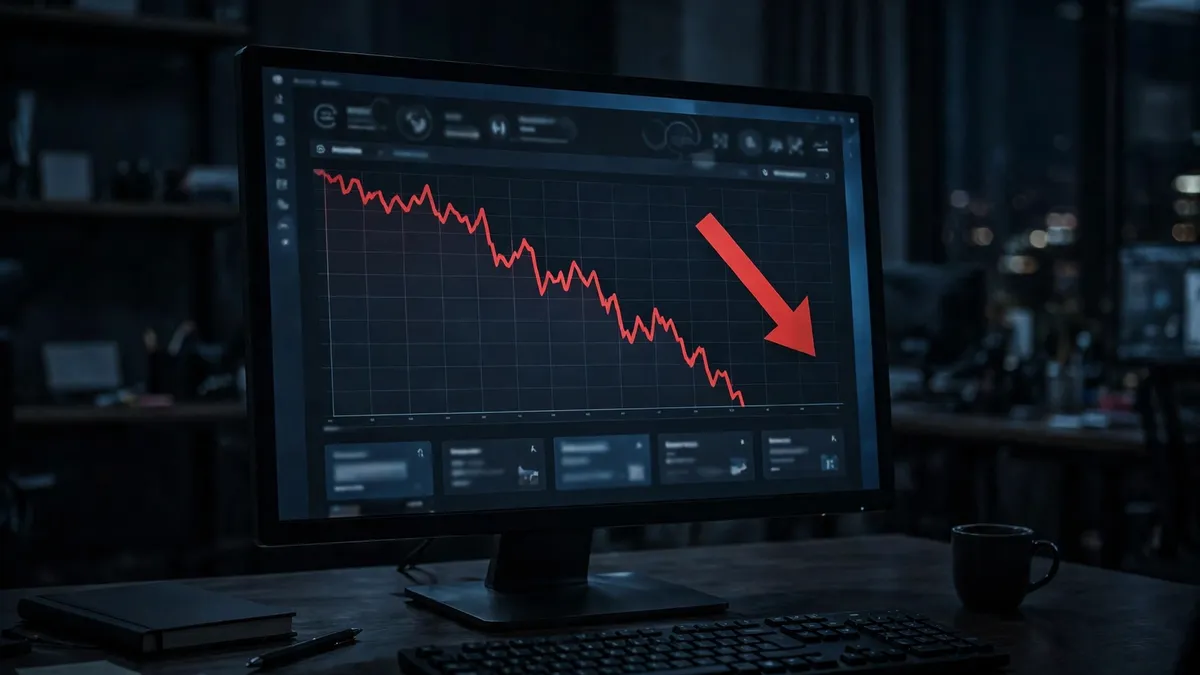
This is the part the September 20 audit could not have covered, and it changes the math for anyone thinking of spending money here. In mid-September 2026, voozon.com’s estimated search traffic fell off a cliff.
The timeline, as reported by MostlyBlogging in October 2026: around 205,434 estimated monthly visits on September 14, collapsing to roughly 4,800 by September 24 — a drop of about 97.7% in ten days. The decline began on September 14, when no Google update was rolling out; Google’s September 2026 spam update started around September 24. That sequencing matters. A drop that starts during a quiet period fits a manual action (a human reviewer at Google penalizing the site) better than an algorithmic update, though the reviewer is careful to say this is unconfirmed — nobody outside Google and the site owner can know for sure.
Now the awkward part: third-party estimates disagree wildly. Ranktracker, in a review updated around the same time, reports 855,400 estimated monthly organic visits, 90% of it from the United States, 738,000 monthly searches for the brand term “voozon.com” — and an estimated traffic value of just $0.16. A site with 855,000 visits worth sixteen cents is a site whose traffic has no commercial intent behind it, which is exactly what you would expect from brand-name curiosity clicks landing on a homepage.
So which number is right? Possibly both, measuring different things at different moments with different methods. That disagreement is itself the lesson: third-party traffic estimates are estimates, and when they differ by two orders of magnitude, none of them should anchor a purchasing decision. What is harder to argue with is the direction — every recent reading points down, and the guest-post price cut from £95 to £30 tells the same story from the revenue side.
[ADD YOUR OWN RESULT / SCREENSHOT HERE — suggested: traffic estimate chart showing the September 2026 drop]
If you already paid for a post before mid-September
Do not panic, but do check four things this week. First, search Google for site: followed by your full post URL — if nothing comes up, the page may have dropped out of the index. Second, open the post and confirm your link is still there and points at the right page. Third, inspect the link’s rel attribute (right-click, Inspect) and note whether it says nofollow, sponsored, or nothing at all. Fourth, look at your own referral traffic for the last three months and see if a single real visitor ever arrived. Keep screenshots, invoices, and emails either way — and if you put these links in a client report, your client should hear about the drop from you first.
Voozon.com timeline: 2019 to 2026
A site’s history tells you what its marketing won’t. Here is the documented timeline, pieced together from the September audit and the October traffic analysis.
March 2019. The earliest month in the content archive. Whatever the domain did before this — one reviewer notes the domain itself dates to 2008 — the current publication’s visible history starts here. An old domain with a young archive deserves a mental asterisk: age of the domain and age of the operation are different things.
2019–2023. Steady but unremarkable output across the category spread. Nothing in the audits suggests this era had a distinct editorial identity either; the multi-niche sprawl looks original to the site, not a later pivot.
2024. An uneven year. Only seven months show published posts (January through April, July, September, December). Gaps like that usually mean a small team, a paused operation, or content deleted after the fact. Any of the three is worth knowing before you pay for a “permanent” placement.
May 2025. Missing entirely from the archive. One blank month in an otherwise continuous run.
January–September 2026. The busy era: continuous output, several posts per week, and visibly commercial content — brand reviews, “best of” roundups, local service pieces. This is also when the guest-post business becomes impossible to miss.
June 2026. The unrelated Voozon Android app appears on Google Play (last updated June 4). Same name, separate universe.
August 2026. New logo files go up on the site, and guest posts are listed at £95. A rebrand and a price point, side by side.
September 14, 2026. Estimated traffic begins collapsing — from roughly 205,000 monthly visits toward ~4,800 by September 24. No Google update is running when the fall starts.
September 20, 2026. The punprime.com audit publishes, documenting the 24 categories, the four contradictory self-descriptions, and the placement-driven content pattern. It cannot yet see the traffic cliff.
September 24, 2026. Google’s September 2026 spam update begins rolling out. Guest-post pricing is now reported at £30 — a 68% cut in about a month.
October 2026. A wave of reviews (MostlyBlogging, Ranktracker, and others) tries to make sense of the collapse. Theories range from manual action to update fallout. Nothing is confirmed.
The pattern across seven years is consistent: a content operation that has never had a clear topical identity, never named its owners, and gradually leaned harder into selling placements — until September 2026, when the search visibility underpinning the whole model fell away.
Inside the 24 categories: what voozon.com actually publishes
Category counts are a quick X-ray of a site’s priorities. The September audit tallied them, and they repay a closer look.
The big five. General (247 posts), Finance (213), Business (197), Tech (197), and Health (190) carry the bulk of the archive. These are also the categories where a placement buyer gets the most “relevant context” — a B2B service piece sits less awkwardly next to 197 business articles than next to two. But “General” being the largest category is itself a tell: the biggest bucket on the site is the one with no topic.
The middle tier. Sports (64), Travel (36), Law (29), Education, Automotive, and a long tail of smaller sections. A placement in Law or Travel lands in a sparse cluster — fewer neighboring articles, thinner topical signals, less reason for Google to see the page as part of something coherent.
The oddities. “Sport” (2 posts) and “Sports” (64) exist as separate categories. “News” holds exactly one post. Nineteen posts sit in “Uncategorized.” This is what a site looks like when nobody is tending the taxonomy — categories get created on impulse, never merged, never cleaned. For a reader it is a minor annoyance. For someone evaluating the operation’s professionalism, it is a window.
What the mix means for E-E-A-T. Finance, Health, and Law together hold over 430 posts. Those are YMYL topics — the kind Google says demand the most experience, expertise, authoritativeness, and trust. Publishing 430+ of them with no named authors, no credentials, and no visible review process is not a technical violation. It is, however, the opposite of what a trustworthy publication does, and it is the single biggest reason to treat the site’s advice content as entertainment rather than guidance.
Is voozon.com safe? The honest trust checklist
Safe to visit and safe to trust are different questions. Here they are, separated.
Safe to visit: yes, technically
The site runs over HTTPS with images served from its own CDN subdomain, and the September audit found a clean Google Safe Browsing record — no detected malware, phishing, or unwanted software. Browsing requires no account, no download, and no payment details, which removes the most common ways a casual visit goes wrong. A clean Safe Browsing result says nothing about content quality, but as a pure “will this harm my device” question, the answer is no.
Safe to trust: not without verification
This is where the site falls short. No named publisher, no company entity, no registered address, and no editorial masthead appear anywhere on it. The contact points are an obfuscated email address and a form; the only author credit the audit could find in the homepage metadata was a first name. The reviewer could not pull registrar data, so there is no public ownership trail to check — privacy-proxy WHOIS is standard practice and not a sin on its own, but stacked on top of a blank About page it removes every accountability signal a reader could use.
Then there is the content itself. Health, finance, and legal articles go up with no visible expert review, no credentials, and no corrections policy. On YMYL topics — the stuff that can affect your health, money, or legal standing — Google’s own quality guidance says E-E-A-T matters most, and this site shows little of it. Add the unlabeled sponsored-looking posts and the occasional risky neighbor (the audit flagged a free-movie-download post tied to a piracy-associated site and a crypto-betting roundup), and you have a backlink neighborhood you would not want your own site photographed in.
A padlock icon means your connection is encrypted. It was never a certificate of honesty.
Who voozon.com is for — and who should stay away
Not every visitor needs the same warning. Here is the honest breakdown.
Casual readers: fine, with a filter on. If you landed on a general explainer about a gadget or a travel idea, read it the way you would read any free content site: useful for orientation, not for decisions. Enjoy the breadth; just don’t treat it as researched.
Marketers considering a placement: proceed with extreme caution, or not at all right now. The traffic collapse, the price cut, the unlabeled sponsored content, and the unclear link attributes add up to a purchase you cannot price accurately. If you buy, you are buying a lottery ticket, not an asset. The full checklist is in the guest-post section below.
Students and researchers: cite it never. No authors, no sources, no corrections policy — nothing a citation needs. Use it as a starting point for search terms, then find the primary source.
Anyone seeking health, finance, or legal guidance: stay away. This is the firmest line in this review. Over 430 posts sit in YMYL categories with no visible expert review. A wrong money tip costs you money; a wrong health tip can cost more. For these topics, use qualified professionals and primary sources, full stop.
Competitors and the merely curious: knock yourselves out. The site is a genuinely interesting case study in how multi-niche placement businesses work — and what happens to them when search visibility disappears.
Red flags and green flags
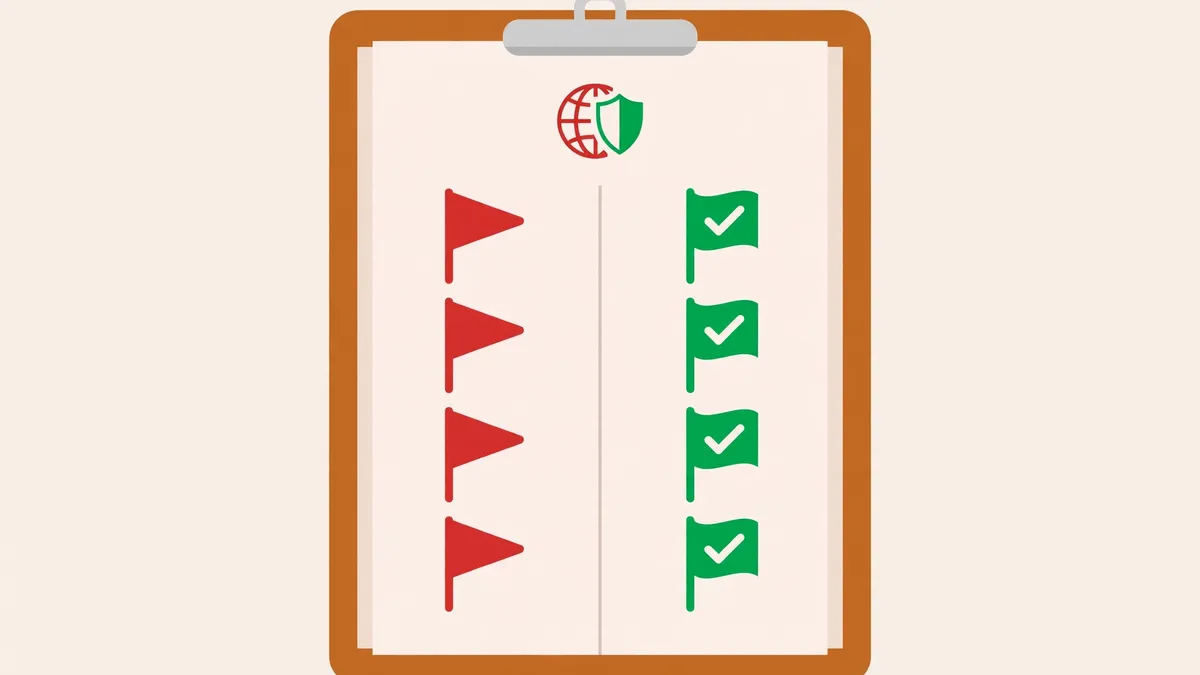
Every site review boils down to two lists. Here are voozon.com’s, with nothing hidden.
🚩 Red flags
- No named publisher, company, address, or editorial masthead anywhere on the site
- Health, finance, and legal content with no visible expert review or credentials
- Sponsored-looking posts with no “Sponsored” labels observed
- Four contradictory self-descriptions (blog, platform, magazine, legitimacy-check)
- Estimated ~98% traffic collapse in September 2026, cause unconfirmed
- Guest-post price cut 68% in a month (£95 → £30)
- Risky link neighborhood: piracy-adjacent and crypto-betting content in the archive
- Sloppy taxonomy (“Sport” vs “Sports,” one-post “News,” 19 “Uncategorized”)
- Third-party traffic estimates disagree by orders of magnitude
✅ Green flags
- Real, browsable publication with years of continuous output — not a parked domain or shell
- HTTPS active, clean Google Safe Browsing record, no malware or phishing flags
- No account required to read; no personal data harvested from casual visitors
- Open about the guest-post model in its own meta description — no hidden business
- Working search, category navigation, and per-post counters; clean magazine layout
- Contact page exists with stated 24–48 hour response time for inquiries
Nine red flags against six green ones — and the reds cluster exactly where trust lives (identity, expertise, money), while the greens cluster where technology lives (encryption, uptime, layout). That distribution is the review in miniature.
Voozon.com next to a real publication: what changes
It helps to see the gap concretely. Below is what the audits observed on voozon.com against what a trustworthy outlet shows as a matter of routine.
| Signal | Voozon.com (observed / reported) | What a trustworthy outlet shows |
|---|---|---|
| Ownership | No named publisher, company, or address | Named publisher, company registration, masthead |
| Author bylines | First name only in homepage metadata | Full bylines with bios and credentials |
| Sponsored labels | None observed on homepage listings | Clear “Sponsored” / “Paid post” labeling |
| Topical focus | 24 scattered categories, no center | Defined beat with demonstrable depth |
| Traffic transparency | Self-reported counters; third-party estimates conflict | Audited figures or no claims at all |
| Expert review (YMYL) | None visible on health/finance/law pieces | Reviewed or written by qualified professionals |
| Corrections | No corrections policy found | Public corrections policy and log |
Voozon.com clears the technical bar — clean layout, working search, HTTPS, no malware flags. It sits well below a real editorial outlet on everything that makes a publication accountable. That is the whole story in one table.
Thinking of paying for a guest post? Read this first
Google’s rules on this are not ambiguous, and I verified them against Google’s official spam policies page on October 29, 2026. Buying or selling links for ranking purposes — including paying for posts that contain links — is link spam. Paid links are allowed to exist only if they carry rel=”nofollow” or rel=”sponsored” so they pass no ranking credit. Google’s site reputation abuse policy separately targets third-party content published with little first-party oversight to exploit a host’s rankings, and violations can bring manual actions or lower rankings.
That is the frame. Here is the pre-purchase checklist, in plain order:
1. Inspect live examples. Open three recent commercial-looking posts, right-click a paid link, and check its rel attribute in the page source. Know whether you are buying a followed link (risky for you), a sponsored one (safe but passes no ranking value), or something the seller will not put in writing.
2. Confirm indexation. Search the exact title of a recent post. A post Google has not indexed passes nothing, and post-September-2026 that check matters more than ever.
3. Get permanence in writing. Ask for a minimum live period and the policy on link removal or edits before you pay.
4. Price it as a mention, not as traffic. Public counters show modest readership; expect negligible referral visitors.
5. Vary your anchors. One exact-match anchor from a single multi-niche site is a footprint, not a strategy.
6. Check the neighborhood. Look at what else the site publishes around your post — piracy-adjacent and betting content was found in the same archive.
[ADD YOUR OWN RESULT / SCREENSHOT HERE — suggested: view-source screenshot showing a link’s rel attribute on a sample post]
My verdict for marketers: at most, a low-cost supplementary mention for brand visibility — if the price is low, the link terms are in writing, and you have inspected the goods. Never the foundation of a link-building strategy. And until the September traffic collapse is explained or reversed, the rational move is to wait.
How to vet any guest-post site in 10 minutes
This is the framework this review runs on, generalized. Use it on any site that offers you a placement — voozon.com or otherwise — before money changes hands.
Minute 1–2: Read the site’s own description of itself. Open the homepage and count how many different things it claims to be. One clear identity is normal. Three or four contradictory ones — blog, platform, magazine, app — means the operator is optimizing for search queries, not for clarity.
Minute 3: Check the money. Search the site for “guest post,” “write for us,” “sponsored,” and “advertise.” A site that sells placements openly is at least honest about the transaction. A site that sells them while labeling everything “editorial” is selling you deception as a bonus.
Minute 4–5: Inspect three live posts. Pick three commercial-looking articles. Check the author byline (real name? bio? anything?), the publish date (current?), and one outbound link’s rel attribute (right-click → Inspect). No bylines plus followed paid links is the worst combination: anonymous content passing ranking credit for cash.
Minute 6: Verify indexation. Search Google for site: plus the domain, then for the exact title of a recent post. Pages that aren’t indexed can’t pass value, and a site with thinning indexation is a site in trouble.
Minute 7–8: Look at the neighborhood. Browse the categories around your would-be post. Gambling, piracy-adjacent, pharma, or adult content in the same archive means your link sits in a risky crowd — and Google judges link neighborhoods.
Minute 9: Find the humans. Look for an About page with real names, a contact page with a real address, and author pages with histories. Every missing human is a missing accountability layer.
Minute 10: Decide what you’re actually buying. If the answers above are good, you’re buying a mention on a real publication — price it modestly. If they’re bad, you’re buying a line in someone’s link spreadsheet. Price it at zero and walk away.
Run voozon.com through this and you get: confused identity, open placement selling, thin bylines, unconfirmed indexation health, a risky neighborhood, no visible humans — and a purchase that prices at zero until the traffic story resolves. The framework doesn’t hate the site. It just reports what it finds.
Alternatives to voozon.com
If what you wanted was a guest post, a backlink, or just good reading, here are better-shaped options.
For guest posts with real editorial standards: niche-relevant blogs in your actual industry, where your expertise is the point rather than your wallet. A single post on a respected trade blog outperforms ten placements on multi-niche marketplaces — and it won’t keep you up at night during spam updates. Industry associations and professional publications often accept contributed articles with genuine review.
For expert visibility without paying for links: journalist-request services (the HARO model, now under new names) connect you with reporters who need quotes. A cited quote in real journalism beats a paid placement on every axis: trust, traffic, and safety.
For backlinks that compound: original data, tools, and definitive guides earn links instead of renting them. It is slower. It also survives every update, because it never depended on someone else’s domain.
For casual reading across topics: established multi-topic publications with named editors and corrections policies — the accountability signals this review keeps coming back to. Wikipedia’s reference lists, for all their flaws, will also take you to primary sources faster than any content farm.
The common thread: put your money and your name where the humans are visible.
How this review was put together
Methodology, stated plainly so you can weigh it. On October 29, 2026, I pulled the live search results for “voozon.com review,” “is voozon.com legit,” and “voozon android app,” and read the full text of the major reviews ranking this month: the September 20, 2026 audit on punprime.com, the October 2026 traffic analysis on MostlyBlogging, the Ranktracker review, and supporting reviews on FinSuranceBiz, TopErNews, DSNews, MagazinePanda, and LiveCasinoMagic. I attempted a direct load of voozon.com’s homepage the same day and was served a Cloudflare bot-verification page, which I report as observed.
What I did not do: access the site’s analytics, ad accounts, or owners; test a login (none exists); or re-run the Safe Browsing and WHOIS checks — those findings are attributed to the September audit, not presented as my own fresh tests. Traffic figures are third-party estimates from the named sources, and where they conflict I say so instead of picking the convenient one.
One more honest note: the site owner provided no first-hand experience notes for this review, so there are no “I tested” claims in it — only observed evidence and attributed reporting. That is a deliberate choice. A review earns trust by showing its work, not by performing certainty.
Voozon.com review: frequently asked questions
QIs voozon.com a mobile app?
No. An Android app named Voozon exists on Google Play, but reviewers found no verified connection between it and voozon.com. The app describes itself as a social platform for photos and messaging; the website is a multi-niche blog. Same name, separate products.
QIs voozon.com safe to visit?
Technically, yes. It uses HTTPS and a September 2026 audit found a clean Google Safe Browsing record, with no malware or phishing detected. But safe browsing is not the same as reliable content — verify anything consequential, especially health, finance, or legal claims, against a primary source.
QCan I create an account on voozon.com?
No. The site has no registration, login, user profiles, or dashboard. Reading is open to everyone, and guest-post inquiries go through a contact form or email rather than an account system.
QHow does voozon.com make money?
Third-party display ads and paid or sponsored guest posts sold to marketers who want backlinks. The site’s own meta description pitches guest posting directly. No subscriptions, paywalls, affiliate programs, or software sales were found.
QWhy did voozon.com lose traffic in September 2026?
Third-party estimates show roughly a 98% drop between September 14 and 24, 2026. Because the fall began before Google’s September spam update rolled out, one reviewer theorizes a manual action, but that is unconfirmed. The cause has not been publicly established.
QIs a voozon.com guest post worth buying?
Not right now. With traffic reportedly collapsed and unrecovered, and guest-post prices cut from £95 to £30, you would be paying for yesterday’s visibility. If you ever consider it, inspect link attributes, confirm indexation, and get terms in writing first.
QWho owns voozon.com?
Unknown publicly. The site discloses no publisher name, company entity, address, or editorial masthead, and the September audit could not pull registrar data. An obfuscated email and contact form are the only contact points.
QIs Voozon a person — what is their net worth?
No. Voozon is a website (and separately, an app name), not an individual, so there is no age, height, family, or personal net worth to report. Searches mixing the site up with a person come from the same name confusion this review addresses.
QDoes voozon.com have an iPhone app?
No iOS app connected to voozon.com has been documented. The only known app using the name is the Android one on Google Play, which reviewers found has no verified link to the website. If an “official Voozon iOS app” appears, verify the developer name before installing anything.
QHow much does a voozon.com guest post cost?
Third-party tracking put the listed price at £95 in August 2026, falling to £30 by September 2026. There is no public rate card — terms come through the contact page — so confirm the current price, link attributes, and permanence in writing before paying.
QWho writes the articles on voozon.com?
Publicly, almost nobody. The September 2026 audit found only a first name in the homepage metadata and no author bios, credentials, or masthead. Some posts may be staff-written and others paid placements, but the site doesn’t distinguish them.
QIs voozon.com still publishing in 2026?
Yes, as of the latest reviews in October 2026 the site is active with recent posts. Output was continuous from January through September 2026 at several posts per week. The open question isn’t whether it publishes — it’s whether anyone still finds it through search after September’s traffic collapse.
Key takeaways
- Voozon.com is a multi-niche WordPress blog monetized through display ads and paid guest posts — not an app, not software, not a social network.
- The identity confusion comes from the site’s own contradictory descriptions plus scraper directories that repeat them.
- The Voozon Android app shares the name but has no verified connection to the website.
- Reported search traffic fell roughly 98% in September 2026; the cause is unconfirmed and third-party estimates conflict.
- Browsing is technically safe (HTTPS, clean Safe Browsing record), but the site shows weak E-E-A-T: no named owner, no expert review on YMYL topics, unlabeled sponsored content.
- Marketers should treat any placement as a low-cost mention at most — and wait until the traffic situation is resolved before paying for anything.
- The 10-minute vetting framework in this review works on any guest-post site: identity, money trail, live post inspection, indexation, neighborhood, humans.
- Voozon.com’s seven-year timeline shows the same pattern throughout: no topical center, no named owners, and a growing dependence on selling placements.
The bottom line on voozon.com
Voozon.com is a real website that publishes real articles, and it is not a scam in the “will steal your data” sense. But it is a multi-niche blog that sells placements, wrapped in marketing language that suggests something grander, floating on traffic that may have just vanished. Read it the way you would read any ad-supported content farm with ambition: fine for casual browsing, useless as an authority, and a poor place to spend a marketing budget until it proves otherwise.
The 4.5-out-of-10 trust score from the September audit feels, if anything, generous after September’s collapse. Check back when the traffic story has an ending.