Last updated: November 19, 2026
By Ethan Parker, Lead Humor Strategist & Senior Editor at Easy Puns
Type glossywise.com into a search box and the first guess is easy: a beauty site. The name joins “glossy” — shiny hair, shiny skin, the finish every beauty ad promises — to “wise”, the voice of someone who knows. Open the site, though, and the beauty counter never appears. What appears is a general blog about business, technology, health, lifestyle, and travel, with a finance post at the top of the feed and a vape review a few scrolls down. This review looks at what glossywise.com actually is, who writes it, what it gets right, and where a reader who needs skincare advice should go instead. The short version: it is a blog with a beauty name, not a beauty authority with a blog.
The confusion is not the reader’s fault. “Glossy” points straight at beauty shelves, and search results make it worse: pages that never opened the site repeat each other’s guesses, and each repeat becomes another source for the next summary. This review breaks that loop with one simple method: look at what the site actually shows, and say plainly where each claim came from.
[ADD YOUR OWN RESULT / SCREENSHOT HERE — suggested: homepage screenshot showing the site title and the top of the article feed]
Quick Facts
| Fact | What we found |
| Site type | Multi-topic informational WordPress blog / general-interest publishing site |
| What it is not | Not a beauty or skincare authority, dermatology site, or beauty retailer |
| Homepage title | Glossywise.com | Business, Tech, Health, Lifestyle & Travel |
| Categories | 11 content categories + Blog + Uncategorized: Blog, Business, Crypto, DIY, Education, Finance, Health, Lifestyle, Pets, Technology, Travel — no beauty or skincare category |
| Beauty words on homepage | Zero — “skincare”, “beauty”, “dermatology”, and “cosmetic” do not appear anywhere on the homepage |
| Skincare posts | 1 of 99 posts in the sitemap — a melasma article from April 2023 |
| Authors shown | Shivi Hyde and Devin Haney, with bylines linking to author archives |
| Login / signup / booking | None for visitors — no login, register, dashboard, or appointment system; newsletter signups are closed (“isn’t open for signups yet”) |
| Legal pages | All exist as real pages — About, Privacy, Contact, Disclaimer, Terms, Editorial Policy — but several still carry unfinished template placeholders |
| Contact | One Gmail address in the footer; contact form on the Contact page |
| Tools page | “Little Helpers” — three free calculators that run in the browser |
| Publishing now | Active but sparse — newest post dated November 4, 2026; 99 posts in the sitemaps |
| PunPrime trust rating | 4.6 out of 10 (their rating, not ours) |
| Monetization | Traffic-based: display ads, affiliate links, sponsored stories, newsletter placements (per the site’s own pages) |
| Lookalikes | glosywise.com is a separate beauty-guides site; glossy-wise.com redirects to Google; glossywisse.com and glossywise.net also resolve |
How this review was put together
No notes from the site’s owner were available for this review, and no one on our side has run the site, bought anything from it, or spoken with its team. So this review does not pretend to have inside knowledge. It rests on three things we could check ourselves. First, a live look at the homepage at glossywise.com on November 19, 2026: the title, the categories, the newest posts, the footer, and the links in the header. Second, the PunPrime review by William Carter, published August 1, 2026 and updated August 5, 2026, which inspected the same pages and checked the domain’s registration and security. Third, four more reviews found through search, each read for what it actually saw rather than what it repeated. Where those sources disagree, this review says so and names who said what. Where a claim could not be checked, it is labeled as reported or unconfirmed, not stated as fact. That is the whole method — slower than copying a summary, and the only honest way to write about a site the internet keeps mislabeling.
This is the fifth review in our research series, using the same method as our Voozon.com review, our ITFastFix.com review, our QuikConsole.com review, and our BrassSmile.com review; the full set sits on our Reviews page.
The short answer
Glossywise.com is a general-interest blog that covers eleven topics, from finance and crypto to pets and travel. It publishes short written articles and three free calculators. It does not run a beauty clinic, it does not employ dermatologists or estheticians, it does not review skincare products with any named expert, and it does not sell a single cream, serum, or brush. The strongest proof is the site’s own structure: the navigation lists content categories, and none of them is beauty; the homepage carries zero mentions of skincare, beauty, dermatology, or cosmetics; and the sitemap holds ninety-nine posts, of which exactly one is about skin. A real beauty authority would show a skincare section, named reviewers with credentials, ingredient science, and product testing. None of those things exist here. What does exist is a steady trickle of posts, the newest dated November 4, 2026 — the site is publishing, just not often, and not about beauty.
That settles the main question, but it leaves a harder one open: if the site is only a blog, why do search results keep calling it a beauty portal? The answer has three parts, and the sections below follow each one — the name, the look-alike domains, and the copied summaries — and end with where to go for real skincare advice.
What the live homepage actually shows
Open glossywise.com today and the first thing you see is a title that never mentions beauty: “Glossywise.com | Business, Tech, Health, Lifestyle & Travel”. The description under it in the page metadata says the same thing in plainer words, calling the site a blog with tips and guides on technology, health, lifestyle, business, education, and travel. The Open Graph description matches the meta description word for word. Below the header sits a feed of article excerpts, newest first. The most recent posts are “Stock Market Myths Every New Investor Should Ignore” (November 4, 2026), “Factory Audit, Supplier Verification or Product Inspection: Which Service Do You Need?” (October 31, 2026), “Tata Capital Share Price vs Bajaj Finance Share” (October 23, 2026), and “SoSoActive: Business, Finance, and Entrepreneurship Insights for Today’s Digital World” (September 9, 2026). Scroll further and the mix widens: an AI translation explainer, an oil spill kit guide, a four-phase Alzheimer’s explainer, an international delivery guide, a CFD trading profit guide, a vape device review, a guide to finding someone on OnlyFans by phone number, a Cane Corso dog food guide, and a guide to growing a blog. One scroll covers stock myths, factory audits, Alzheimer’s, vape hardware, and dog food. That mix is the point of a multi-topic blog, and it is also the proof that the beauty label does not fit: the beauty posts are not a slice of the feed. They are absent from it.
The navigation confirms the shape. Eleven content categories are listed: Blog, Business, Crypto, DIY, Education, Finance, Health, Lifestyle, Pets, Technology, and Travel, plus Uncategorized. Health is one of eleven, and the skincare posts sit inside it — all one of them. The header also carries links to three small tools — an Age & Birthday Calculator, a Bill Split & Tip Calculator, and a Savings Goal Planner — and a Subscribe button, which we will come back to. There is no login, signup, register, or dashboard link anywhere on the homepage. The single appearance of the word “signup” in the page code is inside a newsletter script, and it says the newsletter is not open for signups yet, so nothing was saved. There is also no booking or appointment system. The words “appointment” and “booking” do not appear on the homepage at all.
Two details from the live check deserve a closer look. First, the bylines name two people: Shivi Hyde and Devin Haney. Their bylines link to author archives, and each archive lists fourteen posts on its first page. Devin Haney’s archive is heavy on finance and trading — CFD platforms, MT5 indicators, tokenomics, international stock trading — while Shivi Hyde’s covers the rest, from stock myths to the vape review. Neither author page shows a bio, a photo, or any credential. A site that publishes health and finance advice without saying who its writers are gives readers nothing to check before trusting a claim about skin or stocks. Second, the footer carries the site’s description again, a single Gmail address, and links to About Us, Contact Us, Write for Us, Advertise, Editorial Policy, Privacy Policy, Terms & Conditions, and Disclaimer. It also carries a weekly newsletter pitch, “The Glossywise letter”, and two lines that matter: “© 2026 Glossywise. All rights reserved.” and “General information only — not financial, medical, or legal advice.” That second line is a site-wide disclaimer, printed on every page. It deserves credit, and we will come back to it — because the pages behind those footer links tell a stranger story.
[ADD YOUR OWN RESULT / SCREENSHOT HERE — suggested: category page screenshot showing one of the 11 categories and its article list]
The pages that exist — but are not finished
Here glossywise.com differs from the last site in this series in a way that matters. Brasssmile.com had no real About, Privacy, Contact, Disclaimer, or DMCA pages at all — every such address served the homepage. Glossywise.com has all of them. Each one returns a 200 status, carries its own title, and holds its own text. On a checklist, the site passes. Open the pages, though, and the checklist starts to wobble.
The About page says the site is “a glossy little magazine about living, working, and learning well”, and then, under “Who writes here”, it says: “Glossy Wise is run by [your name], [one line about who runs the site and your experience].” The brackets are still in the text. The Editorial Policy page says the site checks facts against original sources and updates stories when things change, and then, under “Research”, it says: “[describe how you research and test what you write]”. The Contact page invites questions, corrections, and partnership ideas, and ends with: “You can also email us at [your contact email].” The Privacy Policy page says “Last updated: [date]” near the top, names “[provider name]” as the newsletter store, and tells readers that “[list the services you actually use] may use cookies” — while the bottom of the same page says “Last updated: October 21, 2026”. Someone touched that page on October 21, 2026, and still left the brackets in.
That matters for a precise reason. A missing page is an honest gap: the reader sees that nothing is there. A page that exists but still says “[your name]” is a different kind of gap — it looks finished from the footer, and only shows its blanks when read. A reader who clicks “About Us” to find out who runs the site learns that the site does not know either, or has not bothered to say. The same goes for the Editorial Policy: a page that claims the site checks facts, while its own research section is an empty bracket, is asking for trust it has not yet earned.
Two of the pages are genuinely complete, and they should be weighed. The Disclaimer page is real: it says some links are affiliate links, that buying through them may earn the site a commission at no extra cost, that this never decides what it recommends, that health, finance, and legal topics are general information rather than professional advice, and that guest and sponsored articles are labeled. The Advertise page is real too: it offers display ads, clearly labeled sponsored stories, and newsletter placements, and it says plainly, “We don’t sell undisclosed links or positive reviews.” The footer disclaimer line — “General information only — not financial, medical, or legal advice” — is printed on every page. Brasssmile.com had no disclaimer page and no disclaimer line at all, so glossywise.com deserves credit here. The site has the furniture of a trustworthy publication. The name tags on that furniture are still blank.
Publishing in bursts
The site’s publishing history tells its own story, and it is a story of bursts with long quiet stretches between them. The sitemaps list 99 posts, with the earliest dated April 1, 2023. The monthly counts, taken from the sitemaps’ last-modified dates, run like this: sixteen posts in April 2023, sixteen more in August 2023, then a thin spread through 2024, thirteen in November 2025, and one to three a month through most of 2026. Whole months pass with nothing at all. The newest post by last-modified date is “Stock Market Myths Every New Investor Should Ignore”, dated November 4, 2026, and the homepage feed matches: November 4, October 31, October 23, September 9, then August 18, July 5, June 20, June 19.
A note on method: sitemap dates record when a page was last changed, not always when it was first published, so the monthly counts are approximate rather than exact. The shape is still plain. This is a site that publishes in waves, not one that publishes at a steady pace, and the waves are small: ninety-nine posts in three and a half years works out to about two a month, with long gaps. The November 4, 2026 post is real and current, and it should be weighed. It does not yet prove a new steady habit. A site that goes quiet for months at a time can go quiet again, and readers who follow a blog should know whether the feed they are reading is a habit or a burst.
Five reviews, one verdict
The PunPrime review is not the only one. Search turns up four more write-ups that cover glossywise.com, and they all reach the same core finding even though they were written by different people, on different sites, at different times. That agreement is worth more than any single review, because it survives the usual problem with this topic: one wrong page copied by five others. Here the five pages were written independently enough to disagree on details, yet they agree on the thing that matters.
| Review | What it found |
| PunPrime (William Carter, Aug 1, 2026) | A multi-niche general blog, not a dedicated skincare authority. No certified expert sourcing. Their trust rating: 4.6 out of 10. |
| GeeksState | A real, active, multi-niche blogging platform — not a scam, not an authority. Trust & Transparency 5 out of 10; Overall Value 6.5 out of 10. Notes the “glossywisse.com” spelling variant and the lack of author detail. |
| RankUp4U (Sep 19, 2026) | A real, free blog with beginner-level articles on many topics. No sign of a scam; the owner is not named and the authors have no visible credentials. Notes glossywisse.com as a misspelling pointing to the same project, and that Glossy.co is a different trade publication with no link to this site. |
| Aavotcom (Sep 5, 2026) | A genuine, working content blog rather than a scam or a malware trap — but a broad general-interest site, not an authority on any single subject. No clearly published, verifiable owner, company name, or editorial team. |
| ChatPic | A free, multi-topic content site that started with a beauty and skincare identity and expanded into a broad blog. Owner not disclosed; domain registered March 2023 with WHOIS privacy. Lists glossywise.net, glossy-wise.com, and glossywisecom.com as near-identical domains. |
Three points stand out. First, no review that actually opened the site found a beauty authority. The beauty claims all arrive second-hand, from pages that describe a different domain or repeat an earlier guess. Second, the reviews that looked hardest found the same holes we did: no owner named, no author credentials, no citations tying claims to sources. Third, one point needs a correction, and it cuts in the site’s favor. GeeksState reports that there is no visible About page or editorial standards page describing how content is reviewed. Our live check on November 19, 2026 found both pages — About Us and Editorial Policy both exist and both return real content. The honest correction is narrower than the review suggests: the pages exist, but they are unfinished templates with bracketed placeholders still in them. That is how a review gets better over time, as newer checks replace a missing-page claim with the more precise finding.
[ADD YOUR OWN RESULT / SCREENSHOT HERE — suggested: article-page screenshot showing a byline, a headline, and the body layout]
Why the name traps people
The trap has three parts, and each one pulls a different kind of searcher. The first part is the word “glossy”. Glossy is the finish of healthy hair, the shine of good skin, the look of a lipstick ad, and the paper of a fashion magazine. A reader who has just searched for a skincare routine can read the name as a beauty brand that knows its subject. The second part is the word “wise”, which promises an expert voice — someone who has tested the products and can tell you what works. The third part is the site’s own history, which one of the five reviews reports: the site started with a beauty and skincare identity and then expanded into a broad multi-topic blog. If that is right, the name is a leftover from an earlier shape, and the beauty label stuck to it after the content moved on.
That expectation then meets three specific hopes, and the site meets none of them. Some searchers arrive hoping for skincare routines from a named expert — a morning routine, a product list, an ingredient guide. Some arrive hoping for product recommendations with real testing behind them. Some arrive hoping to buy beauty products from a shop. PunPrime names the first two hopes in its review, and our live check confirms the site offers none of them: no beauty category, no routines from a named expert, nothing to buy, and a single skincare post in ninety-nine. What the site does offer is articles about other things. An article about stock market myths is not a skincare routine, and a post about dog food is not a product review. The gap between the article and the service is the whole confusion, and it is built into the name.
The same name causes trouble in the other direction. “Glossy” also describes magazine paper, a photo finish, and a lip gloss, which means the same word can point at a beauty brand, a print style, a product, or a blog, depending on who is writing. A name that points four ways tells a reader nothing on its own. Only the page in front of them does, and the page in front of them is a blog.
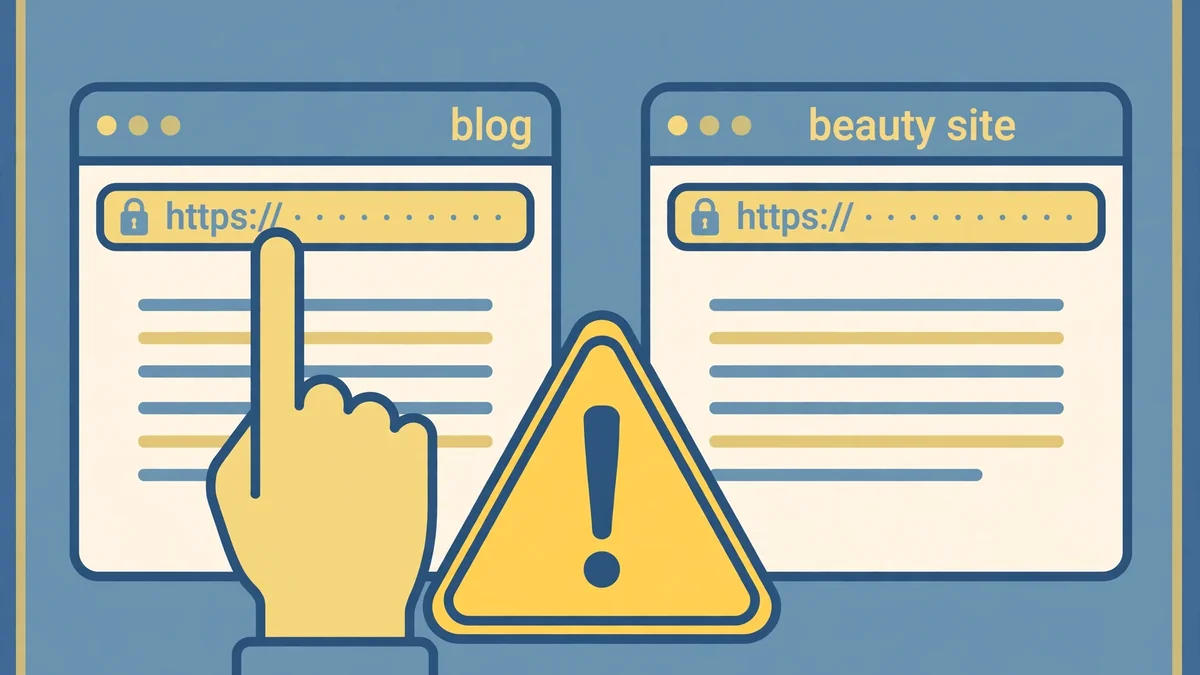
Four lookalike domains
The heaviest confusion around glossywise.com does not come from the site itself. It comes from names that look almost the same. Four domains in particular keep getting mixed into write-ups about glossywise.com, and each one needs to be kept separate.
The first is glosywise.com, the name with one “s” dropped. We opened it live on November 19, 2026. It loads as a beauty site with the title “GlosyWise – Beginner Beauty, Skincare & Fashion Guides” and the same line as its description. This is the beauty portal people are looking for when they type the name slightly wrong — a separate site, with its own content, wearing the beauty label that glossywise.com does not. A reader who lands there and then reads a review of glossywise.com, or the reverse, will carry claims across the gap without noticing. The names are close enough that a search engine can do the same thing, and an AI summary tool certainly can.
The second is glossy-wise.com, the hyphenated version. It would not load as a site at all for our check — the address redirects to Google’s homepage — so this review makes no claim about what it sells. It is named here for one reason only: if you searched for glossywise.com and landed on a page about a beauty tool, check the address bar. One hyphen can be the whole difference between a blog and a product, and a page that redirects to a search engine cannot be trusted on its title alone.
The third is glossywisse.com, the name with a doubled “s” near the end. It resolves and loads, carrying the plain title “glossywise com”. The main site itself names this spelling on its own platform page, which describes glossywise.com as a space to explore ideas and share stories, and adds that the site is “also referred to as glossywisse.com”. A site that points at its own near-identical twin is either careless with its brand or running more than one door into the same rooms. Either way, a reader should know the twin exists before trusting a page that carries the name.
The fourth is glossywise.net, which also resolves and loads, under the title “Glossywise com | Refined News for Modern Minds”. Same name, different tagline, different framing — a news site this time, not a blog about living well. Other reviewers add two more names to the list: glossywise.com.co, which one review says carries a similar description, and glossywisecom.com, which another lists among the near-identical domains. We did not open those two in this review, so their claims are reported, not verified by us. One more distinction matters: Glossy.co is a separate, established trade publication on beauty and fashion, launched in 2016 by Digiday Media. It has no link to glossywise.com, and mixing the two would credit a small blog with a trade magazine’s reputation. The rule for all of them is the same: verify the exact address before trusting the page, and never submit personal details to a site that cannot name its owner.
[ADD YOUR OWN RESULT / SCREENSHOT HERE — suggested: search-result screenshot showing glossywise.com next to the lookalike domains]
The tools page
Glossywise.com has one feature that sets it apart from the other blogs in this review series: a real tools page that actually works. The “Little Helpers” page exists at /tools/, and it is a genuine page with its own title, not a soft-404 like the addresses we checked on brasssmile.com. It holds three small calculators: an Age & Birthday Calculator, a Bill Split & Tip Calculator, and a Savings Goal Planner. Its text says the tools run entirely in the browser, so the site never sees what a visitor enters — not even the numbers — and that the site is supported by advertising and clearly labeled affiliate links. That is a clear, honest line, and it deserves credit. It tells a visitor what the business model is and what happens to their input, in two sentences.
Two limits apply. First, the calculators are general tools — the kind that answer one everyday question — not beauty tools. An age calculator does not diagnose skin, and a bill splitter does not give financial advice. The page’s own line says the tools run in the browser, which means they are simple estimators, not services. Readers should use them as estimators and nothing more. Second, the privacy line on this page is nearly word-for-word the same as the one on brasssmile.com’s calculators page, which we checked in the last review in this series. The two sites also share a creation date of March 5, 2023, according to PunPrime’s audits of both, and the same author handle — “itsshivi” — appears on both sites, as Shivi Hyde’s byline archive on glossywise.com and as one of two bylines on brasssmile.com. Those are observed parallels, and they are worth reporting plainly. They are not proof of one owner running both sites: no public record names a single owner for either domain, and this review does not claim one. The pattern is noted, and the line is drawn there.
The one skincare post
This is the part of the review that matters most, because it is where a blog stops being harmless reading and starts shaping health decisions. Glossywise.com has exactly one skincare post in its ninety-nine. It is called “Observations when managing melasma skin”, published April 1, 2023, by Devin Haney, and last changed August 10, 2023. Melasma is a skin condition that causes dark patches, often during pregnancy or after sun exposure. A reader who comes to this site for skincare lands on this post. Here is what they find.
The table of contents lists six headings. The first reads: “Employ hydroquinone to increase skin discoloration”. That is backwards. Hydroquinone is a skin-lightening agent: it is used to fade dark patches, not to increase them. A heading that says the opposite of what the treatment does is not a small slip — it is the central claim of the section, stated the wrong way round. The fourth heading reads: “Create weekly comic strips”. That line belongs in an art blog, not in an article about a skin condition, and nothing in the post explains what comic strips have to do with melasma. The headings have no body text beneath them at all: the article jumps from its list of headings straight into a short opening paragraph, and the promised sections never arrive. The words “dermatologist” and “doctor” do not appear anywhere in the post. The words “source”, “study”, and “research” do not appear either. No expert is named, no study is cited, and no reader is told to ask a professional.
That is a problem, and it is worth stating plainly. An article that names a prescription-strength treatment, gets its direction wrong, and offers no source and no caution is not a neutral piece of reading. It is a nudge toward a treatment, written by a byline with no visible credentials, on a site with no medical review process. The same pattern does not hold across the whole feed — the finance posts, like the November 4 stock myths piece, are coherent short reads — but the skincare shelf of this site is one post, and that post is the weakest page on the site.
This article is not medical advice either, and it says so here, in the open. Do not pick a skincare treatment from a blog post. If you need help with melasma or any skin condition, start with a board-certified dermatologist, or with a recognized authority such as the American Academy of Dermatology, DermNet NZ, or the Paula’s Choice Ingredients Dictionary. Those sources name their reviewers, explain ingredients, and say plainly when a reader should see a professional. A blog that cannot do any of those things should not be the last word on your skin.
Against a real beauty authority: a side-by-side
The fastest way to settle the beauty question is to put glossywise.com next to the sources that actually are beauty and skin authorities. The table below uses our own layout. Its facts come from the live check and the PunPrime audit, not from any authority page, because the blog has none.
| glossywise.com | A real skin authority (AAD / DermNet NZ / Paula’s Choice) | |
| Skincare section | No beauty or skincare category; one skin post in 99 | Skincare is the whole site, organized by condition and ingredient |
| Named medical reviewers | None — two bylines, no bios, no credentials shown | Board-certified dermatologists named with credentials |
| Sources cited | None in the melasma post — no study, no source, no reference | Clinical references and ingredient science on the page |
| Product testing | No product tests; nothing to buy on the site | Ingredient dictionaries, safety ratings, tested routines |
| What you can do on the site | Read articles, use three small calculators | Look up a condition, check an ingredient, find a dermatologist |
| Medical disclaimer | A footer line and a Disclaimer page — but none inside the melasma post itself | A medical review process, and advice to see a professional |
| Who answers for a mistake | No named company, editor, or owner | A named organization, named reviewers, and a corrections process |
The table makes the gap visible. A real authority is defined by what you can do after you arrive: look up a condition, check an ingredient, find a specialist. Glossywise.com offers none of those actions, because it is not built for actions. It is built for reading. That is a fair thing for a blog to be. It is a strange thing for a site named like a beauty brand to be, and the name sits behind nearly every wrong review written about it.
The comparison also answers a narrower question: does the one skincare post make it a beauty site? The answer is no, and the evidence is the post itself. A beauty site would have a skincare section, a named reviewer, and a cited source. The melasma post has a backwards heading, a comic-strip heading, and no source at all. Trust the post over the rumor.
Trust and transparency: what checks out, what does not
A fair review separates the things a site gets right from the things it gets wrong, and this site has entries on both sides.
On the credit side, the site is real and active. It loads over an encrypted connection, it published a new post on November 4, 2026, and its sitemaps list 99 posts going back to April 2023. That is a genuine library of content, not an empty shell. The legal pages are a second credit: unlike brasssmile.com, which had none, glossywise.com has an About page, a Privacy Policy, a Contact page, a Disclaimer, Terms, and an Editorial Policy, all returning real pages. The Disclaimer page is genuinely complete, and the footer carries a site-wide line that the content is general information only, not financial, medical, or legal advice. The sponsored-content rules are a third credit: the Editorial Policy says sponsored posts are labeled “Sponsored” and paid links use rel=”sponsored”, and the Advertise page says the site does not sell undisclosed links or positive reviews. The site is also safe to read in the narrow sense — PunPrime’s August 2026 audit found no malware, phishing flags, or malicious code on the main domain, and none of the four newer reviews reports any infection. That finding is dated August 2026, and we did not run our own malware scan, so it is reported as their finding, not ours. Still, a clean record from a careful audit counts in the site’s favor, and it is one reason PunPrime’s trust rating of 4.6 out of 10 is about editorial trust, not about danger. That number is theirs, not ours. We do not repeat it as our own score. We report it because it shows how a careful reviewer weighed the same evidence: a real, active blog with a misleading name and anonymous ownership.
On the debit side, the biggest item is ownership. The About page does not name anyone — it still says “[your name]”. The domain record is privacy-protected, which PunPrime confirms and which is normal on its own, but combined with bylines that carry no bios, no company name, no address, and a single Gmail address as the only direct contact, it leaves a reader with no person and no company to hold responsible for what the site publishes. For a blog that covers health, finance, and law, that is a real weakness. Those three topics are exactly the ones where a reader needs to know who is speaking.
The second debit is the unfinished pages. A Privacy Policy that still says “[date]” and “[provider name]” after a page touch on October 21, 2026 is not a page that was written and forgotten — it is a page that was opened, changed, and still left half blank. The third debit is consistency, in two forms. The publishing history runs in bursts — sixteen posts in a month, then nothing for months — which points to a site managed in waves rather than tended steadily. And the site’s own rules contradict its own feed: the Write for Us page bans vape articles and trading-signal articles, yet the site publishes a vape device review and several trading guides. A rule the site does not follow itself is not a rule readers can rely on. The November 4, 2026 post helps, and it should be weighed. It does not yet prove a new steady habit. A few weeks of fresh posts is a start, not a track record.

Who should read it — and who should not
Read glossywise.com if you want a free, general-interest read across a wide set of topics and you are comfortable checking anything important somewhere else. A post about stock market myths, a guide to splitting a bill, or a piece on AI translation can be useful as a starting point. The site’s value is breadth: eleven categories means a curious reader can wander from a finance explainer to a travel piece without changing sites. Treat each article as an introduction, not as the last word, and the site does a fair job.
Do not use it as your only source for anything that affects money, health, or legal decisions. Articles about Alzheimer’s stages, CFD trading, and melasma sit in the same feed as lifestyle pieces, and the site names no expert, shows no credentials, and offers no way to reach the author of a specific claim. That is not a reason to dismiss every post. It is a reason to verify the ones that matter. A finance post that explains a concept in plain language can still be worth reading; a health post that tells you what to do with your skin should be checked against a source that names its author and its data.
Do not go there looking for beauty advice. If you need help with melasma, acne, or any skin condition, go to a board-certified dermatologist. If you want ingredient science, start with the American Academy of Dermatology, DermNet NZ, or the Paula’s Choice Ingredients Dictionary. Glossywise.com will not do any of those jobs, and no review that says otherwise has shown a skincare section, a named expert, or a cited source to prove it.
[ADD YOUR OWN RESULT / SCREENSHOT HERE — suggested: mobile-view screenshot showing how the homepage and article pages read on a phone]
Before you pay for a link here
Marketers read reviews like this one for a different reason: they want to know whether a paid placement on the site is worth the money. The honest answer is that the value is unproven, and the checks below are the ones to run before paying anything.
Start by searching for the page address with a site: query and checking that it shows up at all. If the page never appears, stop — the link cannot pass value the way a buyer expects.
Next, ask the seller to show two paid posts already live on the site, then look at the links inside them. A paid link should be marked sponsored. If the existing paid posts use plain follow links, or the seller cannot show you any, that is a warning. It tells you how the site treats paid links, and what Google may think of the arrangement later. The site’s Advertise page says it sells clearly labeled sponsored stories and does not sell undisclosed links, so the door is open — but an open door is not proof of a fair deal. Ask for the proof.
Then read the links leaving the posts around your target page. A site with eleven categories will always have mixed neighbors — the front of the feed mixes a stock-myths post with a factory-audit guide and a dog food post. That mix waters down topical relevance. If your brand lives in one niche, a link from a page surrounded by unrelated topics carries less weight than a link from a focused publication. Look at the actual neighbors, not at the category label.
Get visitor numbers from a tool that does not belong to the seller. Neither this review nor the PunPrime audit counted visitors or scored authority, so any number a seller quotes should be treated as a claim until an independent tool confirms it.
Check the publishing pattern. The site published one to three posts a month through most of 2026, with whole months empty in between. Ask whether the recent pace will hold, because a link on a site that goes quiet again loses value with every quiet month. A short burst of posts is not the same as a stable publication.
Finally, remember what the site is not. It is not a beauty property. It is a mixed-topic blog whose authority is still unproven. Value any placement as a link from a mixed-topic site, not as a slot on a beauty publication, and pay only after the visitor data, the live paid examples, and the link markings have all been seen. If any of those three cannot be produced, walk away. Focused publications exist in every one of these eleven categories, and they can show all three without being asked twice.
Bottom Line
Glossywise.com is a multi-topic blog with a beauty brand’s name. That sentence is the whole review, and everything else in it is evidence for it. The live homepage shows articles, not a beauty counter. The categories show a general-interest publication, not a skincare authority. Four independent reviews plus PunPrime agree. The beauty claims trace back to lookalike domains, copied posts, and a name that invites the wrong guess. The site is real, active, and safe to read, its legal pages exist, its disclaimer is honest, and its November 4, 2026 post is genuine — all of which count in its favor. Its ownership is anonymous, its trust pages are unfinished templates, its one skincare post gets a treatment backwards and cites nothing, and its own content rules contradict its own feed. Read it as a starting point, verify anything that matters, and never take skincare advice from it without asking a dermatologist first. And if you came here looking for a beauty portal, you are in the wrong place. The name is the only beauty thing about it.
About the author
Ethan Parker is the Lead Humor Strategist & Senior Editor at Easy Puns, where he writes and edits the site’s reviews and research articles. This review rests on a live check of glossywise.com on November 19, 2026, the PunPrime review by William Carter, and four further reviews found through search. No first-hand notes from the site’s owner were available, so it makes no claim to inside knowledge and says where each finding came from.
Frequently Asked Questions
Is glossywise.com really a beauty or skincare site?
No. It is a multi-topic WordPress blog that publishes articles. Our live check on November 19, 2026 found no beauty or skincare category, zero mentions of skincare, beauty, dermatology, or cosmetics anywhere on the homepage, and exactly one skincare post among ninety-nine in the sitemap. The beauty descriptions in some search results come from the name and from lookalike domains, not from the site itself.
Is glossywise.com safe to open?
By the standard measures, yes. The site loads over an encrypted connection, and PunPrime’s August 2026 audit found no malware or phishing flags on the main domain. Treat its ads and affiliate links with the usual care you would give any ad-funded site, and never submit personal or payment details through a pop-up or a lookalike domain.
Who runs glossywise.com?
That is not publicly confirmed. The About page still reads “run by [your name]”, with the placeholder never filled in, and no company, editor, or address appears on the site. The authors are Shivi Hyde and Devin Haney, shown only as bylines with no bios or credentials. The only direct contact found is a single Gmail address in the footer.
Does glossywise.com have beauty experts on staff?
No dermatologist, esthetician, or beauty credential is shown anywhere on the site. The two bylines link to author archives with no bios and no qualifications listed. A real beauty authority names its reviewers and shows their credentials; this site does neither.
Can I trust its skincare advice?
Treat it as general reading, not medical advice. The site’s only skincare post, about melasma, carries a heading that states a treatment’s effect backwards, lists a comic-strip heading that does not belong in a skin article, and cites no source and no expert. Verify anything about your skin with a board-certified dermatologist, or with the American Academy of Dermatology, DermNet NZ, or the Paula’s Choice Ingredients Dictionary.
What are the lookalike domains?
The main ones are glosywise.com, a separate beauty-guides site with the title “GlosyWise – Beginner Beauty, Skincare & Fashion Guides”; glossy-wise.com, which redirects to Google’s homepage; glossywisse.com, which the main site itself names as a spelling variant; and glossywise.net, which loads as a news site under the same name. Other reviewers also list glossywise.com.co and glossywisecom.com. Always check the exact address in your browser bar before trusting a page.
Is glossywise.com still publishing new articles?
Yes, but sparsely. The homepage checked on November 19, 2026 shows a new post dated November 4, 2026, with earlier posts dated October 31, October 23, and September 9, 2026. That follows a pattern of bursts and quiet months across ninety-nine posts since April 2023, so the current pace is a resumption rather than a long-running habit.
Should I buy a sponsored post or backlink on glossywise.com?
Only after checks. Search for the page with a site: query, ask the seller to show two paid posts live and check how their links are marked, look at the outbound links, and get visitor numbers from a tool that does not belong to the seller. Value it as a link from a mixed-topic site whose authority is still unproven, not as a slot on a beauty publication.