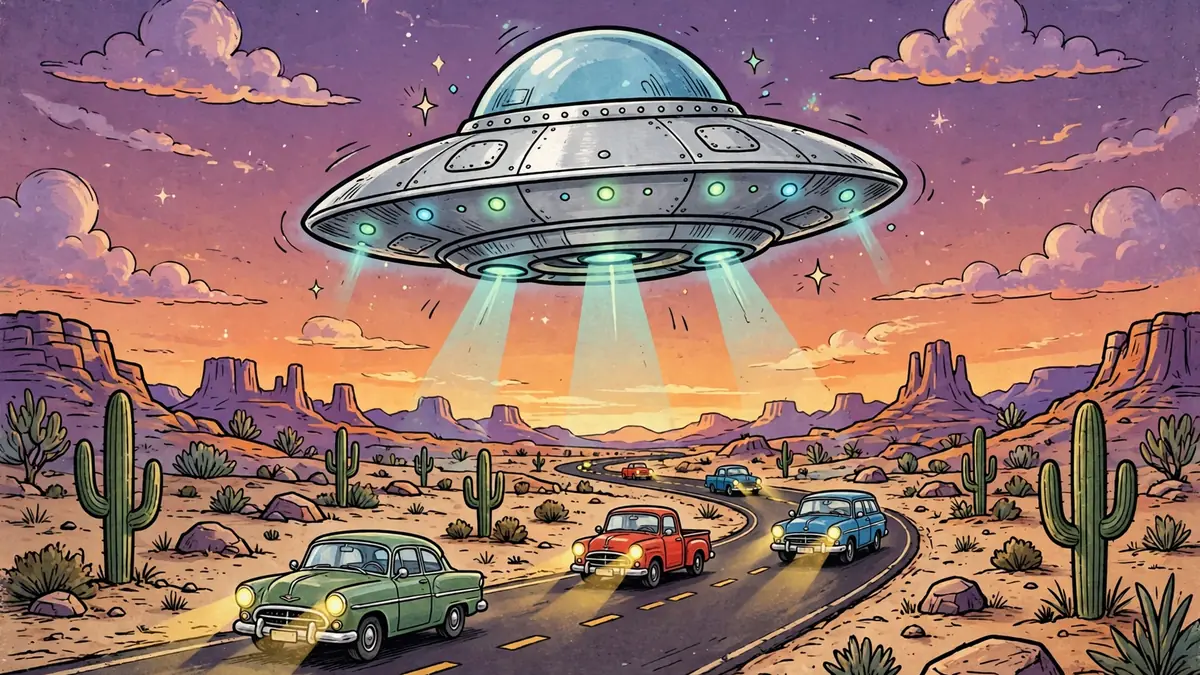
Some visitors arrive with a knock on the door. The funniest ones arrive with a flash of light over a cornfield, a saucer-shaped shadow on the highway, and a little green hand waving hello. This collection takes the whole friendly-alien universe — UFOs, Martians, little green men, flying saucers, and the mysterious folks of Area 51 — and turns it into 200 original alien puns and one-liners, all written fresh for this page, all playful, and all safe for the whole family. No joke here is copied from anywhere; every line was built from scratch for this page alone.
Why do alien jokes work so well? Because space gives every punchline a giant stage: zero gravity, glowing saucers, ray guns, and tentacled tourists who have no idea how Earth works. The jokes below keep everything cartoon-level friendly — our aliens abduct snacks, lose their spaceships, and ask for directions — and they never touch real fear or anything mean. Read the space-lore section first, and every pun after it lands a little better. Then pick your favorites for the sci-fi party, the classroom space week, or the group chat that needs exactly one good line from beyond the stars.
⚡ Quick Answer: Alien puns turn UFOs, little green men, Martians and zero-gravity mishaps into family-friendly sci-fi wordplay. These 200+ original one-liners cover captions, cards, classrooms and costume parties — funny across the galaxy, safe on Earth.
Space Lore & Alien Folklore: The Facts Behind the Laughs
Alien stories are older than rockets. In the 1890s, people across America reported mysterious “airships” in the sky — long before airplanes were common — and newspapers printed the sightings like weather reports. The modern flying-saucer era began in 1947, when a pilot named Kenneth Arnold said he saw nine shiny objects skipping across the sky near Mount Rainier like saucers across water. Reporters picked up his word “saucer,” and the flying saucer was born as a pop-culture icon.
The most famous alien-folklore story is Roswell, New Mexico. In the summer of 1947, something crashed on a ranch near Roswell. The Army first said it recovered a “flying disc,” then corrected itself and said it was a weather balloon. That flip-flop fed decades of stories about captured saucers and secret hangars — but the whole thing is best enjoyed as folklore, a campfire story with a desert setting, not a fact to argue about. The town of Roswell leans into the fun today with alien festivals, green-lamp-post decorations, and a UFO museum.
Area 51 is a real place — a remote U.S. Air Force facility in the Nevada desert — and its real history is about secret airplane testing, not little green men. Because the base stayed classified for so long, people filled the silence with stories: captured spacecraft, midnight landings, guards who chase away curious drivers. The stories are the fun part; the base itself is just a very quiet airfield with a very long runway and a fence that means business.
The Phoenix Lights are another piece of beloved folklore. On March 13, 1997, thousands of people in Arizona reported seeing a V-shaped formation of lights moving slowly across the night sky. Officials later said the lights were military flares dropped during a training exercise — but witnesses still describe the evening as strange and wonderful. It is one of those stories where the official explanation and the personal memories simply agree to disagree.
Scientists look for aliens too — just with telescopes instead of telescopes. The Search for Extraterrestrial Intelligence, or SETI, has been listening to the sky with giant radio dishes since the 1960s, scanning for signals that sound artificial. So far the universe has been very quiet on the radio front, but the search continues, and every year the dishes get a little better at listening.
Then there is the Fermi paradox, the favorite head-scratcher of space fans. It goes like this: the galaxy has hundreds of billions of stars, and many of them have planets — astronomers have confirmed more than 5,000 exoplanets so far, with thousands more candidates waiting for confirmation. With that many worlds out there, shouldn’t somebody have said hello by now? The paradox has no agreed answer, which is exactly why it makes such good joke fuel.
The exoplanet count keeps climbing, and it is worth a moment of awe. The first confirmed exoplanet around a sun-like star was found in 1995. Thirty years later, we know of more than 5,000, including rocky worlds in the “habitable zone” where temperatures could allow liquid water. None of them has sent us a postcard yet — but the list grows every month, and every new world is an invitation to imagine.
Here is the good news for joke writers: space is full of real things that already sound funny. “Zero gravity” means astronauts have to drink their coffee from pouches. A “light-year” is a measure of distance, not time — about 5.88 trillion miles — which makes it the universe’s most misleading name. Mars has the tallest volcano in the solar system, Olympus Mons, nearly three times the height of Mount Everest. Saturn’s rings are made mostly of ice, and one of Saturn’s moons, Enceladus, sprays water geysers into space. The universe hands us the punchlines; we just arrange them nicely.
Now the wordplay engine — the terms that power almost every alien joke. Learn these thirteen and you will catch every pun on the page twice as fast, because nearly every line below is built on one of them:
UFO — Unidentified Flying Object; the classic silver disc of every desert-highway story
Extraterrestrial — the formal word for anything from beyond Earth; “alien” for fancy occasions
Martian — a resident of Mars, usually green in cartoons and always curious
Little green men — the classic cartoon alien: big eyes, small bodies, endless curiosity
Grays — the tall, big-eyed aliens of folklore, said to visit quietly and leave no note
Area 51 — the real secret base in Nevada; the capital city of alien folklore
Crop circle — mysterious patterns flattened into farm fields, blamed on visitors with geometry homework
Mothership — the giant ship the little ships report back to; the boss’s office in orbit
Ray gun — the alien tool of choice: part flashlight, part trouble
Zero gravity — weightlessness; where coffee comes in pouches and crumbs become satellites
Light-year — about 5.88 trillion miles; the universe’s most misleading name
Antenna — the headgear of every cartoon alien, excellent for reception and terrible for hats
Abduction — in cartoons, the friendly kidnapping of snacks, garden gnomes, and the occasional lost cow
Kinds of Aliens: A Friendly Field Guide
Not all aliens are built the same. Before the jokes, here is a quick tour of the regulars — the five kinds you will meet on this page, each with their own style, their own ship, and their own idea of a good time.
Little green men: the classics — big eyes, small bodies, endless curiosity. They land in backyards, wave at the dog, and take exactly one souvenir photo before leaving. Harmless, friendly, and terrible at parallel parking a saucer.
The grays: tall, quiet, and mysterious. In folklore they visit at night, study the neighborhood, and vanish before sunrise. On this page they mostly study the snack table and take notes on how chips work.
Martians: the neighbors from next door, cosmically speaking. Red-planet residents with antennae and opinions about Earth’s weather. They visit in October because the costumes make them feel right at home.
Friendly ETs: the warm-hearted wanderers who phone home, ride bicycles across the moon, and befriend every kid with a flashlight. If an alien is going to share your candy, it is one of these.
Invaders-turned-tourists: they arrived with ray guns and a plan, then saw the pizza and changed their minds. Now they run the gift shop at the landing site and give five-star reviews to Earth’s sunsets.
Classic Alien One-Liners
These are the all-rounders — the lines that work at the sci-fi party, in the group chat, or on a card tucked into a birthday gift for the space fan in your life. They lean on the classic props from the space-lore section: UFOs, little green men, flying saucers, and the desert highway. Each one is a complete little scene, built for reading aloud, and none of them needs explaining. Keep a few ready; the first clear night of the month will hand you a reason to use one, and the second clear night will hand you three more.
The little green man at the end of the street finally fixed his saucer’s blinker, and the whole neighborhood agreed the intersection feels safer now.
A silver UFO hovered over the desert highway at dusk, and the truckers just waved — out here, the sky has always had excellent traffic.
The Martian next door mows his crater lawn every Saturday, and the clippings float away in the low gravity like green confetti.
Two gray aliens spent an hour studying a drive-thru menu, and the cashier still tells the story better than anyone in town.
The mothership parked over the mall last Friday, and security just added “spaceship” to the list of oversized vehicles.
A crop circle appeared in the Johnsons’ wheat field overnight, and the farmer is charging five dollars a photo — the aliens get a cut in corn.
The little green man’s ray gun turned out to be a universal remote, and now the whole block’s TVs change channels at midnight.
An alien tourist asked for directions to Area 51, and the gas station attendant pointed at the gift shop and said, “Second star to the left.”
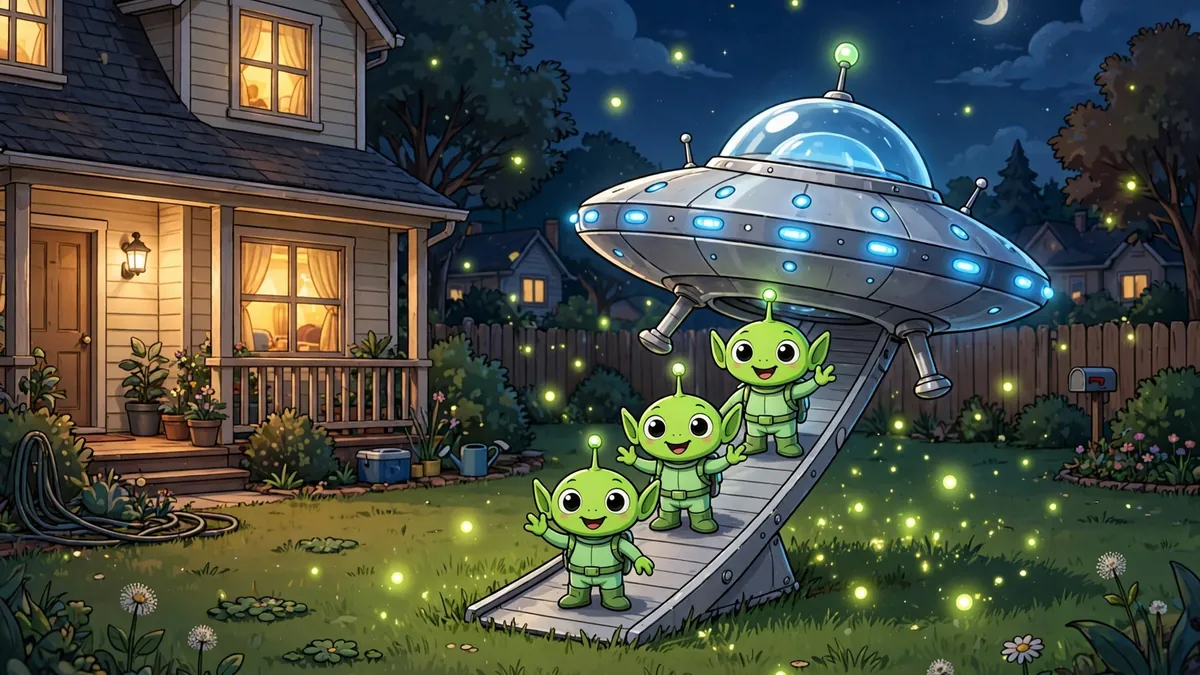
The flying saucer’s landing gear squeaks on our driveway, and the neighbors have started calling it the neighborhood doorbell.
A Martian tried Earth coffee for the first time and spent the next three hours reorganizing the entire solar system by flavor.
The gray alien at the observatory open house asked the best question of the night: “Do you people always look up, or is this a special occasion?”
Zero gravity turned the alien’s lunch into a floating buffet, and the crumbs are now in a stable orbit around the mothership.
The little green men held a bake sale on Mars, and the cookies crumbled in slow motion for a full minute before hitting the plate.
An antenna salesman knocked on the saucer door, and the aliens bought twelve — they have never had better reception in their lives.
The alien kid lost his ray gun at the playground, and the lost-and-found box now glows a faint, friendly green.
A UFO followed the school bus for three blocks, and the driver logged it as “the quietest field trip chaperone we have ever had.”
The Martian weatherman predicts “partly cloudy with a chance of abduction” every single Friday, and he has never been wrong about the cloudy part.
Two little green men argued over the last parking spot at the galaxy mall, and the security saucer had to circle twice.
The alien’s selfie with Earth came out blurry, so now the whole planet is demanding a retake with better lighting.
A flying saucer got a flat tire on the moon, and the tow truck driver is still telling people it was the longest roadside call of his career.
The gray alien’s book club meets on the dark side of the moon, and this month’s pick is a real page-turner — all four hundred pages float.
The little green man waved at the dog through the saucer window, and the dog has been barking at the sky with renewed purpose ever since.
An alien tried to parallel park between two craters and gave up, which is why there is a saucer double-parked on the Sea of Tranquility.
The mothership’s Wi-Fi password is written on a sticky note on the dashboard, and every alien in the fleet knows it by heart.
A Martian ordered a pizza with extra cheese, and the delivery driver is still explaining to his boss why the tip was paid in moon rocks.
The alien tourist’s camera ran out of battery at the Grand Canyon, so he sketched it from memory — the drawing is now hanging in a gallery on Mars.
Two saucers raced down the desert highway at dawn, and the highway patrol just watched — some speed limits are more of a suggestion out here.
The little green man’s garden gnome collection grew by one overnight, and the gnome community is holding a welcome ceremony.
An alien knocked on the observatory door at midnight and asked if the “big telescope” comes in a travel size.
The gray alien’s diary entry for Tuesday reads: “Humans wave at the sky a lot. Noted. Waved back. They seemed delighted.”
A UFO landed softly in the cornfield, and the corn has been standing a little straighter ever since, like it is proud of the visit.
The Martian kid’s science fair project was a model of Earth, and the judges gave it first place for “most improved planet.”
Cute Alien Puns
“Cute” in the galaxy means warm: the lines you would write in a card for the friend who loves space a little too much. These are sweet, gentle, and safe for anyone — pass them along with a shared bag of star-shaped candy, a saved seat at the sci-fi movie night, or a photo of the saucer-shaped cloud at sunset. Nothing here is scary; the spookiest thing in this section is a Martian with somewhere to be.
The baby alien waved all three of his little hands at once, and the whole playground waved back with both of theirs.
A tiny saucer landed in the flower bed, and the daisies leaned in closer like they were listening to a secret.
The little green man packed a lunch for his first Earth picnic: one sandwich, two juice boxes, and a map with a smiley face on our house.
A Martian kitten chased its own tail in zero gravity and spun like a tiny furry planet with excellent rhythm.
The friendly ET tucked the sleeping toddler in with a blanket from the mothership, and it glowed softly like a nightlight.
Two baby aliens held hands during the meteor shower because even space kids know the bright ones are the best ones.
The little green man’s antennae drooped when it rained, and the neighbor kid shared her umbrella without being asked.
A tiny UFO got stuck in the apple tree, and the whole street gathered with a ladder, a net, and a plate of cookies for the pilot.
The Martian puppy learned to fetch in low gravity, and now every stick comes back in slow motion like a magic trick.
The baby gray alien’s first word was “hello,” which the scientists agree is the politest possible first contact.
A little saucer left a thank-you note on the porch: “Nice planet. Great snacks. Will visit again. Love, Zorp.”
The friendly alien braided the little girl’s hair with ribbons from the Andromeda craft fair, and it shimmered for a week.
Two Martian fireflies raced around the backyard at dusk, and the kids cheered like it was the galaxy championship.
The little green man cried happy tears at the fireworks, and each tear floated up and popped like a tiny star.
A baby alien fell asleep in the laundry basket, and the warm towels smelled faintly of stardust for days.
The tiny Martian waved goodbye with all four arms, and the airport security line applauded.
The friendly ET taught the class goldfish to do a loop-the-loop, and the fish has been showing off ever since.
A little saucer’s headlights blinked twice at the crossing guard, which everyone agreed meant “thank you.”
The baby alien’s first steps were on the moon, and the footprints are still there, preserved in the dust like a family photo.
The Martian grandma knitted the baby a sweater with constellations on it, and it fits perfectly in every gravity.
A tiny green hand slipped a star-shaped cookie into the kid’s lunchbox, and nobody saw who — but the sky winked.
The little alien hugged the teddy bear goodbye at the end of the visit, and the bear has smelled faintly of rainbows ever since.
Alien Q&A Jokes
Question-and-answer jokes are the easiest kind to perform: you ask, they guess, you land the punchline. This set is built for sci-fi parties, classroom space weeks, and the stargazing group that wants one more story. The first fourteen answers teach a real space fact on the way to the laugh — the rest are pure playful fun. Try the factual ones on a teacher first; they double as quiz answers.
Q: What happened at Roswell in 1947? A: Something crashed on a ranch in New Mexico, the Army first said “flying disc” then said “weather balloon,” and the flip-flop became the most famous alien-folklore story in America.
Q: What is Area 51 really? A: A real, remote U.S. Air Force facility in the Nevada desert used for secret airplane testing — the alien stories around it are folklore, but the fence is very real.
Q: What is SETI? A: The Search for Extraterrestrial Intelligence — scientists listening to the sky with giant radio dishes since the 1960s, waiting for a signal that sounds artificial.
Q: How many exoplanets have astronomers confirmed? A: More than 5,000, with thousands more candidates — the first one around a sun-like star was found in 1995, and the list grows every month.
Q: What is the Fermi paradox? A: The head-scratcher that asks: with hundreds of billions of stars and thousands of known planets, why hasn’t anybody said hello yet?
Q: What is a light-year? A: A measure of distance, not time — about 5.88 trillion miles, or how far light travels in one year. It is the universe’s most misleading name.
Q: What is zero gravity really like? A: Weightlessness — astronauts drink coffee from pouches and every crumb becomes a tiny satellite orbiting the cabin.
Q: What is Olympus Mons? A: The tallest volcano in the solar system, on Mars — nearly three times the height of Mount Everest.
Q: What are Saturn’s rings made of? A: Mostly ice — countless chunks of frozen water orbiting the planet like a glittering highway.
Q: What are the Phoenix Lights? A: A famous 1997 Arizona sighting where thousands saw V-shaped lights in the sky — officials said military flares, witnesses still call it strange and wonderful.
Q: When did the modern flying-saucer era begin? A: In 1947, when pilot Kenneth Arnold described shiny objects skipping like saucers near Mount Rainier — reporters loved the word “saucer.”
Q: What is Enceladus? A: One of Saturn’s moons — it sprays giant geysers of water into space from its south pole, like a cosmic fountain.
Q: What is the habitable zone? A: The region around a star where temperatures could allow liquid water — astronomers have found rocky exoplanets sitting right in it.
Q: What does UFO stand for? A: Unidentified Flying Object — it just means something in the sky nobody has identified yet, not necessarily a spaceship.
Q: Why did the alien bring a ladder to Earth? A: He heard the party was on the next planet over and wanted a head start on the stairs.
Q: What is a Martian’s favorite Earth snack? A: Anything crunchy — the little green men rate our chips five stars and our pickles a close second.
Q: Why don’t aliens ever get lost on road trips? A: Their GPS covers three galaxies, and the mothership always knows where it parked.
Q: What did the gray alien order at the diner? A: The special — he pointed at the menu, the picture, and then at the sky, just to be safe.
Q: Why did the UFO land in the cornfield? A: The pilot wanted directions, and the corn was the only thing tall enough to flag down.
Q: What do you call an alien who tells great stories? A: A star-teller — the whole saucer crew gathers round every lights-out.
Q: Why did the little green man take up gardening? A: He heard Earth had great soil, and his moon garden was getting lonely.
Q: What is an alien’s favorite Earth holiday? A: Halloween — finally, a night when everybody else dresses up too.
Q: Why did the Martian bring an umbrella to the desert? A: Old habits — it rains stardust on Mars, and he likes to be prepared.
Q: What did the alien say to the telescope? A: “Nice to finally meet the neighbors — I have been waving at you for years.”
Q: Why don’t saucers ever get speeding tickets? A: They slow down for every small town with a good diner — the officers wave them through.
Q: What do aliens put on their toast? A: Meteor jam — spread thin, eaten at light speed, gone by sunrise.
Q: Why did the alien kid bring a flashlight to school? A: Show and tell was “something from home,” and his nightlight is a small sun.
Q: What is the mothership’s favorite Earth show? A: Anything with a laugh track — the crew practices their chuckles in zero gravity.
Alien Captions & Texts
Captions live or die in the first few words, so these stay short and starry. The Instagram set is written for telescope photos, costume shots, and night-sky stories — while the texting set works as quick sci-fi party invites and everyday updates you can send in seconds. Pair any caption with a photo of the moon and the likes take care of themselves.
Alien Instagram Captions
Saucer photo loading… the little green wave is included free of charge.
Current status: cosmically curious, personally cozy.
This meteor shower has better timing than my alarm clock.
The desert sky understood the assignment; the stars overdid it.
Me and the telescope, having our annual staring contest with Mars.
Space week loading: 99% stardust, 1% remaining sleep.
Old craters, new sneakers, same galaxy magic.
Found the quietest neighborhood in the universe. Zero noise, great views.
Moon’s out, saucers are circling, camera is ready.
That moment when the night sky is prettier than the screensaver.
Signal of the day: “Hello from three light-years away.”
Stargazing looks good on this old backyard.
Took the long way home through the Milky Way.
The owls approved this evening. The aliens want a recount.
Orbit goals: low gravity, high spirits, zero regrets.
Somewhere between the constellations and the coffee, midnight happened.
Resting my camera roll in peace after this sky.
The stars have seen eons; I have seen one great meteor.
Antennae up — the universe is showing off tonight.
Short Alien Texts to Send
Rooftop stargazing tonight. Bring a blanket and your best alien wave.
Sci-fi party plan: costumes, saucer snacks, group photo. You are on antenna duty.
The moon is showing off again. Come see before the clouds roll in.
Found the perfect meteor spot. Meet at the hill at ten.
Costume check: are we doing little green men or fancy Martians?
The stars over the desert are doing the thing. Get here fast.
Reminder: flashlights, comfy shoes, and zero fear of the dark. We have hot cocoa.
The telescope misses you. Come visit.
New constellation idea for the group chat. You will love it.
Sunset + telescope + best friends = tonight’s plan.
Bring the camera. The sky is cooperating for once.
Meet at the observatory gate. The bench with our names is free.
Little Green Men
They are the most famous aliens in the universe, and they earned it: big eyes, small bodies, endless curiosity, and a habit of landing in exactly the wrong backyard at exactly the right time. These twelve lines follow the little green men through their Earth adventures — lost keys, borrowed lawn chairs, and one unforgettable bake sale. If you only remember one kind of alien, make it this one.
The little green man rang the doorbell twice, then remembered his people usually just beam in.
Three little green men tried to order at the drive-thru speaker, and the cashier still swears the voice said “one of everything, to go, to Mars.”
The little green man’s antennae picked up the ball game, the weather, and — briefly — a very confused pizza order from 1987.
One little green man stayed behind to finish the crossword, and the saucer circled the block twice waiting for him.
The little green men voted on a team name for trivia night and chose “The Usual Suspects from Sector Seven.”
A little green man borrowed the neighbor’s lawn chair and returned it with a thank-you note written in perfect, tiny cursive.
The little green man’s lost keys turned up in the crater flowerpot, right where his big-eyed kid said they would be.
Two little green men played rock-paper-scissors for the last slice of pie, and the pie got cold while they argued about the rules.
The little green man asked what the flashing lights on the saucer meant, and the mechanic said, “That means it is Tuesday.”
A little green man joined the neighborhood watch, and reported the moon for “suspicious glowing” three nights in a row.
The little green men pooled their allowance and bought a telescope — now they watch us watching them, and everybody waves.
One little green man fell asleep during the movie, and his snores harmonized with the spaceship hum in perfect pitch.
UFO & Flying Saucer Sightings
Every great alien story starts the same way: a light in the sky that does not behave like a light should. This section is for the desert-highway drivers, the midnight stargazers, and everyone who has ever pointed at the clouds and said, “Wait — did you see that?” Read them under an open sky for full effect; a thermos of something warm is strongly recommended.
The silver disc over Route 9 hovered, spun once like it was showing off, and vanished before the camera finished focusing.
A flying saucer cruised low over the cornfield at dusk, and every single stalk leaned the same way, like an audience taking a bow.
The night-shift dispatcher logged the call as “unusual lights, caller very polite, lights also very polite.”
Two saucers played tag around the water tower at midnight, and the town’s dogs provided the soundtrack.
The UFO’s landing lights blinked in a pattern, and the retired signalman at the diner translated it as “just passing through, nice town.”
A saucer-shaped cloud hung over the mesa all afternoon, and the tourists photographed it while the locals just smiled.
The radar operator saw the blip, blinked, and the blip was gone — the fastest coffee break in aviation history.
A glowing disc settled onto the lake so gently that the ducks did not even wake up, which the pilot logged as “a perfect landing.”
The highway patrolman followed the lights for six miles, then turned around — some mysteries get a wave and a good story instead of a ticket.
Three witnesses described the same saucer three different ways, and all three sketches are now framed side by side at the library.
The saucer’s shadow crossed the baseball field during the seventh inning, and the whole stadium looked up at exactly the same moment.
At 2 a.m. the sky over the desert went quiet, the stars seemed to lean closer, and one small light blinked twice — like a wink.
Sarcastic & Clever Alien Puns
Not every close encounter goes smoothly. The sarcastic set is for the telescope that fogged up at the best moment, the meteor shower that peaked during the clouds, and the GPS that confidently routed the saucer into a cornfield — dry laughs aimed at situations, never at people, and always kind to the visitors. The clever half follows with the facts and wordplay from the top of this page, bent into lines that make people say, “Okay, that one was good.” Save the sarcastic ones for friends who have survived a cloudy meteor shower; they will feel seen.
Sarcastic Alien Puns
Oh great, the meteor shower peaked at 3 a.m. behind the clouds. Very professional universe we have here.
Love how the telescope lens fogged up exactly when the bright thing flew over. Perfect timing, as always.
The GPS routed the saucer into a cornfield. Sure. The cornfield is definitely on the star chart.
Sure, the “ten-minute stargazing session” took three hours — the constellations are excellent at wasting time beautifully.
The observatory’s “clear skies” forecast lasted until the exact minute the club arrived. Excellent planning, weather app.
Wonderful: it rained exactly when the astronomy club set up the big telescope on the hill.
The tour guide said “just one more planet” six planets ago. We believe in her anyway.
I wore new shoes to the desert lookout. The gravel has filed a formal complaint.
The “shortcut” to the dark-sky site added forty minutes and three excellent wrong turns. Worth it, allegedly.
The alien’s phone died right before the group photo. Of course it did. The universe has a sense of humor.
The clouds parted for exactly four seconds during the eclipse. Rude. Iconic. Keeping the photo anyway.
No, I did not get lost on the way to the observatory. I was conducting an unscheduled extended tour of the county.
Clever Alien Puns
A light-year is just the universe’s way of saying “it is far” with extra steps and excellent branding.
The mothership is the only office where “working from home” means working from three galaxies away.
Zero gravity is nature’s reminder that crumbs, like problems, are easier to handle when they float.
An antenna is just a hat that gets excellent reception and refuses to stay on in the wind.
The gray aliens’ book club has one rule: no spoilers, because some members can see the future.
A Martian calendar has one season: dust storm. The postman delivers anyway.
Saturday night on the mothership is just Friday night with better views and worse parking.
The little green men’s group chat has 400 members, and every single message is just “look up.”
An exoplanet is just a planet with an excellent agent and a great press release.
The UFO’s blinker has been on since 1947, and nobody has had the heart to tell the pilot.
SETI is the universe’s longest-running “are we there yet?” asked with a radio telescope.
A crop circle is just a farm field that woke up with a new tattoo and no memory of the night before.
Alien Puns for Kids, School & Parties
Everything in this part of the page is clean, simple, and built for the toughest crowd there is: children. Teachers get classroom space-week lines, families get the party set, and the friendly cartoon galaxy stays the star of every section — bright, cheerful, and zero-fear, and the jokes are for everybody. If a joke works for a seven-year-old and a grandparent at the same table, it earned its place here.
Kid-Friendly Alien Puns
Why did the little alien bring a flashlight to Earth? Because even friendly aliens like to see where they are landing.
The Martian at the playground shared his moon-sand bucket, and it sparkled in the sun like tiny diamonds.
What do you call an alien who loves recess? A play-groundling, first in line for the swings every single day.
The baby saucer beeped twice when the school bus passed, which the driver said meant “have a great day.”
Why did the alien kid bring a map to the museum? To find the dinosaur bones before lunchtime, just like the field-trip plan said.
The friendly ET helped the class plant sunflowers, and they grew so tall the aliens used them as a landmark.
What is a little green man’s favorite bedtime story? The one about the brave kid who waved at the sky and got a wave back.
The Martian puppy learned to sit, stay, and float — the floating part took the longest.
Why did the alien pack extra snacks for the trip? Space travel makes everybody hungry, even in zero gravity.
The tiny UFO left crayon drawings on the fridge: a saucer, a smiling sun, and our house with a heart on it.
What do baby aliens drink at parties? Star-berry juice, served in cups that change color in the light.
The little green man tucked the teddy bear into the saucer’s back seat and buckled it in twice, just to be safe.
Alien School Jokes
Our science teacher explained light-years with one flashlight, one long hallway, and a great story — best lesson of the month.
The spelling bee word was “extraterrestrial,” and half the class tried to sneak an extra “r” into “antenna.”
What did the class learn on space week? That the planets are neighbors you can wave at, if you wave at night.
The art teacher had us draw our own aliens, and everyone’s alien came out with excellent antennae.
Why did the space report get an A? It covered the Mars rovers, complete with a hand-drawn map of Olympus Mons.
Our teacher explained zero gravity with one dropped pencil, one slow-motion video, and a photo of floating astronauts.
The class vote for the coolest real space fact went to Saturn’s rings being made of ice, and the teacher confirmed it is genuinely true.
Geography quiz answer of the year: the Sea of Tranquility, where the first astronauts landed on the moon in 1969.
What is a classroom’s favorite planet? Earth — it has the best show-and-tell and the comfiest chairs.
The librarian’s space-week display featured books about Mars, and the hold list filled up by Friday.
Our group project mapped every planet in order, and the model Saturn’s rings took three rolls of tape.
The principal’s morning announcement reminded everyone that the planetarium trip needs permission slips by Thursday.
Alien Party Puns
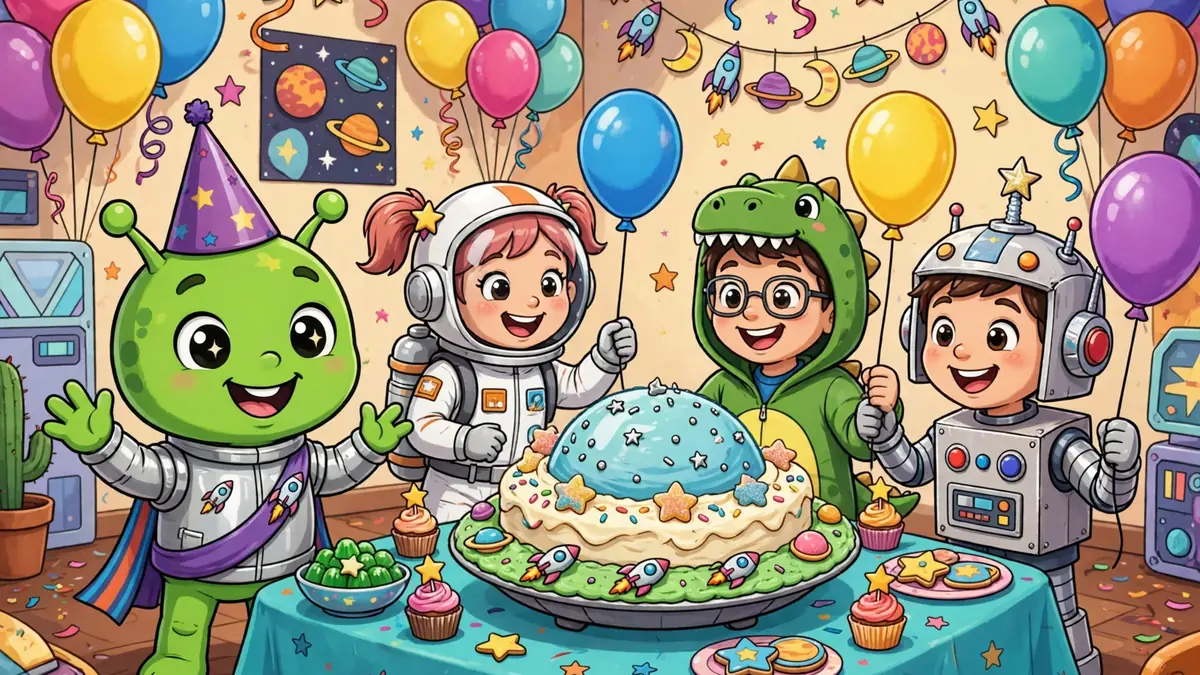
The sci-fi party invites went out on little saucer-shaped cards, and the RSVPs came back faster than a meteor.
Costume contest rule: the best-dressed Martian gets the first slice of galaxy cake, by ancient party law.
The fog machine by the front door worked perfectly this year, and the neighbors are still talking about the alien entrance.
Party game idea: alien antenna ring toss. Most rings on the Martian’s head wins the golden telescope trophy.
The snack table shaped like a tiny mothership was the hit of the party, and it emptied in eleven minutes flat.
Decorations report: glow stars, string lights, and one cardboard UFO that took three hours and was worth every minute.
The “moonwalk” dance contest used the whole living room, and the winning team looked ready for low gravity.
Playlist verdict: space-age synth for arrivals, dance hits after the costume parade, silence for the telescope round.
The photo booth had a cardboard flying saucer, and the line for pictures never got shorter all night.
Midnight snack table: “asteroid” meatballs, “crater” cookies, and punch the color of a perfect nebula.
Favor bags went out as tiny rocket ships, and every kid left with candy and a glow-in-the-dark alien.
Cleanup crew found one lost antenna headband, three plastic ray guns, and zero regrets. Best party of the year.
Knock-Knock Alien Jokes
Knock-knock jokes are the oldest trick in the book, and the flying saucer’s hatch was born for them — a round door that has opened for every curious kid, every midnight stargazer, and every friendly visitor for decades was made for this game. Perform them at the door, over text, or with a kid who will demand all twelve in a row. Fair warning: that kid will then invent a thirteenth, and it will be better than yours.
Knock, knock. Who’s there? Alien. Alien who? Alien a good day for a visit — the sky is clear and the saucer is parked out front!
Knock, knock. Who’s there? UFO. UFO who? UFO-nately for you, I brought snacks from three galaxies over!
Knock, knock. Who’s there? Martian. Martian who? Martian-ry had a little lamb? No wait — Martian-ry had a little saucer!
Knock, knock. Who’s there? Saucer. Saucer who? Saucer-nly the best-looking spaceship on the block — come see!
Knock, knock. Who’s there? Orbit. Orbit who? Orbit you glad I stopped by instead of just flying past?
Knock, knock. Who’s there? Comet. Comet who? Comet inside — the meteor shower is starting and the cocoa is hot!
Knock, knock. Who’s there? Nova. Nova who? Nova good time like a sky full of stars — look up!
Knock, knock. Who’s there? Galaxy. Galaxy who? Galaxy-brain idea: stargazing party at my place tonight!
Knock, knock. Who’s there? Rocket. Rocket who? Rocket science is hard, but knocking is easy — let me in!
Knock, knock. Who’s there? Star. Star who? Star light, star bright, first alien I see tonight!
Knock, knock. Who’s there? Moon. Moon who? Moon over and meet my little green friend — he is very friendly!
Knock, knock. Who’s there? Beam. Beam who? Beam me up — the mothership is leaving and I saved you a seat!
Alien Terms & What Makes Them Funny
Alien talk comes with its own vocabulary — and half of it already sounds like a joke waiting to happen. Here is the cheat sheet: ten terms, what each one really means, and why each one is funny. Memorize three before your next sci-fi party and you will sound like the smartest cadet there.
Term
Quick Fact
Why It Is Funny
UFO
Unidentified Flying Object — the classic silver disc of every desert-highway story
The sky’s most mysterious frequent flyer, never once showing ID
Extraterrestrial
The formal word for anything from beyond Earth
“Alien” dressed up for a fancy dinner it will never attend
Martian
A resident of Mars, usually green in cartoons and always curious
The neighbor from next door who never borrows sugar, only telescopes
Area 51
A real secret base in the Nevada desert used for airplane testing
The capital city of alien folklore, with the world’s most serious fence
Crop Circle
Mysterious patterns flattened into farm fields overnight
A farm field that woke up with a new tattoo and no memory of the night
Abduction
In cartoons, the friendly snatching of snacks and garden gnomes
The only kidnapping where the victim comes home with souvenirs and a full stomach
Mothership
The giant ship the little ships report back to
The boss’s office in orbit, with the worst parking in the galaxy
Ray Gun
The alien tool of choice: part flashlight, part trouble
A universal remote with ambitions far beyond the television
Zero Gravity
Weightlessness — coffee comes in pouches up there
Nature’s reminder that crumbs, like problems, are easier when they float
Light-Year
About 5.88 trillion miles — a distance, not a time
The universe’s most misleading name, confusing students since forever
Alien Puns for Different Moments
The same pun can flop or fly depending on the moment you use it in. Here is a quick guide to matching the line to the occasion, with pointers to the right section of this page. Think of it as a seating chart for jokes: every line has a table where it belongs, and this guide walks it to its seat.
Sci-fi party invites: this is where the Party set earns its keep. A saucer-shaped invite deserves a line like “The sci-fi party invites went out on little saucer-shaped cards,” and the Little Green Men set covers the bigger scenes — antenna contests, galaxy cake, and the costume parade everyone photographs. Send the invite a week early; space parties fill up fast.
Space-day captions for sky photos: keep it short and starry. The Captions section was built for telescopes, moon shots, and meteor streaks — and the Texts set handles the quick “meet at the hill at ten” messages that start the whole evening. One strong line under a starry photo beats a paragraph every time.
Classroom space week: keep it factual, proud, and a little funny. The Q&A section’s first fourteen answers teach real space facts — what a light-year really is, why Saturn’s rings are ice, the true story of Area 51 — and the School set was written for teachers, spelling bees, and planetarium permission slips. Students remember the joke and keep the fact as a bonus.
Greeting cards for brave friends: lead with the cute, not the creepy. The Cute set is full of lines that fit a birthday card, a get-well-soon note for a sci-fi fan, or a thank-you to the friend who shared their telescope — one warm line about a friendly alien tells the reader exactly what kind of fun you are having. Handwriting it makes it twice as good.
Costume-party icebreakers: open with a knock-knock. The Knock-Knock section was written for exactly this moment — a door that opens, a guest who answers, and twelve rounds before anyone remembers to check the snack table. Start with “Alien a good day for a visit” and let the room take it from there; by round three, everyone will be inventing their own.
How to Deliver an Alien Pun
A good alien pun is like a good meteor shower: timed to the dark sky, shared with friends, and never aimed at anyone’s real fears. Three small rules from the mission-control handbook will keep your timing straight and your audience grinning. They fit on an index card, which is convenient, because you will want them in your pocket on space week.
1. Match the pun to the setting
Alien puns land best with the night sky around them. Drop one as the first stars appear on a clear evening, when the telescope club gathers on the hill, or at the sci-fi party as the synth music starts. The setting does half the work, and the same line sounds twice as good with the Milky Way overhead. Even a daytime classroom gets a boost when the model planets are hanging from the ceiling.
2. Keep it kind — never joke about real fear
The best alien jokes laugh at fogged-up telescopes, cloudy meteor showers, and our own wrong turns — never at anyone’s real fright or worry. Space is big and can feel overwhelming; aim for the laugh that makes the whole group look up together, not the one that lands wrong.
3. Timing beats quantity
One well-timed “look up” as the first meteor streaks across the sky beats ten puns before the blankets are even spread. Say it, let it land, then pass the cocoa. Stargazers understand this rule — it is why the best sky stories get told once, properly, at midnight.
Ethan Parker is the Lead Humor Strategist at Easy Puns, where he writes and fact-checks pun collections for readers of all ages. Every line on this page was written originally for Easy Puns — researched against top-ranking pages for topic coverage, then written from scratch so no joke is copied from anywhere. The space facts above reflect widely shared knowledge — what a light-year really is, how many exoplanets astronomers have confirmed, the true history of Area 51 and the folklore of Roswell — and the whole collection is kept family-friendly and free of anything frightening. New collections go up regularly, so there is always a fresh page of puns waiting.
Alien Puns FAQs
What are the most popular alien puns?
The favorites grow from a few classic props: flying saucers, little green men, Martians, and the mysterious lights over the desert highway. Fresh versions of each run through this page — start with the Classic One-Liners and pick your favorites for the party, the caption, and the group chat.
Are alien puns okay for kids?
Yes — when they stay cartoon-friendly like the ones on this page. The Kid-Friendly section was written for bright cheerfulness and zero fear: waving Martians, smiling saucers, and star-shaped cookies, with nothing frightening.
Are alien puns good for space-day captions?
They are some of the best. Telescopes, moon shots, and meteor streaks photograph beautifully, and the Captions section was written for exactly those shots — short lines that fit under a photo without explaining the joke.
What is Area 51?
A real, remote U.S. Air Force facility in the Nevada desert, used for secret airplane testing. The alien stories around it are folklore — fun campfire tales, not facts — which is exactly why they make such good jokes.
Are UFO sightings real?
People really do report strange lights in the sky — the famous ones, like Roswell in 1947 and the Phoenix Lights in 1997, are beloved pieces of folklore. On this page they are treated as fun stories for jokes, not as claims about what is really out there.
How can I write my own alien puns?
Start with a real space detail — the saucer that squeaks on the driveway, the crumbs floating in zero gravity, the owl that watches the telescope — then bend a matching everyday word toward it: a mothership becomes the boss’s office, and a light-year becomes the universe’s most misleading name. Short, kind, and built on a true detail is the whole recipe.