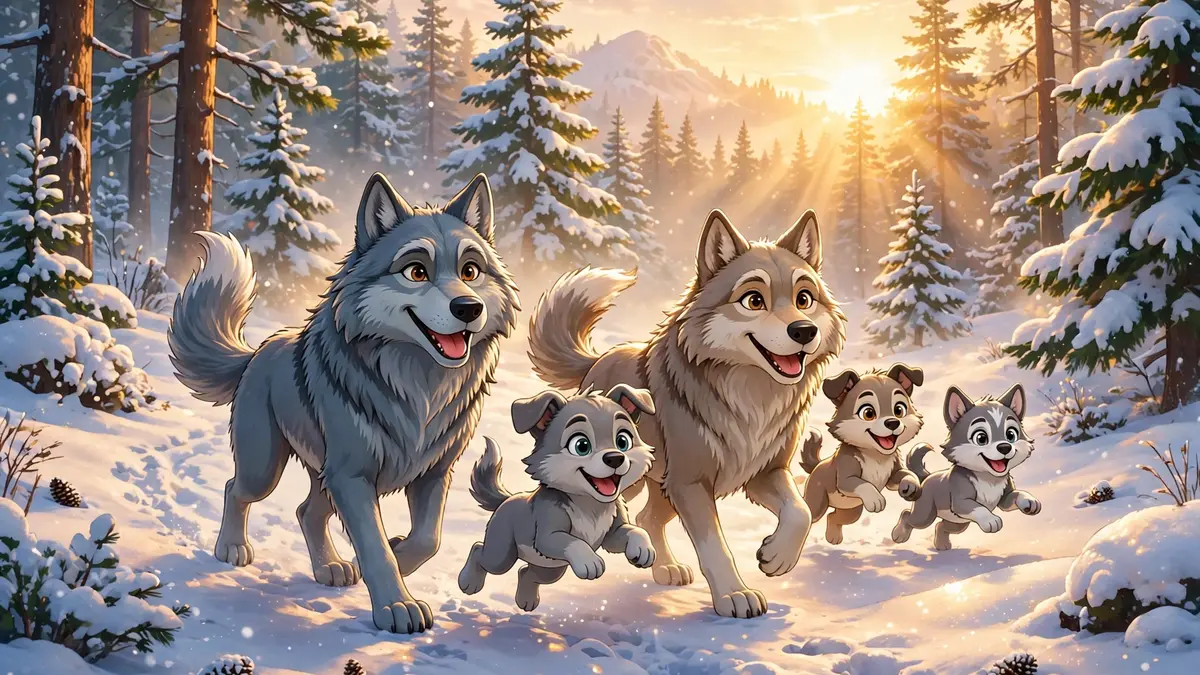
Some animals hurry through the year. Wolves take the long trail, together: a whole pack trotting out of the pines at dawn, the mother and father in front, last spring’s youngsters in the middle, and a row of small pups tumbling over each other’s paws at the back. They are the wild world’s great family singers — checking in with howls, reading the whole forest with one lift of the nose, and raising their pups where everybody babysits. This collection gives you more than 200 original wolf puns and one-liners, written fresh for this page and sorted by where you plan to use them.
Why do wolf jokes land so well? Because wolf life comes with a built-in audience: everyone has watched a pup take its first wobbly steps out of the den, heard that a pack is really just a mum, a dad, and their kids, or learned that the famous howl is not for the moon — it is a family group chat, sung out loud. Once you see how the wordplay works in the next section, every joke below lands a little warmer.
⚡ Quick Answer: The funniest wolf puns play on packs and pups, long moonlit howls and forest trails, devoted parent pairs and Yellowstone valleys. Start with the Classic One-Liners below, try the Q&A jokes for quick laughs, and tap any Copy button to grab a line in one click.
The Science & Wordplay Behind Wolf Humor
A wolf is the largest wild member of the dog family — and that is not storyteller talk. A big gray wolf can stand as tall at the shoulder as a kitchen table and weigh about as much as a grown person, yet most of that outline is fur and confidence — under the coat sits a lean, long-legged traveller built for covering ground.
Start with the famous team. A wolf pack is not a gang ruled by the toughest fighter — it is a family. Most packs are a mother and father, called the breeding pair, raising this year’s pups alongside their youngsters. The old story of the “alpha” who wins the top job by fighting came from watching strangers crowded together; wild packs run on parents, patience, and packed lunches.
The pack’s voice is the howl, and it is pure communication. Wolves howl to say “we are here,” to call a straying pup home, to warn the neighbours off the family hunting grounds, and sometimes just for the joy of the chorus. One wolf starts, the others join at different notes, and the blended song can carry ten miles through still forest air.
And the moon? Pure decoration. Wolves howl at dawn, at dusk, and in the middle of the afternoon, moon or no moon — the raised muzzle simply points the sound up and out, the way cupping your hands around your mouth does. Storytellers added the moon later: a singing wolf under a full moon is the best picture in the forest.
A wolf reads the world through its nose and ears. Its sense of smell is so sharp that it can catch the scent of a moose more than a mile away when the wind is kind, and its hearing picks up sounds far too high and faint for us. Every snapped twig and distant howl arrives like a headline, which is why a resting pack is never truly off duty.
Dinner is a team project. Wolves are built to travel — a pack may trot twenty or thirty miles in a day — and they hunt together with real cooperation: testing the herd, taking turns on the chase, and sharing the meal with the whole family, pups and grandparents first. Back at the den, grown wolves even carry food home in their stomachs and bring it back up for the pups, a delivery service no app has matched.
Spring turns the den into a nursery. New pups are born blind and tiny, about the size of a soup can, and for their first weeks they know only warmth, milk, and their mother’s side. Then the whole pack goes to work: aunties babysit, uncles deliver dinner, and last year’s youngsters become the world’s most patient wrestling coaches.
No modern wolf story skips Yellowstone. Wolves returned in 1995 after a seventy-year absence, and the valley slowly reshaped itself: elk grew warier, willows and aspens along the streams grew back, beavers and songbirds followed, and the rivers settled into steadier banks. One wolf family, it turned out, was a keystone holding up the whole arch.
Finally, the family connection sleeping on your sofa. Every dog alive — from teacup poodle to mightiest mastiff — descends from ancient wolves. The wolf is the original wild draft of humanity’s oldest companion, still trotting the ridges and singing the evening check-in.
Now the wordplay engine — the sound pairs that power almost every wolf joke:
Howl — the pack’s long-distance phone call, a family check-in sung in harmony
Pack — the wolf family itself: parents, pups, and last year’s youngsters
Pup — the baby wolf, born blind and tinier than you would ever guess
Den — the underground nursery where the pups spend their first weeks
Territory — the family’s home range, marked, mapped, and politely defended
Moon — the famous stage light that gets credit for music it never ordered
Paw print — the four-toed signature a wolf presses into mud and snow
Fang — the long canine tooth, built for gripping dinner, not for villains
Fur — the double winter coat that shrugs off forty below without a shiver
Tail — the pack’s mood flag, carried high in confidence and tucked in respect
Snout — the long nose that reads the wind like a morning newspaper
Alpha — the famous myth: in a wild pack, the “leaders” are just Mum and Dad
Lone wolf — usually a youngster who left home to find a family of their own
Gray wolf — the biggest, most widespread wolf, in coats from white to black
Yellowstone — the park where returning wolves rebuilt a whole valley
Awoo — the internet’s spelling of a howl, and the pup’s first attempt at one
Keep those pairs in mind — nearly every line below is built on one of them.
The Gray, the Arctic, the Red: A Quick Forest & Wild Guide
Every wolf beginner started as a person standing at a fence, wondering which wolf is which. Here is the friendly, honest guide:
The Gray Wolf — the classic wolf of the northern forests. The largest and most widespread wolf of all, roaming North America, Europe, and Asia in coats that range from snowy white to charcoal black despite the name. Gray wolves are the Yellowstone families, the long-distance trotters, and the parents behind nearly every true wolf story you have ever heard.
The Arctic Wolf — the white wolf of the far north. A gray wolf in a permanent winter coat, living on the high Arctic islands where the sun vanishes for months and the thermometer falls off the chart. Arctic wolves are famously calm around the rare humans they meet, simply because so few people ever reach their neighbourhood.
The Red Wolf — the rare wolf of the American southeast. Smaller and slimmer than its gray cousins, with a rusty cinnamon coat and long legs for warm, swampy country. The red wolf is one of the rarest wolves on Earth, carefully protected and slowly returning to the coastal forests of North Carolina, where every new litter of pups is headline news.
The Pups — the pack’s small professors. A newborn pup is blind, deaf, and about the size of a soup can, and spends its first weeks curled in the den’s warm dark. By two months the whole litter is out tumbling at the den mouth — practising pounces, testing tiny howls, and being babysat by every grown-up in the family in turn.
The Wolf Kit — what keeps a pack thriving. A safe den dug into a hillside, a territory with water and hunting ground to spare, experienced parents who know every trail, and a full roster of older siblings to babysit, deliver dinner, and coach the wrestling: the quiet items that decide whether a pack’s year feels lucky or just long.
Classic Wolf One-Liners
These are the all-rounders — the lines that work anywhere wolves show up: the ridge trail, the family group chat, the wildlife park fence. They lean on the classic sound pairs from the science section, so they land even with people who have watched wolves for years and have heard every lazy moon line twice. Keep a few in your pocket; the first morning round will give you a reason to use one within the hour.
Grandma checks the ridge before she checks the weather, because a gray wolf standing tall at dawn already knows what kind of day it is.
The first pup of the spring got its own announcement at the visitors’ centre, and by lunch the whole tour group had hiked down to see it.
Grandpa claims the flat rock above the valley for his morning tea and calls it “the front row of the howl show.”
Our meadow wears a map of wide paw prints by midsummer, and every single trail leads back to the den hill.
The wolf path through the pines is so well worn that Dad calls it “the original highway, built one pawstep at a time.”
The first frosty morning of the season gets announced to the whole valley by sunrise; howling season is not a quiet one.
Mom counts the pups tumbling at the den mouth every evening the way other people count sheep, except these keep wrestling.
The old snag at the top of the ridge has stood through a hundred storms, and every wolf in the valley has left a greeting at its roots.
Uncle Ray judges a valley by the confidence of its pack; a family that owns the meadow is a forest well kept.
The morning mist on the river draws a crowd faster than the bakery on a Saturday — every muzzle in the pack lifts at once.
Every valley has one famous sunny boulder, and every wolf knows the mother claims it by noon on a bright day.
My sister photographs the evening lineup along the ridge, “so the wolves can sign the guest book before dark.”
The first deep snow of the season is never crossed right away; it is inspected from the ridge, sniffed twice, and then claimed by the pups’ first great tumble.
A slow elk crossed the wolf trail at noon, and the dust on both sides of the meadow has never fully settled.
The still pond in the clearing holds a perfect mirror at midday, and the drinking meetings there always run long.
Grandpa keeps one notebook of “best howls of the year,” dated like a family album of golden trophies.
The wind rearranged the fallen leaves during lunch; the afternoon nap session had an entirely new mattress.
Our camp dog watched the wolves from a respectful distance all morning, learning wild manners and supervising nothing.
The crack of one branch in the pines is the only ringtone the whole meadow answers to — ears up in every direction.
Dad opens the cabin only after his first coffee, “so the wolves and I start the day equally awake.”
The park sign hangs loose on purpose: the pups have claimed the sunny grass beneath it as their summer clubhouse.
Every glove by the cabin door has a valley story — the blizzard week, the great den debate, the surprise howl of June.
My brother tracks the pack’s winter season in a notebook like train times, with paw-print counts in hand-spans instead of stations.
The guide across the valley reads the evening forest better than any forecast on my phone.
Fresh paw prints at the morning crossing drew a crowd of trackers measuring them like votes.
The first person up always checks the ridge before the phone; wolf news travels by curtain in this cabin.
The young wolf drifted across the whole meadow by Tuesday, and the meadow politely read it as a parade.
Grandpa keeps a jar of “first cold-morning air” from the best wolf day of each year, tightly labelled, never opened.
The old lookout platform has its own bench, its own thermos hook, and — according to Dad — its own seniority among park buildings.
By the second week of the season, the whole valley glances at the ridge at dawn out of habit, each errand paused for the wolf report.
Home is wherever somebody has already put the kettle on because the pack is putting on a morning show at the meadow.
The pack’s winter route goes on the cabin calendar in red ink, circled twice, and the whole family discusses it all summer like a royal tour.
Cute Wolf Puns
“Cute” in wolf country means warm: the lines you would write in a card for the person who keeps your mornings bright. These are sweet, gentle, and safe for anyone — pass them along with a shared thermos of cocoa, a saved seat on the bench, or a photo of the first pup that simply has to be shared.
You are the person I save the sunny end of the bench for when the pack crosses the meadow, and in this valley that is a serious honour.
Grandpa holds the park gate for Grandma at wolf time, every visit — fifty summers of the same quiet arrangement.
My best friend knows my favourite wolf by name and den schedule, which is basically a love language in the cold season.
Dad leaves the porch light on until the last guest is in, “so nobody walks the forest path home in the dark,” and then winks at Mom.
There is a flat stone by my sister’s lookout worn smooth by years of kids stopping to watch the ravens drift over the ridge.
The new pup waits by the den mouth in its fluffiest best, certain the morning parade was scheduled personally for it.
Mom writes “first pup — maybe” on the calendar in pencil, with a tiny star she pretends is not hopeful.
You remembered my glove split at the seam, and the new one appeared by the cabin door without a single word.
A shared thermos passed hand to hand along the fence says everything a long speech would, only warmer.
Grandma still holds the map while Grandpa counts the ridge lines — a two-person tradition invented in 1986 and never updated.
Our first little cabin had one small porch and a view of the valley, and we watched the wolves cross it like it was a private tower.
Holding the flashlight while someone you love checks the night path for pinecones is the proudest job on the whole trip.
Our neighbour leaves a jar of jam on our porch after every wolf visit with a note: “For the crew that keeps our corner cheerful. Booking my bench spot early.”
My son lined up his wolf drawings by size and announced that a family, like a pack, stays strong by growing close.
You held the umbrella over my field notebook before your own, in the first drops of rain, and that is the whole story of us.
Sunday mornings at the cabin end the same way: one last look at the valley, and nobody in a hurry to go inside.
My daughter insists each pup’s first paw print is a tiny signature the meadow collects by hand, and she “reads” the evening prints aloud before dinner.
My daughter builds her pretend den “exactly beside Dad’s lookout,” then quietly adds one tiny gate “for the pups to visit.”
A morning started by someone who knows your coffee order feels warmer. This is not opinion; it is family law.
The porch light, the hush after the pack settles, and the ridge fading into dusk: that is the whole recipe for our favourite evening.
My best friend trades me her Saturday watching shift for my Sunday ridge shift every season, and neither of us mentions it.
A pup does not hurry, and neither should you — every giant of this forest started as a tiny blind bundle curled against its mother’s side.
Wolf Q&A Jokes
Question-and-answer jokes are the easiest kind to perform: you ask, they guess, you land the punchline. This set is built for ridge trails, cabin porches, and school wildlife trips, where one good Q&A starts a whole round of everyone trying their own. The mother wolf, the pup, and one very proud howl do most of the heavy lifting — and the first fourteen answers teach a real wolf fact on the way to the laugh.
Q: What is a wolf? A: The largest wild member of the dog family — a lean, long-legged mammal with a thick double coat, a nose that reads the wind like a newspaper, and a family-first way of life.
Q: What is a baby wolf called? A: A pup. Pups are born blind and tiny — about the size of a soup can — and spend their first weeks curled in the den before the whole pack starts co-parenting them.
Q: What is a female wolf called? A: A she-wolf — and in most packs she is half of the lead team, because the leaders are simply the parents, and Mum’s vote carries at least half the valley.
Q: What is a male wolf called? A: Just a wolf, sometimes a dog wolf to tell him apart. No crown, no throne — the lead male of a pack is usually Dad, and his main jobs are hunting, patrolling, and pup-wrestling practice.
Q: What is a group of wolves called? A: A pack — and the word means family. A typical pack is a mother, a father, this year’s pups, and a few older youngsters who have not left home yet.
Q: Why do wolves howl? A: To talk across the miles. Howling says “we are here,” calls the pack back together, warns neighbours away, and keeps family bonds tuned. It is a group chat with better music.
Q: Do wolves howl at the moon? A: No — wolves howl at every hour, moon or no moon. The raised muzzle just aims the sound farther. The moon simply makes the finest stage lighting in the forest.
Q: How far can a wolf travel in a day? A: A travelling pack may trot twenty to thirty miles before dinner, covering a home territory that can stretch across hundreds of square miles of forest, meadow, and ridge.
Q: How good is a wolf’s sense of smell? A: Extraordinary. A wolf’s nose carries hundreds of millions of scent receptors, and with a kind wind a pack can catch the smell of an elk herd well over a mile away.
Q: Are wolves and dogs related? A: Closely — every dog on Earth descends from ancient wolves. Your sofa companion is the wolf’s great-great-grandchild many thousand times over, which explains the spinning before lying down.
Q: What is the biggest wolf? A: The gray wolf, the largest wild dog-family member alive. A big male can stand about as tall as a kitchen table at the shoulder and stretch longer than a grown person lying down.
Q: What happened when wolves returned to Yellowstone? A: The whole valley rebalanced. Elk browsed more carefully, streamside willows and aspens grew back, beavers and songbirds returned, and the rivers ran steadier — one returning family improved the whole neighbourhood.
Q: Who leads a wolf pack? A: The parents. The famous “alpha” story came from studying unrelated wolves in enclosures; in the wild, the leaders are a breeding pair, and their authority is mostly bedtime, boundaries, and who eats first at dinner.
Q: Do wolves really blow houses down? A: Only in fairy tales. A real wolf saves its breath for howling, travels miles for an honest dinner, and would much rather avoid your house, your street, and your whole postcode entirely.
Q: What did the wolf say to the valley? A: “Keep the mornings coming — I will be at my usual ridge, and I brought the whole pack.”
Q: Why did the pup stay close to its mother? A: Her side is a map, a shelter, and a lookout in one — a pup who naps well grows first and explores best.
Q: What did the mother wolf say to the sunrise? A: “You’re late to my ridge walk again — I started the pack twelve minutes ago.”
Q: Why did the ranger inspect the den hill twice? A: Standards. A valley of this reputation does not settle for yesterday’s paw-print arrangement.
Q: What is a wolf’s favourite meeting style? A: Slow, standing, and held at the den hill — with roll-call howling provided and the minutes taken by whoever sings last.
Q: Why do families love the morning wolf watch? A: It is the only news broadcast that also confirms the pack is up, the river is running, and breakfast is officially a spectator sport.
Q: What did the pup say on its first morning out of the den? A: “Big sky, tall pines, excellent meadow — I accept this position.”
Q: Why did the young wolf visit the high ridge at noon? A: A second lookout never hurt anyone — the view deserves updates, and it deserves an audience.
Q: What is a wolf’s busiest hour? A: Dusk — the last patrol needs trotting, the pups need counting, and every den has one last story from the ridge.
Q: Why did the auntie lead the pups to the sunny meadow? A: Wrestling hour is a family tradition, and they teach it the way they were taught: roll, pounce, rest, repeat.
Q: What did the forest say to the new den? A: “We have reviewed your hillside and tested the drainage for a week. You’re welcome.”
Q: Why do wolf jokes always land? A: They arrive with a story from the deep forest, they are built on real mornings, and there is something in the pack for everybody.
Q: What did the wolf say to the watcher on the platform? A: “Same time tomorrow — you bring the binoculars, I will bring the view.”
Q: Why does the valley ring at dusk? A: The evening roll call has begun, and even the sleepiest pup sits up to add one small note to the family chorus.
Wolf Captions & Texts
Captions live or die in the first few words, so these stay short and warm. The Instagram set is written for photos and clips — morning ridges, proud parents, and pups on parade — while the texting set works as quick replies and everyday updates you can send in seconds.
Wolf Instagram Captions
Gate’s open, frost’s in, first photo goes to whoever spots the first pup tumble.
Ridge status: one mother, one father, and a den of pups nobody can keep up with.
This ridge lineup required both a sunrise and a short pep talk with the mother.
Trail rule one: the person holding the camera names the first wolf; the person holding the thermos names the second.
My morning route — porch, gate, ridge, lookout — has more planning in it than my weekend does.
Sun level: one slow afternoon, parked proudly on the big boulder all day.
This den hill took all spring to find. Photographing it slowly from a safe distance.
Nap day today: same meadow, fancier dreams.
Six ridges of morning, finished in shades of green and gold.
Grandpa’s boots, Dad’s thermos, my trail turn: three generations of teamwork.
Some people collect stamps. I collect sunrise photos with a pack in them.
A tiny pup for the valley log, a deep paw print for the trail notebook.
That first-howl quiet right after says more than this caption can.
Porch light on, boots off, ridge glowing: Saturday, complete.
My paw-print haul reached the size nobody wanted to queue behind. Diplomacy, extended.
The snow moved in an hour after the last photo was taken. The valley accepts the compliment and sparkles.
One pack for this valley, one pack for the next. Winter, in chapters.
Notebook update: the big father on the ridge remains lookout of the month.
Wolf-watching day. The lookout platform has never looked so popular.
The last paw print fit the mud like it was made for it — because the trail arranged it, twice.
Short Wolf Texts to Send
Ridge is open in twenty. Your spot on the platform is saved and non-negotiable.
First pup’s out. Repeat: first pup’s out. The valley is receiving visitors again.
I saved your seat exactly your way — sunny end, best view, nothing written down.
Howl emergency: the pack is on the ridge. The watching crew is being promoted.
Grandpa named the big father at dawn and saluted him out loud. It is a whole thing here.
First wolf Saturday of the season is this weekend. This message is my entire personality until then.
Saved you the sunny side of the lookout. It comes with lemonade and the good blanket.
The shop by the crossroads stocks trail socks in your size this year. We have plans now.
Rain check on the errands — forest day instead, same crew, warmer socks.
Grandpa says the gate is open and the coffee is poured. Bring your appetite for pancakes at eight.
I watched your trail camera while you were away and only adopted one pup emotionally.
Sending a photo instead of paw prints because the mail is cruel. The set was enormous. You’re welcome, and I’m sorry.
Howl & Moonlight Life Wolf Puns
This is the section wolves were born for: evening roll calls on the den hill, choruses that roll from ridge to ridge, and the small rituals that turn a dark forest into the best-run concert hall in the wild. These lines come straight from night life, so they land with campers, stargazers, and anyone who has ever stayed up past bedtime for one more song.
The evening howl starts at the den hill like a roll call, and by the third verse the whole valley is singing harmony whether it planned to or not.
Moonlight rule at our ridge: the wolf who starts the chorus chooses the key, and the pups are forgiven for every note they invent.
The old wolf on the far ridge answers our pack a half-note higher every night, and the neighbourhood has quietly started taking sides.
A clear night beside a singing pack under a wide sky feels better than anywhere else on Earth — established science at our table.
A wolf’s howl is the valley’s group chat: everybody hears the message, the parents reply first, and the pups add their notes in squeaks.
Grandma writes “one song before supper” on the trip plan like it is a classified ingredient, and we respect the secrecy.
Wolves read a coming night without a single weather check, a magic trick performed with a lifetime of watching the light change.
The midnight encore is a whole event at the den: one long note, one sleepy pup harmony, and straight back to the good dream.
The voice from the far ridge knows the valley so well that “the usual harmony, please” is now a full sentence here.
A night spent listening from the porch, cocoa going cold and nobody minding, beats most concerts that sell tickets.
The spare lookout across the valley is not clutter — it is the reserve seat, and the moonrise view outranks it anyway.
Somewhere between the first star and the last echo, every great wolf year earns one legendary midnight chorus.
Pack & Pup Life Wolf Puns
This is the wolf’s front door: den hills at sunrise, babysitting aunties at noon, and the wrestling rings where every pup’s life starts. These lines are for families, teachers, and anyone whose own relatives could field a small, devoted, slightly furry team.
The den hill’s seating chart is unwritten but strict: mother rests at the front, the pups have their own sunny corner, and the father’s spot in the middle never moves.
Pack members share a secret language at the den: one raised tail means “dinner,” and two means “visitors — everybody look tidy, now.”
The first good play morning of the season opens at the meadow edge, and noses start lifting at three dens at once.
Saturday at the den ends with a full wrestling tournament, every single time, like a parade route in reverse.
The neighbour who “never watches wolves” has strong opinions about our wrestling pups and brings his own chair along to supervise.
A slow afternoon with a full meadow and nowhere to be is the richest feeling I know.
Pack life’s real schedule is not the clock — it is “first light,” “wrestling hour,” and “who counts the pups tonight.”
The smell of rain on dry pine down the valley is the forest’s reset button; two ridges over, pup ears start twitching by themselves.
There is a regular at our den hill who has said “I’ll just watch one wrestling match” for six springs and has never once left before the final.
The hush of the pine forest plus a whole row of grey shapes settling into view is the coziest sound-and-picture combination known to science.
Early risers get the quiet forest; den watchers get the golden hour — the best pup photos belong to the morning light.
The porch light comes on, the last pup ambles up the hill, and the den slope becomes the warmest room in the forest — the one without walls.
Sarcastic & Clever Wolf Puns
Not every forest moment is golden. The sarcastic set is for the 5 a.m. howl chorus, the rain that arrives the minute the tent is pitched, and the viewpoint that hid one more ridge over — dry laughs aimed at situations, never at people, and always kind to the wolf. The clever half follows with the facts and wordplay from the top of this page, bent into lines that make people say, “Okay, that one was good.”
Sarcastic Wolf Puns
Oh sure, the pack respects weekends — said nobody whose tent faces the den hill at 5:04 on a Sunday, ever.
Wonderful: the rain arrived the very minute the ridge walk finished its inspection tour. Perfect timing, as always.
I love how the forecast called it “a dry week” while the valley has filed for a boating permit.
Yes, I bought the bigger field notebook. No, the pocket one did not feel sufficient as a paw-print recording system.
The forest lodge sold me a room facing one solid wall of dawn paw prints for four mornings. One. The view is inspiring.
Somebody left the trail gate open by exactly one raccoon’s width. The investigation is ongoing; the suspect list is the entire neighbourhood.
The blackfly season closed the shady lookout again. I have moved my chair twice this spring, and now we are both just pretending this is exercise.
The guidebook calls it a “small pack.” It is one extended family reunion wearing fur, but sure.
Our mother wolf sat through the whole afternoon ranger talk and contributed more presence than the actual ranger did.
Sure, the good binoculars cost more — as if the cheap pair was going to out-spot the night patrol out of pride by Saturday.
The pups’ wrestling ring took all morning to choose and one proud tumble to redecorate. Record construction, terrible management.
No, I do not need a tidier camp. I need a shorter blackfly season, and that is not happening.
Clever Wolf Puns
A line of paw prints is a hundred small facts agreeing to travel in a row: same mud, one very determined arrangement.
Keeping a pack together is applied patience — ten quiet scent marks along the trail now, ten honest miles of family later.
A ridge photo is just editing you can feel: a whole season of forest life, revised into one bright howl.
The mother wolf is the valley’s full stop with a memory debate — set her at the front of the line, and every sentence of the forest after it reads calm.
The pack writes in first snow, the meadow asks for its rains on schedule, and the pup was built for exactly the front row — because it was.
The treeline is the forest’s punctuation: one long edge that tells every wolf where the story goes.
The sun gave the morning, the river gave the water, and a quiet den hill is credited with the result — a truly local committee.
Pine, river, ridge: the forest speaks three small verbs of wolf life, and every watching family is fluent.
The den hill is the unsung furniture of the whole valley — it holds the nursery, the lookout, and most of the meetings.
The rains always come eventually — usually one cloud at a time, starting the minute you praised the dry trail.
The dawn howl is the pack’s polite signature: one bright pass across the valley, and the whole sleepy forest reads easier behind it.
Every forest is a texture argument — silky from the river mist, sturdy from the pine bark, glossy from the wet meadow — and the evening calm settles the debate.
Wolf Puns for Kids, School & Parties
Everything in this part of the page is clean, simple, and built for the toughest crowd there is: children. Teachers get classroom and wild-animal-unit lines, families get the party set, and the mother wolf herself stays the star of every section — the jokes are for everybody.
Kid-Friendly Wolf Puns
Why did the little pup practise its tiny howl before breakfast? The morning roll call was coming, and its verse was almost ready.
Our class counted the paw prints over the school fence and cheered like it was a sports final — there were twenty-three!
What do baby wolves call their mum? The warmest blanket with big ears — she tucks the whole den in and tells the tallest tales.
I drew our valley as a row of green ridges guarding the river, and the teacher hung it by the classroom door.
Why did the wolf bring a camera to the den hill? She heard the pups were going to be tumbling and a little bit muddy.
Grandpa let me carry exactly four pinecones to the picnic blanket, which makes me an official junior keeper of the ridge.
What is a pup’s favourite school subject? History — it loves hearing how forests were grown in the old days.
The morning mist rolled off the ridge in one long white ribbon, and my little brother wore it as a scarf for exactly one photograph.
Why did the young wolf join the school parade? Somebody had to lead the trotting line, and it was already walking straight.
Our class grew one sunflower so tall that Dad says it was clearly raised to wave at the wolves.
What do baby wolves dream about? A sunny meadow, a line of friendly pines, and wrestling practice first thing on Saturday.
The tiniest wolf drawing in the contest went to my stuffed toy wolf, who attends every forest day and never complains.
Wolf School Jokes
Our science teacher explained the howl with one cardboard valley and an echo chart, and it remains the most-watched lesson of the year.
Wild-animal week at school runs on one habitat chart, two teachers, and forty very focused young trackers.
The school nature fundraiser sent the whole class to the autumn forest fair, proving painted paw-print pots raise money and morale.
My nature report covered wolves from the first pup to the last den hill, and the teacher asked for the howling section twice.
The spelling bee word was “territory,” and half the class tried to sneak an extra “r” into “Yellowstone.”
Snack math problem: if the forest has twelve clearings and thirteen cousins coming for the fair, the answer is still “find one more clearing.”
The school fair’s longest line was at the name-the-pup game, and the principal took the voting personally.
Our class spring vote ended in a tie between the ridge walk and the den-model contest, and the wolves won either way.
The school rule for field day is simple: the forest talk stays cheerful and complete, because the teacher can hear everything.
Geography quiz answer of the year: cold air from the north ridge, warm air from the south pines — the class’s favourite map ever.
The teacher’s cap says “chief tracker,” and on forest days the whole school salutes the ridge.
Our book club’s summer chapter ended with lemonade on the library steps and a vote to hold every meeting facing the forest.
Wolf Party Puns
The wolf-photo line at our forest party had six aunties in a row and a queue that outlasted the birthday song.
A backyard campout with a borrowed speaker and unlimited lemonade beats a fancy venue every single time.
The host labelled every lemonade jar, and the honey jar needed a refill before the guests finished arriving.
Party rule: the birthday kid gets the first log spot and the last slice of berry cake, by law of the house.
The hang-your-own paper paw-print table ended with more admiring than hanging, and nobody filed a complaint.
Game night runs better with the porch string lights on under a clear sky; even the sore losers stay for one more wolf story.
Our graduation campout served lemonade in jars with the year printed on them — drinkable diplomas, one guest called them.
The snack table’s den-shaped cake lasted eleven minutes, a new record the host is quietly proud of.
Costume party verdict: the toddler dressed as a tiny pup with a paper-ear hat won before judging was even invented.
The farewell party’s gift was a framed ridge photo for the guest’s own wall, and it got more applause than the speech.
Sleepover law: the window gets checked twice during the scariest story, purely for the moonlit ridge.
Every guest left with a jar of the host’s homemade jam, still cool from the pantry at the first red light.
Knock-Knock Wolf Jokes
Knock-knock jokes are the oldest trick in the book, and the wolf was born for them — an animal who arrives at every cabin door, den mouth, and trail gate all year long was made for this game. Perform them at the gate, over text, or with a kid who will demand all twelve in a row. Fair warning: that kid will then invent a thirteenth.
Knock, knock. Who is there? Pup. Pup who? Pup and at ’em — the whole pack is dressed and waiting by the den!
Knock, knock. Who is there? Howl. Howl who? Howl be home by dark — the ridge walk waits for nobody!
Knock, knock. Who is there? Den. Den who? Den you’re glad I knocked — the pups saved you the sunny spot on the hill!
Knock, knock. Who is there? Moon. Moon who? Moon-umental news — the first pup opened its eyes this morning!
Knock, knock. Who is there? Pack. Pack who? Pack your thermos — the morning howl starts at sunrise sharp!
Knock, knock. Who is there? Paw. Paw who? Paw-don me for knocking — the whole valley already heard the good news!
Knock, knock. Who is there? Tail. Tail who? Tail you what — the pack crossed the whole meadow before breakfast!
Knock, knock. Who is there? Fur. Fur who? Fur-get the forecast — the wolves say it is a perfect ridge day!
Knock, knock. Who is there? Gray. Gray who? Gray-t morning for a walk — the pups are already tumbling at the den!
Knock, knock. Who is there? North. North who? North-ing beats this view — the pack is posing on the ridge!
Knock, knock. Who is there? Snow. Snow who? Snow time to waste — the winter trail is open and the pack is waiting!
Knock, knock. Who is there? Track. Track who? Track down the thermos — the howl concert starts at dusk!
Wolf Terms & What Makes Them Funny
Wolf talk comes with its own vocabulary — and half of it already sounds like a joke waiting to happen. Here is the cheat sheet:
Term
Quick Fact
Why It Is Funny
Pup
A baby wolf, born blind and tiny in the spring den
A soup-can-sized bundle with a nap schedule and a wrestling habit three sizes too big for it
Pack
The wolf family group — parents, pups, and older youngsters travelling together
A small town where everybody is related and Mum and Dad run the whole council
Howl
The pack’s long-distance call, used to check in, regroup, and announce home ground
A group chat with harmony — one message, ten miles of delivery, zero phone bill
Breeding Pair
The mother and father who lead the pack — the true story behind the “alpha” legend
The original power couple: no throne, no crown, just bedtime, boundaries, and the dinner roster
Territory
The pack’s home range, mapped with scent marks and patrolled as a family
A fenceless estate with the best security system in the forest — a nose at every corner
Den
The underground nursery, often dug into a hillside, where pups spend their first weeks
A five-star burrow with a dirt roof, rated cosy by every pup in the family
Gray Wolf
The largest and most widespread wolf, in coats that range from white to black
The valley’s long-distance champion — marathon legs and gold-medal family values
Arctic Wolf
The white-coated wolf of the far north, at home in months of darkness and deep cold
A snow-coloured neighbour who treats the whole frozen map like a hometown
Paw Print
The four-toed track a wolf presses into mud and snow, claw marks showing
The forest’s fountain pen — every trail it signs tells the whole day’s story
Moon
The famous night light that shares the poster with every howling wolf
The stage lighting that gets top billing for music it never ordered
Wolf Puns for Different Moments
The same pun can flop or fly depending on the moment you use it in. Here is a quick guide to matching the line to the occasion, with pointers to the right section of this page:
Forest-trip and wildlife-park posts and captions: this is where the Captions section earns its keep. A perfect morning ridge deserves a line like “Gate’s open, frost’s in, first photo goes to whoever spots the first pup tumble,” and the Howl & Moonlight Life set covers the bigger scenes — dusk choruses, moonlit ridges, and the den hill every pack treats like a front door.
Classroom wild-animal units: keep it clean, short, and proud. The Kids and School sets were built for teachers — habitat charts, wild-animal weeks, and spelling-bee warnings — and the Q&A jokes double as quiz material, since the first fourteen of them teach a real wolf fact on the way to the punchline.
Birthday and campout-party invites: the Kids, School & Parties section was written at the trailhead, not at a desk. Drop one line in the group chat when the park gate opens, save another for the dusk photograph of the ridge lineup, and let the Party set handle the “best log spot in the whole forest” debate.
Encouragement cards for steady travellers: lead with the wolf’s own lesson, not the paperwork. A pack crosses a whole valley one honest day’s trot at a time, and the Cute set is full of lines that fit an exam week, a new job, or a long recovery — one steady line about the pup that never hurried tells the reader exactly what kind of quiet confidence you are cheering for.
Thank-you notes for guides and hosts: the ranger who walked you to the platform, pointed out the parents, and sent you home with a warm story deserves more than a plain thanks. A Cute line about saving someone the sunny end of the bench makes a fine closer for a card, and it tells that ranger their whole system was noticed.
How to Deliver a Wolf Pun
A good wolf pun is like a good ridge morning: set up at first light, timed to the first chorus, and never forced on a crew that is still lacing its boots. Three small rules from the ranger’s handbook will keep your timing straight and your audience grinning.
1. Match the pun to the setting
Wolf puns land best in wolf company. Drop one as the trail gate opens in the morning, when the first howl rolls down the valley, or on the viewing platform as the parents lead the pack out for the evening round. The setting does half the work, and the same line sounds twice as good with the sound of the forest in the air.
2. Keep it kind, keep it forest-warm
The best wolf jokes laugh at melting schedules, ambitious tracking plans, and our own six-tent setups — never at a person’s tracking skills, drawings, or snack luck. Every valley is the right valley on its own ridge. Aim for the laugh that makes the whole platform grin, not the one person squint.
3. Timing beats quantity
One well-timed “first howl, full house” as the pack wakes up beats ten puns before the coffee is even poured. Say it, let it land, then pass the thermos. Forest people understand this rule — it is why the best wolf story gets told once, properly, over the evening lemonade.
Ethan Parker is the Lead Humor Strategist at Easy Puns, where he writes and fact-checks pun collections for readers of all ages. Every line on this page was written originally for Easy Puns — researched against top-ranking pages for topic coverage, then written from scratch so no joke is copied from anywhere. The wolf facts above reflect widely shared wildlife knowledge — including how a pack is really a family, why howling is communication rather than moon worship, and what happened when wolves returned to Yellowstone — and the whole collection is kept family-friendly.
Wolf Puns FAQs
What are the most popular wolf puns?
The favourites grow from a few sound pairs: howl, pack, pup, den, territory, and the moon that takes the credit for every chorus. Fresh versions of each run through this page — start with the Classic One-Liners and pick your favourites for the caption, the card, and the ridge group chat.
What is a baby wolf called?
A pup. Pups are born blind and tiny in a spring den, open their eyes at about two weeks old, and grow up with the whole pack as babysitters — parents, older brothers and sisters, and aunties all take turns raising them.
Who leads a wolf pack?
The parents do. A pack is a family, and its leaders are a mother and father — the breeding pair. The famous “alpha” idea came from unrelated wolves kept together in enclosures; in the wild, leadership is simply parenthood with a bigger territory.
Why do wolves howl?
To communicate. Howling checks in with family members across the miles, calls the pack back together, warns neighbouring packs to keep their distance, and sometimes seems to be pure chorus joy. It happens at every hour — the moon gets the photo credit, but never the booking.
Are wolves dangerous to people?
Wild wolves are naturally shy of people and go out of their way to avoid us, so healthy wolves almost never trouble humans. The sensible rule is the one good watchers already follow: enjoy them from a respectful distance, never feed them, and let the pack stay wild.
How can I write my own wolf puns?
Start with a real forest detail — the pup that beat your alarm clock, the mother who inspects the ridge twice, the chorus that starts exactly at dusk — then bend a matching everyday word toward it: a pack becomes a family council, and a paw print becomes a signature. Short, kind, and built on a true detail is the whole recipe.