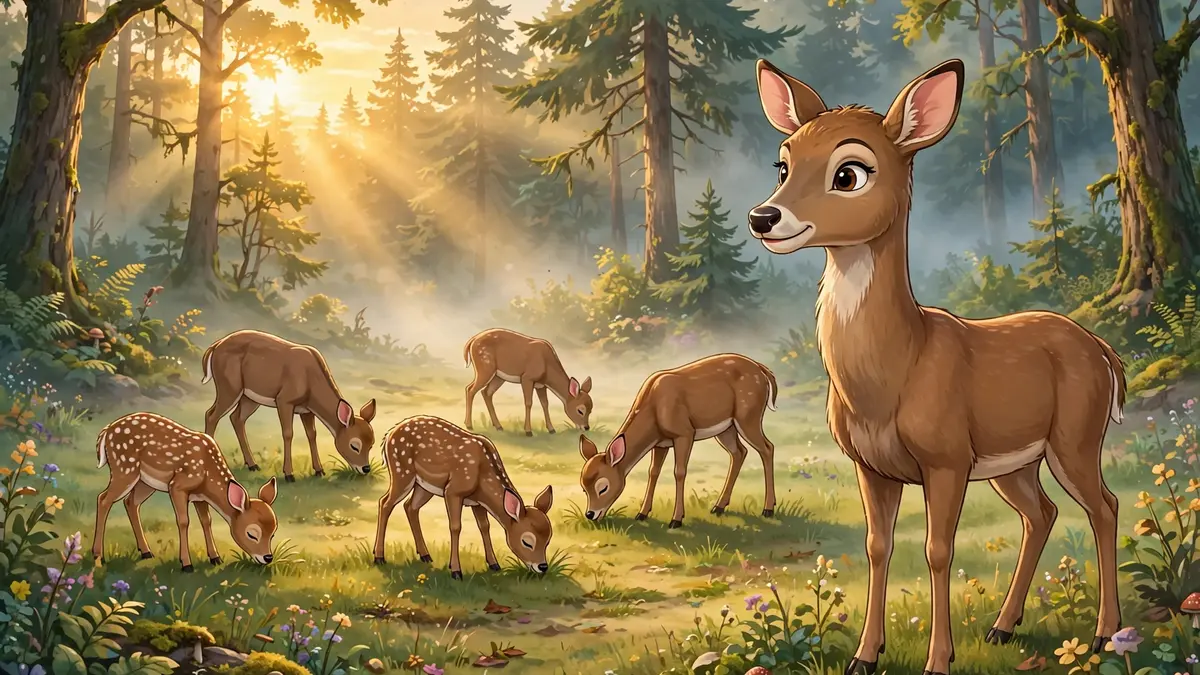
Some animals hurry through the year. Deer take the edges of the day, together: a whole herd drifting out of the treeline at dawn, the lead doe in front, last spring’s youngsters in the middle, and a row of spotted fawns bouncing at the back. They are the meadow’s neighbours — reading the whole forest with one swivel of an ear, growing a fresh crown of antlers every year, and raising their fawns in the tall grass where everybody watches. This collection gives you more than 200 original deer puns and one-liners, written fresh for this page and sorted by where you plan to use them.
Why do deer jokes land so well? Because deer life comes with a built-in audience: everyone has watched a fawn take its first wobbly bounce, heard that a buck sheds his whole crown and calmly grows a better one, or learned that the famous white tail is not decoration — it is a signal flag the whole herd reads. Once you see how the wordplay works in the next section, every joke below lands a little warmer.
⚡ Quick Answer: The funniest deer puns play on fawns and does, growing antlers and soft velvet, white tail flags and quiet forest meadows. Start with the Classic One-Liners below, try the Q&A jokes for quick laughs, and tap any Copy button to grab a line in one click.
The Science & Wordplay Behind Deer Humor
A deer is a hoofed grazer of forests and fields — and that is not storyteller talk. A big red deer stag can stand as tall at the shoulder as a kitchen counter and weigh about as much as two grown people, yet most of that outline is lean muscle and patience — under the coat sits a light-footed traveller built for crossing whole valleys before breakfast.
Start with the famous crown. Antlers are not horns. Horns stay for life, but a buck sheds his antlers every winter and grows a brand-new set each year, and the new set is often bigger than the last. Antler is among the fastest-growing bone tissue in the animal world — in a good summer a stag’s crown can grow an inch of new bone in a single day.
While they grow, antlers wear velvet — a soft, fuzzy skin full of tiny blood vessels that feeds the growing bone and keeps it safe. When the crown is finished, the velvet dries, and the deer rubs it off against young trees and shrubs, polishing the hard antler underneath in a few busy days of work.
The white-tailed deer’s party trick is its tail flag. When a deer spots something worrying, the tail goes straight up and the bright white underside flashes like a flag. It warns the whole herd at a glance — and when everyone runs, the bouncing white flags give the fawns a moving banner to follow through the trees.
A deer reads the world through its nose and ears. Its sense of smell can sort a walker’s scent from a thread of wind, its big ears swivel like two small satellites to catch the faintest snapped twig, and its wide-set eyes watch the edges of the world. Most visitors are announced long before they ever see a deer.
Spring turns the tall grass into a nursery. New fawns are born with white spots that break up their outline in dappled light, and a newborn fawn carries almost no scent at all. So the fawn’s whole first job is lying still: curled in the grass, nearly invisible, while its mother grazes close by and returns to feed it through the day.
Deer keep the hours of the in-between. They are crepuscular — most active at dawn and dusk, grazing the open meadows in the soft light, then resting in shade or cover through the middle of the day. The meadow’s rush hour is sunrise and suppertime, and the herd keeps that timetable better than any clock.
And do not let the gentle grazing fool you — deer are athletes. A white-tailed deer can clear a fence of about eight feet from a near standstill, bound some thirty feet in one leap, and swim strongly across rivers and lakes, helped by hollow hairs that add a little buoyancy. The meadow’s quietest resident is also its high-jump champion.
Now the wordplay engine — the sound pairs that power almost every deer joke:
Fawn — the baby deer, born spotted, nearly scentless, and a champion at lying still
Doe — the mother and guide of the herd, first to the good grass every morning
Buck — the male deer who grows, sheds, and regrows his crown on a yearly plan
Stag — the mature red deer male, the ridge’s wide-antlered elder
Antlers — the bony crown grown fresh each year and polished on young trees
Velvet — the soft living skin that feeds an antler while it is still growing
Herd — the deer family group: does, fawns, and youngsters travelling together
Hart — the old word for a stag, and a near-twin of “heart” in every poem
Meadow — the open grassland that serves as the herd’s dining room
Tail flag — the bright white alarm signal flashed for the whole herd to read
Graze — the slow meadow meal, a bite of grass at a time, ears always turning
Leap — the thirty-foot bound that turns fences into minor suggestions
Spots — the fawn’s white camouflage dots, fading as the young deer grows
Browse — the leaf-and-twig menu deer trim from shrubs and low branches
Crepuscular — the dawn-and-dusk schedule the whole herd keeps by heart
White tail — the famous flag itself, and the deer named after it
Keep those pairs in mind — nearly every line below is built on one of them.
The White-Tailed, the Mule, the Red: A Quick Meadow & Forest Guide
Every deer beginner started as a person standing at a fence, wondering which deer is which. Here is the friendly, honest guide:
The White-Tailed Deer — the classic deer of woods and fields. The most widespread deer in the Americas, named for the bright white underside of its tail, which flashes upright like a flag whenever the herd is alerted. White-tails are the garden-edge grazers, the fence-clearing leapers, and the deer behind nearly every true deer story you have ever heard.
The Mule Deer — the big-eared deer of the western hills. Named for its large, mule-like ears, this deer of dry hills and open country moves with a stiff-legged, all-four-hooves bounce called stotting. Mule deer are champion travellers of the high desert, following the seasons up and down the mountain slopes.
The Red Deer — the great stag of the old forests. One of the largest deer of all, the red deer stag carries a wide, many-pointed crown and fills autumn woods with a deep, carrying call. Red deer herds keep the does and youngsters together for most of the year, while the stags hold their own bachelor ground nearby.
The Reindeer — the northern deer where the mothers grow antlers too. Also called caribou, the reindeer is the one deer where females grow antlers alongside the males — and the does keep theirs through the winter. Built for snow and long migrations, reindeer herds walk some of the longest journeys of any land animal.
The Fawns — the nursery’s small professors. A newborn fawn weighs about as much as a house cat and spends its first days curled silent and scentless in the grass, visited by its mother for meals. By a few weeks old the whole nursery class is out bouncing at the meadow edge — practising leaps, testing wobbly legs, and learning every trail their mother knows.
Classic Deer One-Liners
These are the all-rounders — the lines that work anywhere deer show up: the forest trail, the family group chat, the wildlife park fence. They lean on the classic sound pairs from the science section, so they land even with people who have watched deer for years and have heard every lazy tail line twice. Keep a few in your pocket; the first morning round will give you a reason to use one within the hour.
Grandma checks the meadow before she checks the weather, because a doe standing calm at dawn already knows what kind of day it is.
The first fawn of the spring got its own announcement at the nature centre, and by lunch the whole walking group had drifted down to see it.
Grandpa claims the old stump at the meadow edge for his morning tea and calls it “the front row of the grazing show.”
A deer’s morning shift starts before the alarm clock has even thought about it — dew on the grass, ears up, breakfast in progress.
The buck by the orchard fence has a full crown’s worth of confidence and absolutely no schedule at all.
Our meadow runs on deer time: dawn means breakfast, noon means shade, and dusk means the whole herd comes home for supper.
The doe at the stream drinks like a queen inspecting her own reflection, one careful sip at a time.
Somebody counted eleven deer at the clearing last night, and the whole village is still talking about it like election results.
A fawn’s spots are the meadow’s best polka dots — fashion that also works as a hiding place.
The stag on the ridge poses for exactly one photograph per morning, and he has never once repeated a pose.
Trail rule at our forest: if a deer’s white tail goes up, everyone stops talking and starts watching.
The herd crosses the lane in single file, like it rehearses on Sundays.
My neighbour swears the big buck waves at him through the fence. The buck has not confirmed this, but he has not denied it either.
A deer leaping the fence makes it look like the fence was the one that needed practice.
The twin fawns behind the blackberry hedge have two settings: statue and spring.
Morning mist plus a quiet herd equals the softest picture the forest owns.
The doe stamps her foot once, and the whole meadow gets the message faster than any group chat.
Every deer in the herd knows which apple tree drops first, and the waiting list is strictly ears-first.
The old buck’s antlers carry a full season of stories, and he sheds every one of them to start the book fresh.
A deer at rest folds itself into the grass so neatly the meadow looks empty until one ear twitches.
The yearling practised his first little jumps all week and landed the big one on Saturday, to general applause from the fence.
Our dawn walks have one rule: the deer set the pace, and the deer are in no hurry at all.
The doe teaches her fawn the stream crossing like a driving lesson — slow, steady, and with snacks at the far side.
A white tail flashing through the trees is the forest’s way of saying “show’s over, folks” — politely.
The herd’s evening route passes the same three clearings in the same order, like a tour bus with better scenery.
Some deer collect meadows. The big stag in the north woods collects sunrises, and his gallery is full.
The fawn’s first snow produced forty photographs and one very patient mother.
A deer’s ears turn like two small satellites, and they pick up channels we will never hear.
The buck rubbed the velvet off his antlers against the young pine and walked away looking like he had won something.
Quiet feet, soft eyes, tall grass: the meadow’s whole management team arrives on four legs.
The does hold their morning meeting at the stream, and the agenda is always the same: grass, water, gossip.
When the whole herd lifts its heads at once, the meadow holds its breath with them.
Cute Deer Puns
“Cute” in deer country means warm: the lines you would write in a card for the person who keeps your mornings bright. These are sweet, gentle, and safe for anyone — pass them along with a shared thermos of cocoa, a saved seat on the bench, or a photo of the first fawn that simply has to be shared.
You are my favourite part of the morning round — even before the fawns show up.
I saved you the sunny side of the meadow bench, right where the doe brings her twins.
If home had a sound, it would be soft hooves on wet grass at dawn.
You make ordinary Tuesdays feel like the first day of spring in the clearing.
I like you more than a doe likes the first green shoots after a long winter.
Sending you a whole herd of good wishes, tails up and ears forward.
You are the calm in my meadow and the reason the walk takes twice as long.
May your day be as gentle as a fawn’s first steps.
I would share my last apple with you — and the deer at the fence would understand.
You light up the forest path better than sunrise through the pines.
Being near you feels like finding the quiet clearing nobody else knows about.
You are worth every early alarm the dawn chorus ever set.
My heart does the fawn wobble whenever you walk in — brand-new legs, zero control.
I saved the good seat, the warm drink, and the best deer story for you.
You are the velvet on my year — soft now, with something splendid growing underneath.
If I had one wish at the wishing stump, the herd already knows your name.
You make the long way home through the woods feel short.
I am keeping your spot by the fence warm, same as always.
You are the reason the meadow looks brighter in every photograph.
Stay close — the best part of the herd is the company.
You turn a plain field walk into a story I tell all week.
I would wait out the whole winter just for one spring morning with you.
Deer Q&A Jokes
Question-and-answer jokes are the easiest kind to perform: you ask, they guess, you land the punchline. This set is built for forest trails, meadow benches, and school wildlife trips, where one good Q&A starts a whole round of everyone trying their own. The lead doe, the fawn, and one very proud stag do most of the heavy lifting — and the first fourteen answers teach a real deer fact on the way to the laugh.
Q: What is a deer? A: A gentle hoofed mammal that grazes and browses in forests and meadows — famous for its leaping legs, swivelling ears, and, on the males, a crown of antlers regrown fresh every year.
Q: What is a baby deer called? A: A fawn. A newborn fawn is a small, spotted bundle that can stand within minutes and spends its first days lying still and hidden in the grass while its mother feeds nearby.
Q: What is a female deer called? A: A doe — and she is the herd’s teacher, leading her fawns to the best grazing, the safest water, and the quietest sleeping grass in the valley.
Q: What is a male deer called? A: A buck, or a stag for the big red deer males — and he is the one who grows the antlers, polishes them on young trees, and starts each autumn with a brand-new crown.
Q: What is a group of deer called? A: A herd. Herds are often family groups of does and young deer, while bucks may gather in small bachelor groups or wander on their own outside the autumn season.
Q: Why does a white-tailed deer raise its tail? A: The bright white underside flashes like a flag — an alarm signal that warns the whole herd, and a moving banner the fawns can follow when everyone runs for the trees.
Q: Are antlers the same as horns? A: No. Horns stay for life, but antlers are shed and regrown every single year — a buck drops last year’s crown in winter and grows a new, often bigger set by late summer.
Q: Which deer grow antlers? A: Almost always the males alone — with one famous exception: female reindeer, also called caribou, grow antlers too, and the does keep theirs through the winter.
Q: What is velvet on an antler? A: A soft, fuzzy skin full of tiny blood vessels that covers antlers while they grow — some of the fastest-growing tissue in the animal world. When the growing finishes, the deer rubs the velvet off against trees.
Q: How do deer know you are coming? A: Teamwork of the senses: a superb nose reads the wind, two big swivelling ears catch the faintest snap, and wide-set eyes watch the edges of the world — most walkers are announced long before they arrive.
Q: Why do fawns have spots? A: Camouflage. The white spots break up the fawn’s outline in dappled light, and a newborn fawn has almost no scent, so it can lie still and stay nearly invisible while its mother grazes close by.
Q: Can deer swim? A: Beautifully. Deer are strong, confident swimmers, helped by hollow hairs that add a little buoyancy, and they cross rivers and lakes without a second thought when the herd’s route calls for it.
Q: When are deer most active? A: At the edges of the day — dawn and dusk. Deer are crepuscular, so the meadow’s rush hour is sunrise and suppertime, with quiet grazing through the night and rest in the shade at noon.
Q: How high can a deer jump? A: A white-tailed deer can clear a fence of about eight feet from a near standstill and bound some thirty feet in a single leap — the meadow’s fences were never really more than a suggestion.
Q: What did the doe say to the sunrise? A: “You’re late to my morning round again — the herd started breakfast twelve minutes ago.”
Q: Why did the fawn stay close to the tall grass? A: That grass is a nursery, a blanket, and a hiding place in one — a fawn who naps well grows first and explores best.
Q: What did the buck say to the young pine? A: “Hold still — this velvet is coming off today, and you have the sturdiest bark on the ridge.”
Q: Why did the keeper count the herd twice? A: Standards. A meadow of this reputation does not settle for yesterday’s head count.
Q: What is a deer’s favourite meeting style? A: Short, standing, and held at the stream — with splashing provided and the minutes taken by whoever stamps last.
Q: Why do families love the dawn deer watch? A: It is the only news broadcast that also confirms the herd is up, the meadow is shining, and breakfast is officially a spectator sport.
Q: What did the fawn say on its first bright morning? A: “Big sky, tall trees, excellent grass — I accept this position.”
Q: Why did the stag visit the ridge at noon? A: A second look at the view never hurt anyone — the valley deserves inspection, and it deserves an audience.
Q: What is a herd’s busiest hour? A: Dusk — the last graze needs finishing, the fawns need counting, and every clearing has one last story from the stream.
Q: Why did the doe lead the fawns to the sunny slope? A: Leaping practice is a family tradition, and they teach it the way they were taught: bounce, land, look proud, repeat.
Q: What did the meadow say to the new wildflowers? A: “We have reviewed your colours and tested the lower beds for a week. You’re welcome.”
Q: Why do deer jokes always land? A: They arrive with a story from the far clearing, they are built on real mornings, and there is something in the herd for everybody.
Q: What did the deer say to the watcher on the platform? A: “Same time tomorrow — you bring the binoculars, I will bring the view.”
Q: Why does the herd go quiet at sunset? A: The evening head count has begun, and even the bounciest yearling respects a full family settling in for the night.
Deer Captions & Texts
Captions live or die in the first few words, so these stay short and warm. The Instagram set is written for photos and clips — morning meadows, proud stags, and fawns on parade — while the texting set works as quick replies and everyday updates you can send in seconds.
Deer Instagram Captions
Gate’s open, dew’s on, first photo goes to whoever spots the first fawn.
Meadow status: one doe, two fawns, and a patch of clover nobody can agree on.
This herd lineup required both a sunrise and a short pep talk with the lead doe.
Trail rule one: the person holding the camera names the first deer; the person holding the thermos names the second.
My morning route — porch, gate, clearing, lookout — has more planning in it than my weekend does.
Sun level: one slow afternoon, parked proudly in the tall grass all day.
This fawn photograph took all week to earn. Taken slowly, from a safe distance.
Nap day today: same meadow, fancier dreams.
Six fields of morning, finished in shades of green and gold.
Grandpa’s boots, Dad’s thermos, my gate turn: three generations of teamwork.
Some people collect stamps. I collect sunrise photos with a herd in them.
A tiny fawn for the nature log, a neat hoofprint for the trail notebook.
That first-graze quiet right after dawn says more than this caption can.
Porch light on, boots off, meadow glowing: Saturday, complete.
My wildflower haul reached the size nobody wanted to queue behind. Diplomacy, extended.
The rain moved in an hour after the last photo was taken. The meadow accepts the compliment and glistens.
One herd for this valley, one herd for the next. Spring, in chapters.
Notebook update: the big stag at the ridge remains poser of the month.
Deer-watching day. The viewing platform has never looked so popular.
The last hoofprint fit the mud like it was made for it — because the trail arranged it, twice.
Short Deer Texts to Send
Meadow is open in twenty. Your spot on the platform is saved and non-negotiable.
First fawn’s out. Repeat: first fawn’s out. The valley is receiving visitors again.
I saved your seat exactly your way — sunny end, best view, nothing written down.
Antler emergency: the big stag just polished his crown. The watching crew is being promoted.
Grandpa named the lead doe at dawn and saluted her out loud. It is a whole thing here.
First deer Saturday of the season is this weekend. This message is my entire personality until then.
Saved you the sunny side of the lookout. It comes with cocoa and the good blanket.
The shop by the crossroads stocks field socks in your size this year. We have plans now.
Rain check on the errands — forest day instead, same crew, warmer gloves.
Grandpa says the gate is open and the coffee is poured. Bring your appetite for pancakes at eight.
I watched your trail camera while you were away and only adopted one fawn emotionally.
Sending a photo instead of hoofprints because the mail is cruel. The print was enormous. You’re welcome, and I’m sorry.
Meadow & Forest Life Deer Puns
This is the section deer were born for: dew-heavy clearings at first light, single-file crossings at the lane, and the small rituals that turn a quiet field into the best-run meeting place in the wild. These lines come straight from meadow life, so they land with dawn walkers, forest regulars, and anyone who has ever been handed the binoculars like a baton.
The clearing’s seating chart is unwritten but strict: the lead doe grazes the front, the fawns have their own sunny corner, and the old buck’s shady spot under the oak never moves.
Deer share a secret language in the meadow: one ear flick means “all calm,” and one foot stamp means “everybody look up, now.”
The first good grazing morning of spring opens at the east gate, and noses start lifting at the edges of three fields.
Saturday at the clearing ends with a full-herd graze, every single time, like a parade route in reverse.
The neighbour who “never watches deer” has strong opinions about our lead doe and brings his own chair along to supervise.
A slow afternoon with a full meadow and nowhere to be is the richest feeling I know.
Forest life’s real schedule is not the clock — it is “first graze,” “stream hour,” and “who counts the hoofprints tonight.”
The smell of rain on warm grass is the valley’s reset button; two fields over, ears start turning by themselves.
There is a regular at our clearing who has said “I’ll just take one photo” for six seasons and has never once left with fewer than a dozen.
The hush of the dawn mist plus a whole line of soft shapes settling into view is the coziest sound-and-picture combination known to science.
Early risers get the quiet field; grazing deer get the golden hour — the best meadow photos belong to the morning light.
The porch light comes on, the last fawn ambles up the path, and the treeline becomes the warmest room in the forest — the one without walls.
Doe & Fawn Life Deer Puns
This is the deer’s front door: tall nursery grass at sunrise, patient mothers on the noon shift, and the bouncing ground where every fawn’s life starts. These lines are for families, teachers, and anyone whose own relatives could field a small, devoted, slightly spotty team.
The doe inspects three sleeping spots every evening like a captain with a clipboard, and the one she finally picks gets talked about all season.
Nursery rule at our meadow: the fawn stays hidden, the mother stays close, and the last one in fluffs the grass.
The old hollow log beside the nursery grass has not changed in years, but the welcome performed inside it runs all week long.
A cool morning beside a happy doe in full bounce-and-graze mode feels better than anywhere else on Earth — established science at our table.
A deer family’s group chat is a tail-flag message line: everybody sees the news, and the oldest doe replies first.
Grandma writes “nap still, drink deep, mind the fence line” on the season’s plan like it is a classified ingredient, and we respect the secrecy.
Does read a coming storm without a single window check, a magic trick performed with a lifetime of watching clouds.
The mid-morning fawn pile is a whole event at the nursery grass: one long stretch, one tiny bounce, and straight back to the warm side.
The voice from the front of the herd knows the valley so well that “the usual crossing, please” is now a full sentence here.
A family that sleeps in a ring, fawns in the middle and mothers on guard, beats most hotels that take reservations.
The spare clearing across the stream is not clutter — it is the reserve plan, and the lead doe’s first choice outranks it anyway.
Somewhere between the first blossom and the last long evening, every great meadow year earns one legendary golden morning.
Sarcastic & Clever Deer Puns
Not every meadow moment is golden. The sarcastic set is for the 5 a.m. grazing chorus at the fence, the rain that arrives the minute the tent is pitched, and the perfect clearing that hid one more field over — dry laughs aimed at situations, never at people, and always kind to the deer. The clever half follows with the facts and wordplay from the top of this page, bent into lines that make people say, “Okay, that one was good.”
Sarcastic Deer Puns
Oh sure, the herd respects weekends — said nobody whose tent faces the clearing at 5:04 on a Sunday, ever.
Wonderful: the rain arrived the very minute the walking tour finished its inspection round. Perfect timing, as always.
I love how the forecast called it “a clear week” while the meadow has filed for a swimming permit.
Yes, I bought the bigger field notebook. No, the pocket one did not feel sufficient as a recording system.
The lodge stay sold me a room facing one solid wall of dawn hoofprints for four mornings. One. The view is inspiring.
Somebody left the meadow gate open by exactly one fawn’s width. The investigation is ongoing; the suspect list is the entire neighbourhood.
The blackberry season closed the sunny bank again. I have moved my chair twice this spring, and now we are both just pretending this is exercise.
The guidebook calls it a “small clearing.” It is one mountain wearing green, but sure.
The old stag sat through the whole afternoon keeper talk and contributed more presence than the actual keeper did.
Sure, the good binoculars cost more — as if the cheap pair was going to outspot the dawn patrol out of pride by Saturday.
The fawns’ mud puddle took all morning to find and one proud splash to redecorate. Record discovery, terrible management.
No, I do not need a tidier cabin. I need a shorter winter, and that is not happening.
Clever Deer Puns
A line of hoofprints is a hundred small facts agreeing to travel in a row: same mud, one very determined arrangement.
Keeping a fawn hidden is applied patience — ten quiet minutes in the tall grass now, ten honest bounces in the open later.
A meadow photo is just editing you can feel: a whole season of grazing life, revised into one bright frame.
The stag is the valley’s full stop with an autumn debate — set him at the front of the herd, and every sentence of the field after it reads calm.
The herd writes in first dew, the stream asks for its visits on schedule, and the fawn was built for exactly the front row — because it was.
The treeline is the meadow’s punctuation: one long curve that tells every deer where the story goes.
The sun gave the morning, the rain gave the grass, and a quiet herd at rest is credited with the result — a truly local committee.
Antler, tail, hoofprint: the forest speaks three small signs of deer life, and every watching family is fluent.
The storms always pass eventually — usually one cloud at a time, starting the minute you praised the calm field.
The dawn graze is the herd’s polite signature: one slow pass of the meadow, and the whole sleepy valley reads easier behind it.
Every field is a texture argument — silky from the dawn mist, sturdy from the old oaks, glossy from the fresh rain — and the evening calm settles the debate.
Velvet is the year’s rough draft: soft, fast-growing, and rubbed away the moment the finished crown is ready to be read.
Deer Puns for Kids, School & Parties
Everything in this part of the page is clean, simple, and built for the toughest crowd there is: children. Teachers get classroom and wild-animal-unit lines, families get the party set, and the lead doe herself stays the star of every section — the jokes are for everybody.
Kid-Friendly Deer Puns
Why did the little fawn wear a tiny scarf to the meadow? Because the cold was coming close and the wind was almost ready.
Our class counted the hoofprints over the school fence and cheered like it was a sports final — there were twenty-three!
What do baby deer call their mum? The best guide in the whole forest — she finds the sweetest grass and tells the tallest tales.
I drew our valley as a row of green hills guarding the stream, and the teacher hung it by the classroom door.
Why did the deer bring a camera to the clearing? She heard the leaping was going to be bright and a little bit splashy.
Grandpa let me carry exactly four smooth pebbles to the picnic blanket, which makes me an official junior ranger of the meadow.
What is a fawn’s favourite school subject? Geography — it loves hearing how the forest was mapped in the old days.
The morning mist rolled off the meadow in one long white ribbon, and my little brother wore it as a scarf for exactly one photograph.
Why did the young deer join the school parade? Somebody had to lead the bouncing line, and it was already walking straight.
Our class built one paper stag so tall that Dad says it was clearly raised to wave at the real herd.
What do baby deer dream about? A sunny slope, a line of friendly apple trees, and bouncing in first thing on Saturday.
The tiniest deer drawing in the contest went to my stuffed toy fawn, who attends every field day and never complains.
Deer School Jokes
Our science teacher explained antlers with one shed crown and a piece of velvet cloth, and it remains the most-watched lesson of the year.
Wild-animal week at school runs on one habitat chart, two teachers, and forty very focused young trackers.
The school nature fundraiser sent the whole class to the spring meadow fair, proving painted flower pots raise money and morale.
My nature report covered deer from the first fawn to the last hoofprint, and the teacher asked for the antler section twice.
The spelling bee word was “meadow,” and half the class tried to sneak an extra “t” into “velvet.”
Snack math problem: if the meadow has twelve clearings and thirteen cousins coming for the fair, the answer is still “find one more clearing.”
The school fair’s longest line was at the name-the-fawn game, and the principal took the voting personally.
Our class spring vote ended in a tie between the stream walk and the leaf-model contest, and the deer won either way.
The school rule for field day is simple: the wildlife talk stays cheerful and complete, because the teacher can hear everything.
Geography quiz answer of the year: cool air from the north woods, bright sun from the south hills — the class’s favourite map ever.
The teacher’s cap says “chief tracker,” and on deer days the whole school salutes the meadow.
Our book club’s summer chapter ended with lemonade on the library steps and a vote to hold every meeting facing the fields.
Deer Party Puns
The deer-photo line at our meadow party had six aunts in a row and a queue that outlasted the birthday song.
A backyard campout with a borrowed speaker and unlimited lemonade beats a fancy venue every single time.
The host labeled every lemonade jar, and the cocoa jar needed a refill before the guests finished arriving.
Party rule: the birthday kid gets the first lookout spot and the last slice of berry cake, by law of the house.
The hang-your-own paper antler table ended with more admiring than hanging, and nobody filed a complaint.
Game night runs better with the porch string lights on under a clear sky; even the sore losers stay for one more deer story.
Our graduation campout served lemonade in jars with the year printed on them — drinkable diplomas, one guest called them.
The snack table’s meadow-shaped cake lasted eleven minutes, a new record the host is quietly proud of.
Costume party verdict: the toddler dressed as a tiny fawn with a paper-spot cape won before judging was even invented.
The farewell party’s gift was a framed meadow photo for the guest’s own wall, and it got more applause than the speech.
Sleepover law: the window gets checked twice during the scariest story, purely for the moonlit meadow.
Every guest left with a jar of the host’s homemade jam, still cool from the pantry at the first red light.
Knock-Knock Deer Jokes
Knock-knock jokes are the oldest trick in the book, and the deer was born for them — an animal who arrives at every cottage door, park gate, and fence line all year long was made for this game. Perform them at the gate, over text, or with a kid who will demand all twelve in a row. Fair warning: that kid will then invent a thirteenth.
Knock, knock. Who is there? Fawn. Fawn who? Fawn and games are over — the meadow tour starts right now!
Knock, knock. Who is there? Doe. Doe who? Doe-n’t keep me waiting — the clearing is shining and breakfast starts sharp!
Knock, knock. Who is there? Antler. Antler who? Antler you glad the herd saved you a seat — the dawn show is about to start!
Knock, knock. Who is there? Buck. Buck who? Buck-le up — the meadow trail is open and the fawns are already bouncing!
Knock, knock. Who is there? Herd. Herd who? Herd you the first time — you bring the binoculars, I will bring the view!
Knock, knock. Who is there? Velvet. Velvet who? Velvet be a great day — the new antlers are polished and the good clearings are free!
Knock, knock. Who is there? Stag. Stag who? Stag-gering news — the first fawn took its first steps this morning!
Knock, knock. Who is there? Tail. Tail who? Tail you what — the whole herd crossed the meadow before breakfast!
Knock, knock. Who is there? Meadow. Meadow who? Meadow been waiting all morning — the gate is open and the day is young!
Knock, knock. Who is there? Graze. Graze who? Graze expectations — breakfast was legendary and the line was short!
Knock, knock. Who is there? Spot. Spot who? Spot on — you found the fawns’ favourite hiding grass on the first try!
Knock, knock. Who is there? Leap. Leap who? Leap over and make room — the whole class wants a seat for the morning show!
Deer Terms & What Makes Them Funny
Deer talk comes with its own vocabulary — and half of it already sounds like a joke waiting to happen. Here is the cheat sheet:
Term
Quick Fact
Why It Is Funny
Fawn
A baby deer, born spotted and nearly scentless, hidden in grass while its mother feeds
A polka-dotted bundle with a nap schedule and legs it is still learning to drive
Doe
An adult female deer, the herd’s guide and the fawns’ teacher
The meadow’s headmistress: first to the good grass, last to leave the stream
Buck
An adult male deer, the antler-grower of the family
A gardener who grows his own crown every year and prunes it on the young pines
Stag
A mature male red deer, famous for his wide, branching antlers
The ridge’s retired champion — poses like the valley was named after him
Antlers
Bony headgear grown, shed, and regrown every year by male deer
The fastest-growing fashion in the forest: a new crown each season, no two alike
Velvet
The soft, blood-rich skin that covers and feeds a growing antler
A fuzzy overcoat the crown wears all spring, rubbed off the moment it is finished
Herd
A group of deer, usually does and youngsters grazing and travelling together
A small town where everybody is related and the lead doe runs the whole council
Tail Flag
The bright white underside of a white-tail’s tail, flashed upright as an alarm
The herd’s signal flag: raised once, and every fawn knows exactly where to run
Meadow
The open grassland where deer graze at dawn and dusk
The herd’s dining room — wall-to-wall grass, seating for the whole family
Spots
The white markings on a newborn fawn’s coat, fading as the young deer grows
Nature’s polka dots: camouflage you can also wear to a party
Deer Puns for Different Moments
The same pun can flop or fly depending on the moment you use it in. Here is a quick guide to matching the line to the occasion, with pointers to the right section of this page:
Forest-walk and wildlife-park posts and captions: this is where the Captions section earns its keep. A perfect morning meadow deserves a line like “Gate’s open, dew’s on, first photo goes to whoever spots the first fawn,” and the Meadow & Forest Life set covers the bigger scenes — dawn grazes, sunny clearings, and the stream crossing every herd treats like a front door.
Classroom wild-animal units: keep it clean, short, and proud. The Kids and School sets were built for teachers — habitat charts, wild-animal weeks, and spelling-bee warnings — and the Q&A jokes double as quiz material, since the first fourteen of them teach a real deer fact on the way to the punchline.
Birthday and meadow-party invites: the Kids, School & Parties section was written at the trailhead, not at a desk. Drop one line in the group chat when the park gate opens, save another for the dusk photograph of the herd lineup, and let the Party set handle the “best lookout spot in the whole field” debate.
Encouragement cards for patient growers: lead with the deer’s own lesson, not the paperwork. A buck grows a whole new crown one quiet day at a time, and the Cute set is full of lines that fit an exam week, a new job, or a long recovery — one steady line about the fawn that never hurried tells the reader exactly what kind of quiet confidence you are cheering for.
Thank-you notes for guides and hosts: the ranger who walked you to the platform, pointed out the lead doe, and sent you home with a warm story deserves more than a plain thanks. A Cute line about saving someone the sunny end of the bench makes a fine closer for a card, and it tells that ranger their whole system was noticed.
How to Deliver a Deer Pun
A good deer pun is like a good meadow morning: set up at first light, timed to the first graze, and never forced on a crew that is still lacing its boots. Three small rules from the ranger’s handbook will keep your timing straight and your audience grinning.
1. Match the pun to the setting
Deer puns land best in deer company. Drop one as the trail gate opens in the morning, when the first doe steps out of the treeline, or on the viewing platform as the lead doe brings the fawns out for the evening round. The setting does half the work, and the same line sounds twice as good with the sound of the stream in the air.
2. Keep it kind, keep it meadow-warm
The best deer jokes laugh at melting schedules, ambitious watching plans, and our own six-layer outfits — never at a person’s tracking skills, drawings, or snack luck. Every valley is the right valley on its own ridge. Aim for the laugh that makes the whole platform grin, not the one person squint.
3. Timing beats quantity
One well-timed “first fawn, full house” as the herd wakes up beats ten puns before the coffee is even poured. Say it, let it land, then pass the thermos. Meadow people understand this rule — it is why the best deer story gets told once, properly, over the evening lemonade.
Ethan Parker is the Lead Humor Strategist at Easy Puns, where he writes and fact-checks pun collections for readers of all ages. Every line on this page was written originally for Easy Puns — researched against top-ranking pages for topic coverage, then written from scratch so no joke is copied from anywhere. The deer facts above reflect widely shared wildlife knowledge — including why antlers are shed and regrown every year, how a fawn’s spots work as camouflage, and what the white tail flag really means — and the whole collection is kept family-friendly.
Deer Puns FAQs
What are the most popular deer puns?
The favourites grow from a few sound pairs: fawn, doe, buck, antler, velvet, and the white tail flag every dawn starts with. Fresh versions of each run through this page — start with the Classic One-Liners and pick your favourites for the caption, the card, and the meadow group chat.
What is a baby deer called?
A fawn. Fawns are born spotted and almost scentless, and spend their first days lying still and hidden in the tall grass while their mother grazes nearby. Within weeks they are bouncing at the meadow edge, learning the herd’s trails one wobbly leap at a time.
Are antlers the same as horns?
No — and the difference is the deer’s best trick. Horns are kept for life, but antlers are shed every winter and regrown through spring and summer under a soft skin called velvet, making them some of the fastest-growing bone in the animal world.
Why does a deer raise its white tail?
It is an alarm flag. The bright white underside flashes upright to warn the whole herd of something worrying, and when the deer run, those bouncing white flags give the fawns a clear banner to follow through the trees.
Are deer dangerous to people?
Deer are naturally shy wild animals that would much rather graze in peace than meet us, so the kind rule is the sensible one: watch from a respectful distance, never feed them, and never touch a fawn you find hidden in the grass — its mother is almost always close by, waiting for you to leave.
How can I write my own deer puns?
Start with a real meadow detail — the fawn that beat your alarm clock, the doe who inspects the clearing twice, the fresh crown polished exactly at dawn — then bend a matching everyday word toward it: a herd becomes a family council, and a hoofprint becomes a signature. Short, kind, and built on a true detail is the whole recipe.