🌿 2026 • GARDEN FENCE PUNS • 200+ ORIGINAL ONE-LINERS
Some garden features arrive in a pot and get moved around all summer. The fence never moves: it is dug in during one muddy spring weekend, painted in long patient strokes, and then it stands through storms, birthdays, and forty rose seasons, holding the whole garden together. It starts as a pile of posts and a string line, and somehow it becomes the reason the garden feels like a place of its own. This collection gives you more than 200 original garden fence puns and one-liners, written fresh for this page and sorted by exactly where you plan to use them.
For every use: fence-finishing captions, housewarming cards, classroom garden units, painting-day posts, and thank-you notes for the neighbor who shares your boundary.
For every age: kid-safe sections, sweet lines for garden crews, clever wordplay for grown-ups — the whole page is family-friendly.
With real fence know-how: a quick science and wordplay section up front, plus an honest guide to fence types, parts, and the care every line of pickets needs.
Curated by a human editor: every line below was written for Easy Puns — no copied lists, no filler.
Why do garden fence jokes land so well? Because a fence is a project with a built-in audience: everyone has leaned on a gate, waved through the pickets, or stood a little taller beside a freshly painted line. Once you see how the wordplay works in the next section, every joke below stands a little straighter.
⚡ Quick Answer: The funniest garden fence puns play on pickets and posts, panels and gates, boundaries and good neighbors — plus the garden ritual every fence line shares. Start with the Classic One-Liners below, try the Q&A jokes for quick laughs, and tap any Copy button to grab a line in one click.
The Science & Wordplay Behind Garden Fence Humor
A garden fence is a barrier with a welcome mat: a line of posts, rails, and boards built around a garden or yard to mark exactly where one garden ends and the rest of the world begins. It gives the people inside privacy, keeps children and pets safely in, and politely shows strays and rabbits where the visiting hours end.
Fences come in more styles than garden gates have hinges. The picket fence stands upright boards with pointed tops and small gaps you can wave through. The panel fence sets solid boards shoulder to shoulder for full privacy. Post-and-rail and split-rail fences run long rails between sturdy posts, chain-link weaves steel wire into diamonds, lattice criss-crosses thin strips, and woven willow hurdles bring a rustic, hand-made look.
Every fence is built from the same honest parts. Posts do the heavy work: they are set deep in the ground, often a third of their length below the surface, bedded in gravel or concrete and finished with a cap that sheds the rain. Horizontal rails join the posts, pickets or panels fill the spaces, a gravel board guards the bottom line, and the gate swings on hinges and closes with a latch.
A garden fence usually stands right on the boundary line, which makes it a two-household project. Neighbors commonly walk the line together first, agree on the style, and often share the cost — the old proverb says good fences make good neighbors, and gardeners who have split a paint bill in the spring sunshine tend to repeat it with a smile.
The materials decide the fence’s personality. Cedar naturally resists rot and insects, pressure-treated pine is infused with preservative, vinyl never needs painting, and composite and metal bring their own long, quiet service. Care is simple but steady: stain or paint shields the wood from sun and rain, post bases get checked at the ground line where rot starts, and loose boards get fixed before the wind finds them.
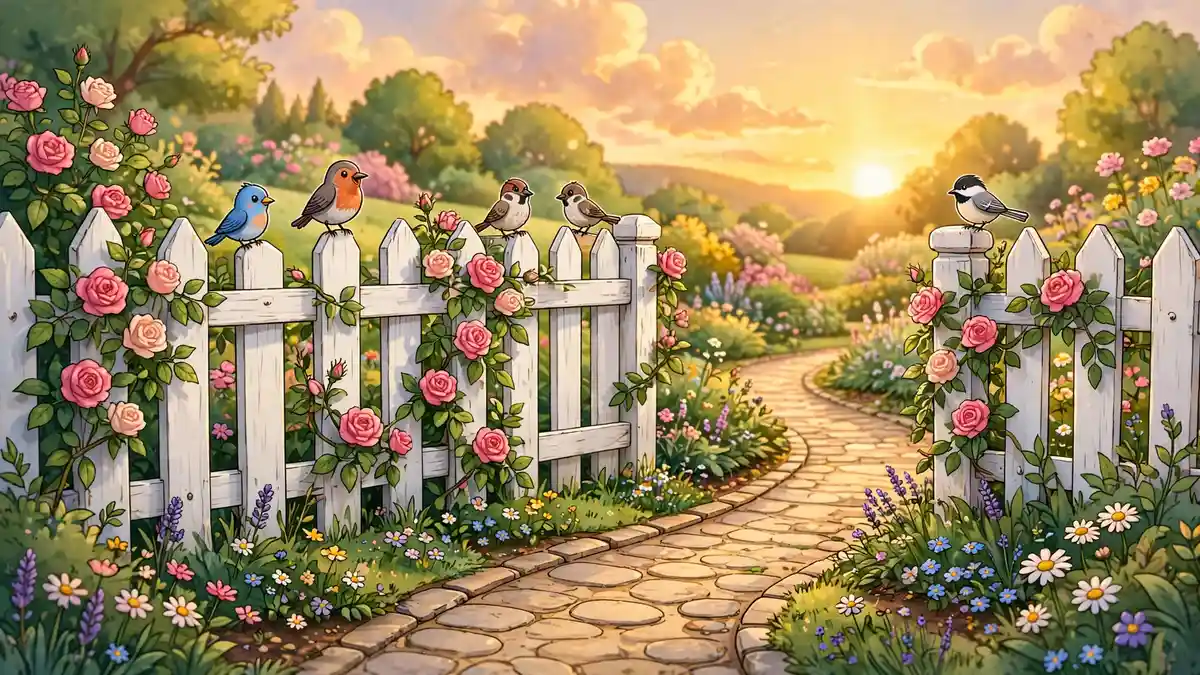
And a fence is never only a fence. Its rails and lattice are a ladder for climbing roses, clematis, and beans, giving the plants sunshine and the fence a coat of flowers. A solid line shelters young seedlings from hard wind, sparrows queue along the top rail, and the whole garden gains a room of its own — walls made of pickets and a ceiling of sky.
Now the wordplay engine — the sound pairs that power almost every garden fence joke:
Post — the upright timber holding the whole line true, and the letter-carrying cousin it shares a name with
Picket — one upright board in the row, and the sign a friendly protest carries down the street
Panel — one solid section between two posts, and the group of judges a garden show lines up
Gate — the swinging door in the fence, and every warm welcome that passes through it
Rail — the horizontal beam the pickets answer to, and the track a good story runs along
Board / bored — a single plank in the line, and the feeling a garden never allows for long
Hedge — the fence’s leafy next-door neighbor, and the careful answer a gardener gives a hard question
Stake — the peg that marks the line before digging, and everything a gardener has riding on the spring
Boundary — the line the fence stands on, and the one good manners draw at the same place
Private — what the panels promise the garden, and the quiet hour every gardener guards
Neighbor — the household on the other side of the line, and half the fence’s whole reason for standing
Latch — the little catch that clicks the gate shut, and the sound every homecoming ends with
Hinge — the joint the gate swings on, and the small thing big welcomes turn upon
Cedar — the red, rot-resistant wood of long fences, and the smell of every good lumber yard
Treat — what the pressure does to the pine, and what the painting crew earns at noon
Paling — the old name for a single fence picket, and what a long story does beside a fresh coat of paint
Keep those pairs in mind — nearly every line below is built on one of them.
Wood, Vinyl, or Wire? A Quick Garden Fence Types & Care Guide
Every fence beginner started as a person standing in a garden center aisle, wondering why one panel costs three times the next. Here is the friendly, honest guide:
The Classic Picket — the one all others are measured against. Upright boards, pointed tops, and friendly gaps you can wave through: the picket fence is the front garden’s handshake. It marks the line clearly without hiding the garden behind it, which is why cottage gardens have loved it for centuries. Give it a fresh coat every few springs and it will greet the street like new.
The Privacy Panel — the quiet giant. Solid boards standing shoulder to shoulder, sometimes with a lattice top for light and climbers. It blocks the wind, screens the view, and turns a back garden into an outdoor room where seedlings and sunbathers both relax. Choose it when the garden’s business should stay the garden’s business.
The Rustic Rail & Hurdle — the country cousin. Long rails slotted into sturdy posts, or panels of woven willow and hazel: these fences mark a boundary without closing the view. They suit big gardens, vegetable patches, and any line where the countryside should still be visible through the fence. Their charm is handmade, and a single damaged hurdle swaps out in minutes.
The Care Kit — the fence’s best friend. A brush, a tin of stain or paint, a handful of spare pickets, and oil for the latch: the four quiet items that decide whether a fence ages gracefully or gives up early. One spring walk with a screwdriver — checking post bases, tightening boards, oiling the gate — buys a whole year of standing straight. Gardeners who love their fences talk about the care kit the way cooks talk about a good knife roll.
Classic Garden Fence One-Liners
These are the all-rounders — the lines that work anywhere a fence shows up: the front garden, the painting Saturday, the family group chat. They lean on the classic sound pairs from the science section, so they land even with people who check post bases on a schedule and take their jokes the same way. Keep a few in your pocket; a sunny morning will give you a reason to use one within the hour.
Dad checks every post with a firm two-handed shake before he checks the weather, because a fence that wobbles in April is a fence that lies down in the first June storm.
The new pickets went up in a single Saturday, but Grandpa still tells the story like it was a barn raising that happened to have better snacks.
Our gate latch clicks with a sound the whole family knows by heart — two generations of children learned to come home to that click.
Mom paints the fence in long, patient strokes and says a straight run of white is the garden’s way of dressing up for the street.
The fence leans one inch further toward the roses every year, as if it wants a closer look at the blooms it has guarded all this time.
Uncle Ray set the corner post in a full bucket of concrete and declared it the most honest piece of engineering on the whole road.
A fence post stands in the same spot for twenty years and overhears every garden secret, yet it has never repeated a single one at the gate.
The neighbor’s dog inspects our fence daily at six, nose working along the gravel board, like a building inspector with a wagging tail.
Fresh stain on cedar smells like a lumber yard and a promise: this fence fully intends to outlast the mortgage.
The kids measured our fence in handprints — one coat of white paint, thirty small palms, and a height chart nobody had planned.
Our fence throws thin striped shadows across the lawn at four o’clock, and the cat naps in whichever stripe is warmest.
A loose picket rattles in the night wind like a loose tooth, and Dad is out with the screwdriver before it can worry the whole row.
The gate swings inward, always inward, because Grandma says a garden should open like an invitation, never like a push.
Sparrows line up along the top rail every morning, a small feathery audience waiting for the watering show to begin.
The fence around the vegetable patch is short, sturdy, and absolutely clear about rabbits: visits are by invitation only.
Grandpa dug every post hole by hand and named the rocks he hauled out, each one older than the house and twice as stubborn.
One panel of our fence is a slightly different shade of green — the souvenir of a paint sale and a family vote that ended in a tie.
The mailbox post and the fence post stand side by side at the corner, one delivering the news and the other keeping it private.
Rain darkens the cedar pickets to a deep red-brown, and for one wet evening the whole garden looks brand new again.
The garden gate wears a wreath in December and a hanging basket in May; it is easily the best-dressed door on the property.
My sister chalked a hopscotch court in the long shadow of the fence and declared the widest stripe to be home base.
The old fence at the bottom of the garden has a knot-hole at exactly eye height — the official window for watching the lane.
Posts first, rails second, pickets third: Dad’s building order turns out to be his advice for family arguments too, in the same sequence.
The climbing rose reached the top rail by June and kept right on going, like it had somewhere important to be before July.
A good fence hums in a high wind — one low note from the panels that tells you exactly which corner to check in the morning.
The spare pickets lean in the shed like understudies, ready to step into the line the day one of the regulars gives up.
Our fence ends exactly where the old hedge begins, and the two of them have shared the boundary peacefully for thirty years.
The latch on the side gate froze twice last winter; one drop of oil and a warm glove fixed what a week of complaints could not.
Dad reads the fence line the way other people read the morning newspaper — one slow walk, coffee in hand, checking for news.
The new-fence smell of fresh cedar and wet concrete lasted exactly one week, and the whole street noticed the day it was gone.
Every fence on our road leans a little toward the garden it protects — or so the gardeners keep assuring the neighbors.
Home is wherever the gate latch clicks behind you and the garden goes quiet on the other side.
Cute Garden Fence Puns
“Cute” in fence country means warm: the lines you would write in a card for the person who keeps your garden — and your springs — bright. These are sweet, gentle, and safe for anyone — pass them along with a jar of jam, a potted rose, or the good seat on the gate bench.
You are the person I save the gate-side bench for, right where the roses lean over the rail — the best seat outside the house.
Grandpa carved a small heart into the top of the gate post the spring he married Grandma, and forty summers of weather have only made it clearer.
My best friend knows our gate routine by heart — push, lift, click — which is basically a love language in fences.
Dad paints one picket a shade brighter every spring, “the one the grandchildren look for,” and then pretends it was an accident with the brush.
There is a flat stone beside our gate worn smooth by forty years of visitors pausing there to unlatch it and say hello first.
The cat supervises the whole garden from the middle fence post all summer, certain the boundary was built as her personal lookout.
Mom writes “fence painting day” on the calendar in her best handwriting, with a tiny picket fence drawn beside it.
You remembered the gate swings inward, not out, after hearing it exactly once last spring.
A shared paintbrush passed hand to hand down the fence line says everything a long speech would, only whiter.
Grandma still holds the lantern while Grandpa checks the latch on dark evenings — a two-person tradition from 1982 that they refuse to update.
Our first garden had a fence of bent saplings and string, and we guarded it like it was the wall of a small and beloved castle.
Holding the level steady while someone you love sets a post is the proudest job on the whole fence line.
Our neighbor leaves a jar of her strawberry jam on the gate post every June with a note: “For the crew that keeps both gardens smiling.”
My son lined up his toy fences by height and announced that boundaries, like families, stand tallest together.
You closed the gate gently behind my sleeping toddler without being asked, in your good shoes, and that is the whole story of us.
Sunday evenings at the garden gate always end the same way: one last look down the straight white row, and nobody in a hurry to go in.
My daughter insists the gaps between the pickets are windows the garden looks out of, and she waves at it every single morning.
My daughter paints her toy fence “exactly like Dad’s pickets,” then quietly adds one purple board “for the fairies’ side.”
A fence painted by someone who knows your garden stands straighter. This is not opinion; it is family law.
The string lights along the top rail, the smell of fresh stain, and you on the gate bench: that is the whole recipe for our favorite evening.
My best friend trades me her Saturday painting shift for my Sunday planting shift every spring, and neither of us mentions it.
Home is wherever somebody has already fixed the gate because they knew you were coming to visit.
Garden Fence Q&A Jokes
Question-and-answer jokes are the easiest kind to perform: you ask, they guess, you land the punchline. This set is built for garden gates, painting days, and hardware-store aisles, where one good Q&A usually starts a whole round of everyone trying their own. The corner post, the string line, and one very patient fence do most of the heavy lifting.
Q: What is a garden fence for? A: It marks the edge of a garden or yard, adds privacy, shelters plants from wind, and gives climbers something to hold — a boundary with a day job.
Q: What is a picket fence? A: A fence of upright boards called pickets, usually with pointed tops and small gaps between them — the classic front-garden look that says hello without saying much.
Q: What is the difference between a picket fence and a privacy fence? A: Pickets leave gaps you can chat through; solid panels stand shoulder to shoulder and keep the garden’s business the garden’s business.
Q: What holds a fence up? A: The posts. They are set deep in the ground, often in gravel or concrete, and every rail, picket, and panel answers to them.
Q: What is a gravel board? A: The board that runs along the bottom of a wooden fence, touching the ground so the boards above it stay dry and last longer.
Q: Why do fence posts rot at the bottom first? A: The ground line is where wood stays wettest the longest, so careful owners check the base of every post each spring and catch the trouble early.
Q: What is a post cap for? A: It sits on top of the post like a little hat, shedding rain away from the end grain — the cheapest insurance a fence can wear.
Q: How is cedar different from pressure-treated pine? A: Cedar naturally resists rot and insects, while treated pine is infused with preservative under pressure. Both make sound fences when they are cared for.
Q: Why do people stain or paint a wooden fence? A: The finish shields the wood from sun and rain, slows the graying and the rot, and — if you ask the painters — gives the whole street something to admire.
Q: What does a gate need to work well? A: Two honest hinges, a latch that clicks, and a post that stands straight — a gate is only ever as good as the post it hangs from.
Q: What is a post-and-rail fence? A: Long horizontal rails slotted into sturdy posts, with no pickets at all — a wide-open boundary that marks the line without hiding the view.
Q: What is chain-link fencing? A: Woven steel wire in a diamond pattern — plain, tough, and nearly see-through, which is why gardens dress it up with climbing beans.
Q: What is a willow hurdle? A: A woven panel of willow or hazel rods, light and rustic — the fence equivalent of a hand-knitted sweater for the vegetable patch.
Q: Why do climbing plants love fences? A: Rails and lattice give roses, clematis, and beans a ladder into the sunshine — the plant gets the light, and the fence gets the flowers.
Q: What did the gate say to the latch? A: “Stick with me, and every homecoming on this street will end with a satisfying click.”
Q: Why did the fence win an award? A: Straightest posts, truest rails, not a picket out of line — the judges said it was built like it meant it.
Q: Why do neighbors talk before building a fence? A: The fence usually stands on the shared boundary line, so a friendly chat first can split the cost — and keep both gardens smiling at the same fence.
Q: How can you tell a fence post is loose without any tools? A: Give it a gentle push at the top. A sound post answers with a firm no; a tired one wobbles and quietly asks for help.
Q: What is lattice on a fence? A: A criss-cross panel, often added on top of a solid fence for extra height — pretty to look at, and a ready-made ladder for climbing roses.
Q: Why does the fence get painted in spring? A: Dry wood drinks the finish best, and spring gives the whole street a front-row seat for the garden’s annual makeover.
Q: What did the picket say to the rail? A: “You hold me up, and I will hold the line — that has always been the arrangement on this boundary.”
Q: Why is vinyl fencing popular? A: It never needs painting and washes clean with a hose — the low-effort neighbor of the fence world, and entirely proud of it.
Q: How deep should a fence post go? A: Deep enough that the ground holds it like it means it — builders commonly set about a third of the post below ground, and deeper where winters freeze hard.
Q: Why do picket fences have gaps between the boards? A: Wind slips through instead of pushing, neighbors can wave through them, and the garden keeps a little mystery without going fully private.
Q: What happens if you skip the gravel under a post? A: Water sits at the base and stays for dinner — drainage gravel lets it leave, which is why posts bedded on gravel outlast the others.
Q: Why did the climbing rose choose our fence? A: South-facing rails, patient gardeners, and a whole summer of sunshine — the rose read the reviews and moved in.
Q: What is the fence’s busiest season? A: Spring — new posts, fresh stain, one gate to re-hang, and every neighbor suddenly an expert on straight lines.
Q: Why do garden fence jokes always land? A: They arrive with a story from the garden, they are built on real Saturday work, and there is something along the line for everybody.
Garden Fence Captions & Texts
Captions live or die in the first few words, so these stay short and warm. The Instagram set is written for photos and clips — white pickets in the sun, straight painted lines, and gates at golden hour — while the texting set works as quick replies and everyday updates you can send in seconds.
Garden Fence Instagram Captions
Posts are in, rails are true, first photo goes to whoever brought the lemonade.
Fence status: one more straight panel than last spring.
This paint job required both hands and a short pep talk with the corner post.
Garden rule one: the person holding the brush sets the pace; the person holding the hose sets the breaks.
My boundary route — dig, set, level, paint — has more planning in it than my weekend does.
Paint level: one white picket, worn proudly on my jeans all day.
The rings in this post took thirty years to grow. Reading them slowly before we set it.
Vinyl today: same straight line, zero painting — the fence practically poses itself.
Six feet of spring, finished in sections of eight.
Grandpa’s line, Dad’s level, my painting turn: three generations of teamwork.
Some people collect stamps. I collect perfectly straight fence lines.
A shower of sawdust for the big posts, gentle hands for the new gate.
That first-click-of-the-latch quiet says more than this caption can.
String lights on, fence painted, garden glowing: Saturday, complete.
My gate reached the rose nobody wanted to prune around. Diplomacy, extended.
Rain moved in an hour after the last coat dried. The fence accepts the compliment and stays white.
One panel for this garden, one for the view. Building in chapters.
Gate update: the new latch remains employee of the month.
New post day. The whole street has never looked so popular.
The last picket fit the line like it was made for it — because it was measured for it, twice.
Short Garden Fence Texts to Send
Fence is painted in twenty. Your seat on the gate bench is saved and non-negotiable.
Gate’s fixed. Repeat: gate’s fixed. The garden is receiving visitors again.
I set yours exactly your line’s way — posts straight, ends even, nothing written down.
Picket emergency: we are out of spare boards. The shed pile is being promoted.
Dad leveled the corner post in April and apologized to it out loud. It is a whole thing here.
First fence-painting Saturday of spring is this weekend. This message is my entire personality until then.
Saved you the sunny painting side. It comes with iced tea and the good brush.
The hardware store on Fifth stocks cedar pickets in your size. We have plans now.
Rain check on the hike — garden weekend instead, same crew, warmer porch.
Grandpa says the fence is straight and the rows are painted. Bring your appetite for pie in June.
I fixed your gate while you were away and only admired the garden a little bit.
Sending a photo instead of a rose cutting because the mail is cruel. It was perfect. You’re welcome, and I’m sorry.
Neighbor & Boundary Life Garden Fence Puns
This is the section boundary people were born for: first hellos over the panels, shared paint bills, and the small ceremonies that turn a line on a map into the friendliest address on the street. These lines come straight from boundary life, so they land with neighbors, painters, and anyone who has ever been handed the level like a baton.
The boundary seating chart is unwritten but strict: the owners chat at the gate, the kids wave through the pickets, and Grandpa’s corner post never moves.
Fence neighbors share a secret language: one raised eyebrow over the panels means “storm coming,” and two means “bring the ladder, a picket is loose.”
The first hello over a brand-new fence carries down the whole street, and porch chairs start unfolding on their own two houses down.
Saturday fence work at our place ends at the gate, every single time, like a parade route in reverse.
The neighbor who “never notices fences” has strong opinions about our paint color and brings his own chair along to supervise.
A slow morning with a full repair list and nowhere to be is the richest feeling I know.
Boundary life’s real schedule is not the clock — it is “first post,” “paint break,” and “who hangs the gate.”
The smell of fresh stain from our yard is the street’s dinner bell; two fences down, lemonade appears on a porch rail as if by magic.
There is a regular on our street who has said “I’ll just hold the level a minute” for six springs and has never once stayed out of the painting line.
Rain tapping on the porch roof plus a straight new fence in view is the coziest sound-and-picture combination known to science.
Early risers get the dawn shift; fence crews get golden hour — the picket line belongs to the evening light.
The string lights go on, the last picket gets its coat, and the yard becomes the warmest room on the street — the one without walls.
Garden & Gate Life Garden Fence Puns
This is the fence’s evening life: rose arches, gate benches, and long light where the line by the flower beds earns its keep one hello at a time. These lines are for garden hosts, gate-leaners, and anyone whose family map is really just a list of beloved gardens.
The garden gate keeps the climbing rose trained over its arch, and the first bloom of June is when it starts its real job.
Gate rule at our place: the person who built the fence opens for guests, and the person who painted it chooses the music.
The old bench by the fence has not moved in years, but the flower border in front of it performs all summer long.
A garden evening feels better inside a good fence than anywhere else on Earth — established science at our table.
The lemonade somehow gets colder the hotter the day is, while the paint line gets shorter on the walk back. Nobody knows why.
Gardens write “cedar, six feet, lattice top” on the spring plan like it is a classified ingredient, and we respect the secrecy.
Grandpa oils the gate latch without looking up from his paper, a magic trick performed with two fingers and forty years of practice.
Our family’s map of the county is just a list of gardens with good gates, connected by lanes and strong opinions about rose varieties.
The voice from our kitchen door knows the garden order so well that “the usual Saturday, please” is now a full sentence here.
A mug of tea drunk on the gate bench, boots resting against the gravel board, beats most cafés that take reservations.
The fence’s spare picket stack by the shed is not clutter — it is the reserve team, and it gets full respect.
Somewhere between the first post hole and the last coat of paint, every great spring earns one legendary fence day.
Sarcastic & Clever Garden Fence Puns
Not every fence moment is golden. The sarcastic set is for the leaning post, the sudden storm, and the gate that swelled shut in the rain — dry laughs aimed at situations, never at people. The clever half follows with the facts and wordplay from the top of this page, bent into lines that make people say, “Okay, that one was good.”
Sarcastic Garden Fence Puns
Oh sure, the fence is perfectly straight — said nobody who has sighted down our back line with one eye closed, ever.
Wonderful: the storm arrived the very night the new panels went up unbraced. Perfect timing, as always.
I love how the builder called the fence finished while the gate still waves hello at every passing breeze.
Yes, I bought the taller panels. No, the standard height did not feel sufficient as a privacy system.
The hardware store sold me one post cap for a whole run of posts. One. The confidence is inspiring.
Somebody painted the panels gate-side in again. The investigation is ongoing; the suspect list is everyone.
Leaning post again. I pushed it straight twice this spring, and now we are both just pretending this is fine.
The tag calls it a “decorative” fence. It is three pickets wearing a fancy name, but sure.
My fence attended the whole neighborhood meeting and contributed more boundary than the agenda did.
Sure, the cedar costs more — as if the cheap pine was going to straighten itself out of pride by Friday.
The fence took all weekend to build and one determined toddler to find the single loose picket. Record speed, terrible supervision.
No, I do not need a taller fence. I need a shorter street, and that is not happening.
Clever Garden Fence Puns
A fence is a hundred small boards agreeing to stand in a line: same posts, one very determined arrangement.
Leveling is applied patience — ten quiet minutes with the string line now, ten years of straight later.
Painting is just editing you can see from the street: a whole boundary, revised in long white paragraphs.
The post is the fence’s full stop — set it true, and every sentence of pickets after it reads straight.
Cedar resists in decades, pine asks for its stain on schedule, and the gravel board was built for exactly the ground line — because it was.
The string line is the build’s punctuation: one tight thread that tells every post where the story goes.
The garden gave the roses, the spring gave the Saturdays, and a well-set corner post is credited with the result — a truly local committee.
Dig, set, level: the fence speaks three small verbs of spring, and every gardening family is fluent.
The gate is the unsung furniture of the whole operation — it holds the hellos, the goodbyes, and most of the meetings.
The paint drips always catch up eventually — usually on your best shoes, one minute after you finished the last panel.
The latch is the fence’s polite full stop: one small click, and the whole garden walks easier behind it.
Every post is a texture argument — smooth from the plane, rough from the bark side, gray from the weather — and the straight string line settles the debate.
Garden Fence Jokes for Kids, School & Parties
Everything in this part of the page is clean, simple, and built for the toughest crowd there is: children. Teachers get classroom and garden-day lines, families get the party set, and the fence itself stays the star of every section — the jokes are for everybody.
Kid-Friendly Garden Fence Jokes
Why did the little picket wear a sun hat to the garden? Because June was coming close and the line was almost painted.
Our class counted the pickets along the school garden fence and cheered like it was a sports final — there were sixty-four!
What do baby fences call their dad? Pop — he works at the corner post and tells the tallest tales.
I drew our garden fence as a row of white soldiers guarding the roses, and the teacher hung it by the classroom door.
Why did the gate bring sunglasses to painting day? It heard the afternoon was going to be bright and a little bit drippy.
Grandpa let me carry exactly four spare screws to the gate, which makes me an official junior builder of the house.
What is a fence’s favorite school subject? History — it loves hearing how gardens were guarded in the old days.
The paint dripped off one picket in a single long ribbon, and my little brother wore it on his sleeve like a medal.
Why did the fence join the school parade? Somebody had to lead the garden line, and it was already perfectly straight.
Our class grew one sunflower so tall that Dad says it was clearly raised to see over the fence.
What do fences dream about? A sunny spring, a row of friendly gardens, and being painted first thing on Saturday.
The tiniest flower in the border went to my stuffed bear, who sits by the gate every painting day and never complains.
Garden Fence School Jokes
Our science teacher explained climbing plants with one rose on the school fence, and it remains the best-smelling lesson of the year.
Spring fair day at school runs on one fence-painting booth, two teachers, and forty very focused young gardeners.
The school garden fundraiser sent the whole class to the autumn farm trip, proving painted pickets raise money and morale.
My nature report covered the garden fence from the corner post to the latch, and the teacher asked for the cedar section twice.
The spelling bee word was “picket,” and half the class tried to sneak an extra “t” into “lattice.”
Snack math problem: if the garden fence has twelve panels and thirteen cousins coming for the fair, the answer is still “paint one more panel.”
The school fair’s longest line was at the guess-the-pickets game, and the principal took the counting personally.
Our class spring vote ended in a tie between the garden walk and the greenhouse visit, and the fence won either way.
The school workshop has one rule: the safety talk stays cheerful and complete, because the teacher can hear everything.
Geography quiz answer of the year: the cedar from the coast, the roses from the south bed — the class’s favorite map ever.
The teacher’s apron says “chief gardener,” and on planting day the whole school salutes the fence line.
Our book club’s spring chapter ended with lemonade by the school fence and a vote to hold every meeting outdoors.
Garden Fence Party Jokes
The fence-photo line at our garden party had six aunts in a row and a queue that outlasted the birthday song.
A backyard garden party with a borrowed speaker and unlimited lemonade beats a fancy venue every single time.
The host labeled every lemonade jar, and the mint jar needed a refill before the guests finished arriving.
Party rule: the birthday kid gets the first seat on the gate bench and the last slice of strawberry cake, by law of the house.
The hang-your-own flower basket table ended with more admiring than hanging, and nobody filed a complaint.
Game night runs better with the string lights on the fence lit; even the sore losers stay for one more garden story.
Our graduation garden party served lemonade in jars with the year printed on them — drinkable diplomas, one guest called them.
The snack table’s fence-shaped cake lasted eleven minutes, a new record the host is quietly proud of.
Costume party verdict: the toddler dressed as a tiny gardener with a watering can won before judging was even invented.
The farewell party’s gift was a potted rose for the guest’s own fence, and it got more applause than the speech.
Sleepover law: the gate gets checked twice during the scariest story, purely for courage.
Every guest left with a jar of the host’s homemade jam, still cool from the pantry at the first red light.
Knock-Knock Garden Fence Jokes
Knock-knock jokes are the oldest trick in the book, and the garden fence was born for them — a line that greets visitors at gates, garden doors, and picket corners all spring long was made for this game. Perform them at the gate, over text, or with a kid who will demand all twelve in a row. Fair warning: that kid will then invent a thirteenth.
Knock, knock. Who is there? Picket. Picket who? Picket up and bring it inside — the garden crew brought the whole spring with them!
Knock, knock. Who is there? Latch. Latch who? Latch the gate and come in — the lemonade is poured and the roses are showing off!
Knock, knock. Who is there? Post. Post who? Post the photo later — first come and see the new fence in person!
Knock, knock. Who is there? Panel. Panel who? Panel of judges at the gate — and your garden just scored a perfect spring!
Knock, knock. Who is there? Hinge. Hinge who? Hinge-ing on you to open up — the gate crew brought cake!
Knock, knock. Who is there? Rail. Rail who? Rail be right here with the spare pickets — Saturday crew, reporting for duty!
Knock, knock. Who is there? Gate. Gate who? Gate a move on — the garden party starts when this gate opens!
Knock, knock. Who is there? Stain. Stain who? Stain right here is not an option — the garden is calling and the gate is open!
Knock, knock. Who is there? Willow. Willow who? Willow you open the gate — the whole fence crew is here with lemonade!
Knock, knock. Who is there? Board. Board who? Board of directors at the gate — the fence company has arrived for the spring inspection!
Knock, knock. Who is there? Vine. Vine who? Vine not come in — the roses are blooming and your bench by the fence is saved!
Knock, knock. Who is there? Cap. Cap who? Cap off a perfect day — the fence is finished and the gate swings like a dream!
Garden Fence Terms & What Makes Them Funny
Fence talk comes with its own vocabulary — and half of it already sounds like a joke waiting to happen. Here is the cheat sheet:
Term
Quick Fact
Why It Is Funny
Post
The upright timber set deep in the ground that every rail and picket answers to
The fence’s longest-serving employee — same corner, same shift, twenty years
Picket
One upright board in the row, often with a pointed top and a small gap beside it
A soldier in a white uniform who has never once missed a parade
Panel
A solid section of boards fixed between two posts, built for privacy
The garden’s way of closing the curtains without ever raising its voice
Rail
The long horizontal beam that joins the posts and carries the pickets
The backbone of the whole line — quiet, straight, and never thanked at parties
Gate
The hinged, swinging section of fence that lets people in and out
The only part of the fence with a social life
Latch
The small catch that clicks the gate shut and keeps it shut
The click every homecoming ends with — the fence’s full stop
Gravel board
The board along the bottom of the fence that touches the ground to protect the boards above
The front-line volunteer who takes the wet shift so the others stay dry
Cap
The small cover fitted on top of a post to shed rain off the end grain
A tiny hat doing the biggest waterproofing job on the whole street
Stain
The tinted finish brushed onto wood to shield it from sun and rain
Sunscreen and a wardrobe refresh in one tin, applied with great opinions
Boundary
The legal line between two properties that the fence usually stands on
The one line both neighbors guard, paint, and tell stories about
Garden Fence Puns for Different Moments
The same pun can flop or fly depending on the moment you use it in. Here is a quick guide to matching the line to the occasion, with pointers to the right section of this page:
Fence-finishing posts and captions: this is where the Captions section earns its keep. A freshly painted line deserves a line like “Posts are in, rails are true, first photo goes to whoever brought the lemonade,” and the Neighbor & Boundary Life set covers the bigger scenes — first hellos, shared paint bills, and the gate that always gets hung before dark.
New-home and housewarming cards: lead with the home, not the hardware. The Party set was written for garden parties, new-home weekends, and fence-warming afternoons — one line in the card tells the new owners exactly what kind of street they have moved to, and card writers can borrow straight from the Texts set.
Classroom garden units: keep it clean, short, and proud. The Kids and School sets were built for teachers — climbing-plant lessons, spring fairs, and spelling-bee warnings — and the Q&A jokes double as quiz material, since half of them teach a real fence fact on the way to the punchline.
Fence-repair and painting days: the Neighbor & Boundary Life section was written at the fence line, not at a desk. Drop one line while the stain is being brushed, save another for the dusk photograph of the finished line, and let the Classic set handle the “straightest fence on the whole street” debate.
Thank-you notes for fence-sharing neighbors: the household that gave up their Saturday, held the level, and split the paint bill on a shared boundary deserves more than a plain thanks. A Cute line about the strawberry jam left on the gate post makes a fine closer for a card, and it tells that neighbor their whole system was noticed.
How to Deliver a Garden Fence Pun
A good garden fence pun is like a good fence day: prepared in daylight, timed to the moment, and never forced on a crew that is still holding a post upright. Three small rules from the fence-line handbook will keep your timing straight and your audience grinning.
1. Match the pun to the work
Garden fence puns land best in fence company. Drop one as the brush comes out in the morning, when the first post of the season stands straight against the string line, or when the latch clicks on the finished gate. The setting does half the work, and the same line sounds twice as good with the smell of fresh cedar in the air.
2. Keep it kind, keep it garden-warm
The best garden fence jokes laugh at leaning posts, swollen gates, and our own six-foot ambitions — never at a person’s fence, painting style, or budget. Everyone’s line is the right line at their own garden. Aim for the laugh that makes both sides of the boundary grin, not the one side wince.
3. Timing beats quantity
One well-timed “straight as a string line” as the last post settles beats ten puns before the paint has even been opened. Say it, let it land, then pass the lemonade. Fence people understand this rule — it is why the best painting-day story gets told once, properly, over the evening tea.
Ethan Parker is the Lead Humor Strategist at Easy Puns, where he writes and fact-checks pun collections for readers of all ages. Every line on this page was written originally for Easy Puns — researched against top-ranking pages for topic coverage, then written from scratch so no joke is copied from anywhere. The garden fence facts above reflect widely shared gardening and fence-building knowledge — including the post care, boundary etiquette, and neighbor habits real fence crews swear by — and the whole collection is kept family-friendly.
Garden Fence Puns FAQs
What are the most popular garden fence puns?
The favorites grow from a few sound pairs: posts and pickets, panels and gates, rails and latches, plus the boundary line two gardens share. Fresh versions of each run through this page — start with the Classic One-Liners and pick your favorites for the caption, the card, and the housewarming note.
What is the difference between a picket fence and a privacy fence?
A picket fence stands upright boards with pointed tops and small gaps between them, so neighbors can wave through and wind slips past. A privacy fence sets solid panels shoulder to shoulder with no gaps at all, screening the view and sheltering the garden. Pickets say hello; panels keep the garden’s business private.
How long does a wooden garden fence last?
A well-built wooden fence that is cared for can serve a garden for many years, and the care matters more than the timber. Cedar and pressure-treated pine stand up best, post bases get checked at the ground line every spring, and a fresh coat of stain or paint every few years keeps sun and rain from doing their slow work.
Why do fence posts rot at ground level first?
The ground line is where a post stays wet the longest: rain soaks in from above, soil holds moisture against the wood below, and the middle never fully dries. That is why builders bed posts in drainage gravel, fit caps to shed rain off the top, and why the gravel board takes the wet shift at the bottom.
Should neighbors split the cost of a boundary fence?
Very often, yes — a garden fence usually stands right on the shared boundary line, so many neighbors walk the line together first, agree on the style, and split the bill. A friendly chat before the first post hole keeps both gardens happy, and it is worth a quick check of your deeds and local rules before you dig.
How can I write my own garden fence puns?
Start with a real fence detail — the string line that keeps the posts honest, the latch click that ends every homecoming, the rose that treats the rails as a ladder — then bend a matching everyday word toward it: a post becomes a letter delivered daily, and a boundary becomes an agreement two gardens keep. Short, kind, and built on a true detail is the whole recipe.