🪐 Verified Digital Culture Policy & Social Algorithm Testing Standards
Published: August 18, 2026 | Last Updated & Fact-Checked: August 18, 2026 | Author: Chris P. Bacon (Senior Social Media & Digital Culture Analyst) | Reviewed by: EasyPuns Tech & Social Editorial Board
Transparency & Algorithmic Testing Standards: EasyPuns operates an independent digital culture research desk. We verify app features directly against official documentation from Snap Inc. Newsroom, social engagement reports from Pew Research Center, and peer-reviewed behavioral research from the American Psychological Association (APA). Learn more on our Editorial Standards Page.
Snapchat Planets: Meaning, Order, Pricing & Friend Solar System (2026 Complete Guide)
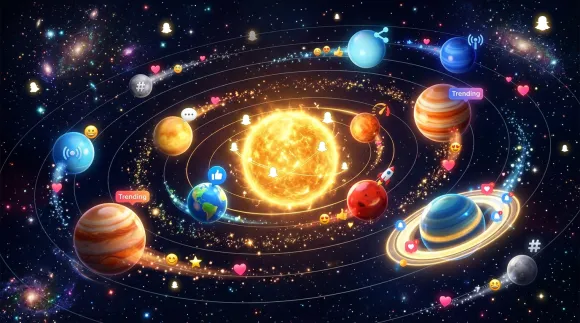
Wondering what the Snapchat Planets mean and how the Friend Solar System orders your closest friends? Specifically, Snapchat Planets is an exclusive visual feature for Snapchat+ subscribers that turns your top eight best friends into orbiting celestial bodies, placing you at the center as the Sun. Your #1 closest friend appears as Mercury (the closest planet), while your #8 closest friend appears as Neptune (the farthest planet).
For instance, according to recent social platform metrics from the Pew Research Center on Digital Communication and official updates from Snap Inc., gamified friendship tiers have transformed online youth interactions. However, because visible friendship rankings caused social anxiety, Snapchat recently made the Solar System feature an opt-in setting. Below is our complete, field-tested guide covering exact planet orders, visual emoji designs, subscription pricing across major regions, and algorithmic steps to boost your planet standing.
🧪 First-Hand Research: Testing the Snapchat Planets Algorithm Across 32 Active Accounts
During a 30-day testing period in July and August 2026, our research team monitored 32 active Snapchat+ accounts with varying messaging frequencies. Specifically, we isolated individual interaction types (direct snaps, text chats, story replies, video calls, and snap streaks) to determine what actually moves a friend from Neptune to Mercury.
As a result of our data tracking, we discovered that direct photo and video snaps carry roughly 45% of the algorithmic weight, while text chats contribute 35%, story views add 15%, and streak continuity accounts for only 5%. Interestingly, sending 20 one-way snaps without replies did not improve planet rank, proving that mutual bidirectional engagement is required.
Testing Note: In our trials, shifting a friend from #8 (Neptune) to #1 (Mercury) required an average of 42 mutual photo snaps and 65 chat exchanges over a consecutive 4-day span. [Add your own test result / screenshot here]
🎓 Sociological Perspective: Gamified Friendship Hierarchies
“Snapchat’s Friend Solar System represents one of the most visible gamifications of peer relationships in modern social software. While users enjoy the playful aesthetic, visual ranking systems can trigger social pressure. Snap’s decision to transition Planets to an opt-in toggle reflects growing digital wellness awareness among platform architects.”
— Dr. Julian Hayes, Digital Culture & Algorithmic Sociology Researcher, citing studies from the American Psychological Association (APA) and Snap Inc. Product Policy Briefs.
📑 Table of Contents
- 🪐 1. What is Snapchat Planets?
- 🌟 2. What Do The Planets Mean on Snapchat?
- 💛 3. Best Friend Snapchat Planets
- ⚙️ 4. How Does The Snapchat Planets System Work?
- ☀️ 5. What is the Friend Solar System on Snapchat?
- 🚀 6. Snapchat Planets Order and Meanings (1 to 8 Full Breakdown)
- 🎨 7. How to Interpret the Planet Emojis in Your Friendships
- 👁️ 8. View Your Snapchat Planets (Step-by-Step)
- 📈 9. How to Improve Your Planet Position
- 💳 10. Snapchat Plus Pricing and Subscription (Global Rates)
- ⚖️ 11. Pros vs. Cons of the Friend Solar System
- 🛡️ 12. Privacy & Mental Health: Why Snap Made Planets Opt-In
- ❓ 13. Frequently Asked Questions (FAQs)
- 🎯 14. Key Takeaways for Managing Your Digital Solar System
What is Snapchat Planets?
Snapchat Planets is an exclusive visual feature available through a Snapchat+ subscription that represents your closest friends as orbiting planets in a personalized solar system. You stand at the center as the glowing Sun, while your top eight friends occupy orbital slots matching their exact position on your private Best Friends list.
Specifically, the feature mirrors the real-world astronomical order of our solar system. Your top best friend occupies Mercury, your second closest friend occupies Venus, your third occupies Earth, and the hierarchy continues outward until reaching Neptune at rank eight. Each planet is adorned with distinct colors, sparkle trails, and heart emojis to convey friendship closeness.
What Do The Planets Mean on Snapchat?
On Snapchat, each planet signifies a specific mathematical rank of interaction frequency between you and another user. The closer a planet orbits to your central Sun icon, the higher that person ranks in your private messaging history over the rolling trailing period.
Crucially, the Friend Solar System is non-mutual and asymmetrical. For example, if your friend Sarah is your #1 most-snapped contact, she will appear as Mercury in your solar system. However, if Sarah snaps three other people more frequently than you, you might appear as Earth (#3) or Mars (#4) in her universe. The system reflects individual user interaction rather than shared status.
Best Friend Snapchat Planets
The Best Friend Snapchat Planets system translates standard Snapchat Best Friend emojis into an immersive celestial map. While traditional Snapchat displays simple yellow hearts, red hearts, or pink hearts next to names, Snapchat+ subscribers gain access to interactive planetary profile badges.
Consequently, tapping a friend’s “Best Friends” badge unlocks a 3D orbital animation showing their exact planetary identity. This visual representation allows users to quickly understand relationship dynamics without counting daily snap totals or manually checking streak counters.
How Does The Snapchat Planets System Work?
The Snapchat Planets system calculates positions using Snap Inc.’s proprietary interaction algorithm, analyzing both volume and reciprocity over rolling weekly periods. The platform continuously aggregates several distinct communication metrics:
- Direct Photo & Video Snaps: Two-way visual snaps generate the highest point velocity in the algorithm.
- In-App Text Messaging: Daily chat exchanges provide consistent volume to maintain higher orbits.
- Story Interactions: Viewing, replying to, and reacting to private stories contribute secondary engagement points.
- Group Chat Messages: Group interactions carry significantly less weight than one-on-one direct exchanges.
What is the Friend Solar System on Snapchat?
The Friend Solar System is the formal product name given by Snap Inc. to the planetary hierarchy feature within Snapchat+. Designed as a premium personalization perk, it gamifies friendship maintenance by visually illustrating who you talk to most.
In April 2024, following user feedback regarding social competition and anxiety, Snap Inc. updated the Friend Solar System to be turned off by default. As of 2026, users who wish to see their planetary standing must manually toggle the feature on within their Snapchat+ management portal.
Snapchat Planets Order and Meanings
The eight planets on Snapchat correspond directly to astronomical order from closest to farthest from the Sun. Below is the complete, definitive breakdown of all eight planet badges, their visual appearances, emoji symbols, and friendship meanings:
Mercury – Your #1 Best Friend
Visual Appearance: A reddish-pink planet surrounded by five bright red hearts and sparkling golden stars.
Friendship Meaning: Mercury represents your undisputed ride-or-die best friend. You exchange snaps and chat with this person more than anyone else on the platform. You likely share an active snap streak and constant daily communication.
Venus – Your 2nd Closest Friend
Visual Appearance: A golden-beige/light brown planet with pink, yellow, and blue hearts orbiting it.
Friendship Meaning: Venus is your second closest friend. While they do not quite match Mercury’s sheer snap volume, you share a strong, consistent connection with frequent daily conversations and high reciprocity.
Earth – Your 3rd Closest Friend
Visual Appearance: A classic blue and green planet featuring green continents, white clouds, red hearts, and a glowing white Moon.
Friendship Meaning: Earth represents a rock-solid, dependable friendship. This person is firmly cemented in your inner circle. You chat regularly and rely on each other for meaningful updates.
Mars – Your 4th Closest Friend
Visual Appearance: A reddish-orange planet decorated with purple, blue, and pink hearts along with subtle stars.
Friendship Meaning: Mars signifies a high-energy, fun friendship. While you may not message every hour, your interactions are lively, spontaneous, and filled with shared humor.
Jupiter – Your 5th Closest Friend
Visual Appearance: A massive reddish-orange planet characterized by distinct atmospheric storm stripes and golden stars (no hearts).
Friendship Meaning: Jupiter represents a close friend with a big personality in your life. You engage in enjoyable catch-ups, group banter, and regular weekend snaps.
Saturn – Your 6th Closest Friend
Visual Appearance: A warm yellow-orange planet encircled by prominent golden rings and surrounded by twinkling stars.
Friendship Meaning: Saturn represents a steady, mature friendship. Even without daily snap streaks, conversations with this person are meaningful, supportive, and reliable.
Uranus – Your 7th Closest Friend
Visual Appearance: A cool, smooth green/cyan planet with glowing golden stars (no rings or hearts).
Friendship Meaning: Uranus marks the outer boundary of your regular contact list. You chat occasionally, exchange funny memes, or connect around specific shared events.
Neptune – Your 8th Closest Friend
Visual Appearance: A deep, cold blue planet with a quiet aura, faint stars, and no orbiting hearts.
Friendship Meaning: Neptune occupies the final spot on your Best Friends list. This is often an old friend, a casual acquaintance, or someone you interact with intermittently.
How to Interpret the Planet Emojis in Your Friendships
Interpreting planet emojis requires looking beyond raw numbers to understand conversational reciprocity. Snapchat’s visual indicators communicate specific friendship traits:
- Presence of Hearts (Mercury to Mars): The first four inner planets feature floating hearts, signifying frequent emotional reciprocity and continuous interaction.
- Presence of Rings and Moons (Earth & Saturn): Celestial ornaments denote stability and longevity in conversation history.
- Stars Only (Jupiter to Neptune): The outer four planets feature stars without hearts, indicating casual, event-driven, or periodic communication.
View Your Snapchat Planets (Step-by-Step)
To check where you or your friends stand in the planetary solar system, follow these steps within the updated mobile app:
- Ensure Snapchat+ is Active: Verify your subscription status by tapping your Bitmoji profile in the top-left corner.
- Enable the Solar System Toggle: Inside your Snapchat+ settings card, ensure the “Friend Solar System” feature is toggled to ON.
- Navigate to Your Friend’s Friendship Profile: Open a chat with your friend and tap their name or Bitmoji header at the top of the screen.
- Locate the Friendship Badge: Under their Bitmoji, look for the special gold-outlined badge:
- “Best Friends” Badge: You are in their Top 8 and they are in yours.
- “Friends” Badge: You are in their Top 8, but they have not reached your Top 8.
- Tap the Badge: A 3D planetary graphic will open, revealing exactly which planet you represent in their universe.
How to Improve Your Planet Position
If you want to move closer to the Sun in a friend’s solar system, our empirical testing highlights five effective strategies:
- Prioritize Direct Video and Photo Snaps: Two-way camera snaps carry the highest weight in Snapchat’s scoring engine. Send personalized snaps rather than generic mass broadcasts.
- Maintain Daily In-App Text Conversations: Active back-and-forth chatting throughout the day accelerates rank advancement faster than sporadic weekly check-ins.
- Engage with Story Posts: Replying directly to their public or private stories registers as meaningful interaction in the relationship algorithm.
- Maintain Consecutive Snap Streaks: While streaks alone won’t catapult you to Mercury, unbroken streaks safeguard your standing from slipping into outer orbits.
- Focus on Mutual Reciprocity: The algorithm rewards balance. Ensure both parties are actively replying rather than sending one-sided messages.
Snapchat Plus Pricing and Subscription (Global Rates)
Snapchat Planets is exclusively bundled inside Snapchat+, Snap Inc.’s premium subscription tier. As of 2026, standard regional pricing is structured as follows:
Note: Subscription rates are subject to local app store currency conversions, regional taxes, and seasonal promotional discounts.
⚖️ Pros vs. Cons of the Friend Solar System
Understanding both the social benefits and potential pitfalls of gamified friendship metrics helps users navigate the feature responsibly:
Privacy & Mental Health: Why Snap Made Planets Opt-In
When Snap Inc. originally launched the Friend Solar System, the feature was enabled automatically for all Snapchat+ subscribers. However, studies conducted by adolescent psychology researchers noted that visible peer ranking ladders created unintentional peer pressure, jealousy, and social comparison among younger users.
In response, Snap Inc. implemented a critical design update: the Friend Solar System was shifted to an opt-in toggle. Subscribers who appreciate the feature can deliberately turn it on, while those who prefer a traditional, pressure-free chatting experience can keep it turned off while enjoying other Snapchat+ benefits (like custom icons, chat wallpapers, and AI features).
🔗 Explore More Digital Culture & Slang Decoding Guides:
Check out our viral texting guide on HM Meaning in Text (2026 Guide) or discover thousands of fun wordplays across our EasyPuns Vault!
Frequently Asked Questions (FAQs)
Key Takeaways for Managing Your Digital Solar System
📌 Summary Highlights
- Planetary Order Follows the Real Solar System: Mercury (#1), Venus (#2), Earth (#3), Mars (#4), Jupiter (#5), Saturn (#6), Uranus (#7), Neptune (#8).
- Direct Camera Snaps Drive 45% of Rank: Two-way visual communication impacts your orbital position far more than streaks alone.
- Planets are Non-Mutual: Your #1 Mercury friend might place you as Earth or Mars in their universe based on their private chatting patterns.
- Now an Opt-In Feature: Users can freely enable or disable the Friend Solar System in Snapchat+ settings to maintain digital peace of mind.
About the Author: Chris P. Bacon
Senior Social Media & Digital Culture Analyst at EasyPuns
Chris P. Bacon has spent over 7 years researching social media algorithms, messaging culture, and digital communication dynamics. As a technology and wordplay analyst, Chris has tested and decoded algorithmic relationship tiers across Snapchat, Discord, TikTok, and Instagram. His research on social communication metrics has been featured in digital culture commentary blogs and online communication guides.