Some animals wait for the day to come to them. Chickens start it: up before the alarm, busy by first light, and running a whole farmyard on clucks, scratches, and very firm opinions. They are small birds with big daily routines, and every routine is a joke waiting to happen. This collection gives you more than 200 original chicken puns and one-liners, written fresh for this page and sorted by exactly where you plan to use them.
For every use: farm-visit captions, classroom farm units, farm-party invites, early-morning texts, and thank-you notes for the neighbors who share fresh eggs.
For every age: kid-safe sections, sweet lines for family crews, clever wordplay for grown-ups — the whole page is family-friendly.
With real chicken know-how: a quick science and wordplay section up front, plus an honest guide to hens, roosters, chicks, and coop life.
Curated by a human editor: every line below was written for Easy Puns — no copied lists, no filler.
Why do chicken jokes land so well? Because chickens are farm life with a built-in audience: everyone has heard a rooster announce a morning, watched a hen scratch like the ground owed her money, or followed a line of chicks across a yard. Once you see how the wordplay works in the next section, every joke below lands a little warmer.
⚡ Quick Answer: The funniest chicken puns play on hens and roosters, chicks and clucks, dawn crowing and coop life — plus the pecking order every flock keeps. Start with the Classic One-Liners below, try the Q&A jokes for quick laughs, and tap any Copy button to grab a line in one click.
The Science & Wordplay Behind Chicken Humor
A chicken is a small bird with an ancient family tree. Chickens were domesticated thousands of years ago from the red junglefowl, a wild bird of Asia’s forests, and people have kept them ever since for their eggs, their company, and their gift for turning a quiet yard into a busy little town before breakfast.
The flock has three main citizens. A hen is an adult female — she is the layer, the scratcher, and usually the one actually running the yard. A rooster, also called a cockerel, is an adult male, taller-combed and louder. And a chick is a baby chicken: a ball of yellow fluff with a peep you can hear through a closed coop door.
Here is the fact that surprises most people: a hen lays eggs whether or not a rooster lives anywhere near her. Laying is simply her body’s daily rhythm, tied to light and season. In her prime, a healthy hen can lay close to one egg a day. Only eggs from a flock with a rooster can hatch — and a kept-warm egg takes about 21 days to do it.
And why does the rooster crow at dawn? His body runs on an internal clock tuned to the first light of morning, so he announces the day before the sun has fully shown up. But dawn is only his favorite slot — a rooster may crow at noon, at a passing truck, or at absolutely nothing, just to remind the yard whose voice carries farthest.
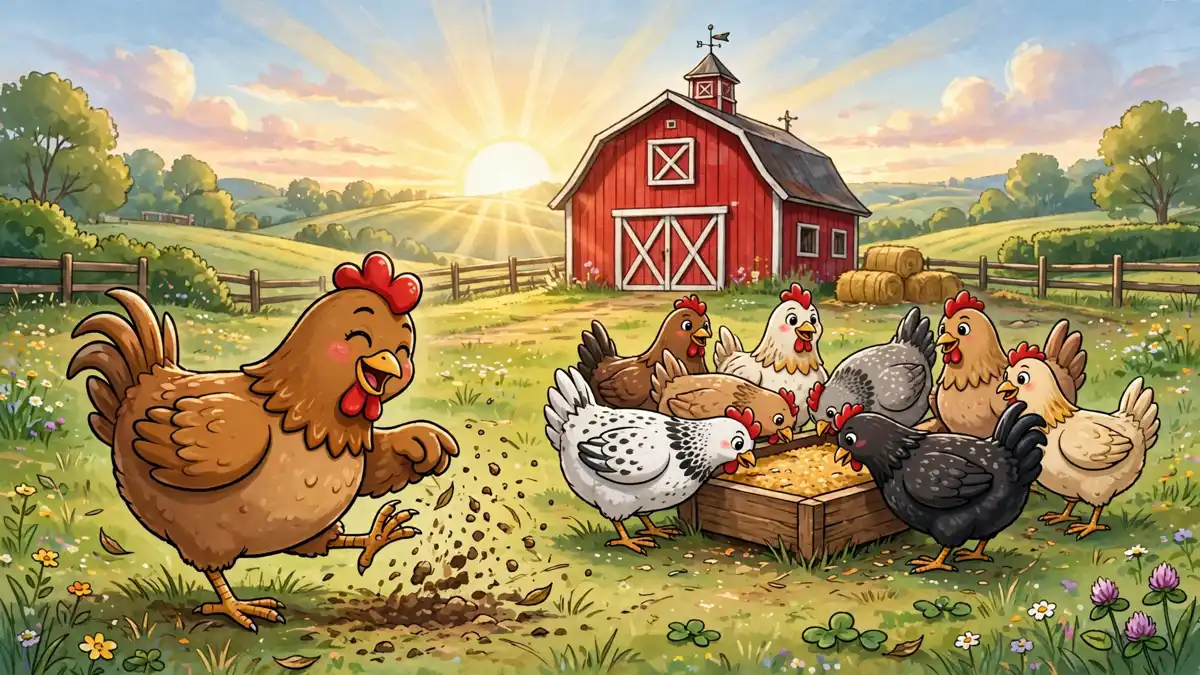
A chicken’s day is built around two small tools: feet and beak. Chickens scratch the ground with strong toes to uncover seeds, bugs, and grit, then peck up what they find with quick, precise jabs. A busy hen repeats this scratch-and-peck dance hundreds of times a day, which is why a good patch of yard looks freshly gardened by evening.
Chickens are also cleaner than their reputation. They keep their feathers in shape with dust baths — rolling and fluffing in dry dirt, which helps shake off loose feathers and tiny pests — followed by a careful session of preening, where each feather gets straightened and oiled with the beak, one by one.
Flocks run on a real social system with a real name: the pecking order. First described by scientists watching chickens, it is the flock’s ranking — who eats first at the feeder, who gets the best spot on the roost, whose cluck settles an argument. Every flock has one, and every chicken in it knows exactly where she stands.
The soundtrack matters too. Hens talk to their chicks in soft, rhythmic clucks, and the chicks answer with high little peeps — a conversation that starts before the chicks even hatch, through the shell. Chickens also recognize the faces of their flock mates, and studies show they remember far more of their neighbors than we once gave them credit for.
Can chickens fly? Only just. Their bodies are built heavy and their wings short, so a chicken’s best effort is a fluttering hop — enough to reach a fence top or a low branch, not enough to leave the county. At dusk the whole flock uses that hop to settle onto a raised perch, the roost, and sleep in a row. Coming home to roost is not a saying to a chicken; it is the schedule.
Now the wordplay engine — the sound pairs that power almost every chicken joke:
Cluck / luck — the hen’s everyday greeting, and what a good farm day runs on
Hen / pen — the bird herself, and the fenced yard she treats as her office
Peck — the beak’s quick jab at a seed, and a tiny kiss of a hello
Crow — the rooster’s dawn announcement, and bragging after a job well done
Coop — the flock’s house, and any snug team that works as one
Chick — the fluffy baby bird, and the newest member of any crew
Feather — the hen’s whole wardrobe, soft enough to make pillows jealous
Beak / peak — the bird’s built-in tool, and the top of every morning
Yolk / joke — the golden middle of an egg, and the golden middle of this page
Scratch — how a hen shops for breakfast, digging with both feet
Dawn — the rooster’s showtime, and the yard’s daily starting bell
Brood — a hen sitting warm on her eggs, and any deep-thinking mood
Hatch — a chick’s grand entrance, and the moment any good plan opens
Roost — the flock’s bedroom perch, and home base for the whole crew
Flock — the whole chicken community, and any loyal group that moves together
Egg / exactly — the hen’s daily delivery, saved for rare and careful use
Keep those pairs in mind — nearly every line below is built on one of them.
The Hen, the Rooster, the Chick: A Quick Flock & Coop Guide
Every chicken beginner started as a person standing at a fence, wondering which bird does what in the yard. Here is the friendly, honest guide:
The Hen — the flock’s daily worker. The hen is the engine of the farmyard: she scratches, pecks, dust-bathes, and lays her egg with the steady pride of a professional meeting a deadline. Hens keep the flock’s social calendar, warn the chicks about hawks with one sharp call, and can tell their favorite humans apart from strangers. Respect the hen; the whole yard quietly revolves around her routine.
The Rooster — the yard’s alarm clock. Taller, glossier, and impossible to ignore, the rooster is the flock’s guardian and town crier. He watches the sky while the hens eat, calls them over when he finds a good patch of seeds, and crows at dawn loud enough to set the whole farm’s schedule. He is not really showing off — in chicken terms, the crowing, the strutting, and the sky-watching are simply his job description.
The Chick — the smallest voice on the farm. A chick arrives as a damp little bundle and dries into a walking pom-pom within hours. Chicks peep constantly, follow their mother in a waddling parade, and learn the whole chicken handbook — scratching, dust baths, roosting — by copying her before they are a month old. By six weeks the fluff has become feathers, and the peeping has opinions.
The Coop & Roost Kit — the flock keeper’s best friend. A dry coop with snug nest boxes, a raised roost bar for the nightly lineup, fresh water that never runs empty, and a patch of bare dirt reserved for dust baths: the four quiet items that decide whether a flock feels lucky or just housed. Ten minutes of setup buys a calmer, healthier, funnier yard — keepers talk about their coop the way bakers talk about a good oven.
Classic Chicken One-Liners
These are the all-rounders — the lines that work anywhere chickens show up: the farm gate, the family group chat, the feed-store counter. They lean on the classic sound pairs from the science section, so they land even with people who have kept hens for years and have heard every lazy barnyard line twice. Keep a few in your pocket; the first dawn chorus will give you a reason to use one within the hour.
Dad checks the coop before he checks the weather, because a hen standing at the gate already knows what kind of day it is.
The first crow of the morning came at 5:04, and by 5:05 the whole farm had opinions about it.
Grandpa claims the same fence post for his morning coffee and calls it “the front row of the dawn show.”
Our yard wears a map of scratch marks by July, and every single trail leads to the tomato patch.
The hen crossed the yard with such purpose that three other hens fell in behind her without asking where they were going.
A fresh-laid egg gets announced to the entire county; the hen’s celebration song is not a quiet one.
Mom counts the hens at dusk the way other people count sheep, except these keep moving.
The rooster stands on the highest stump for his morning crow, because acoustics matter and he knows it.
Uncle Ray judges a farm by the confidence of its chickens; a flock that owns the yard is a flock well kept.
The feeder at sunrise draws a crowd faster than the bakery on a Saturday.
Every fence in the neighborhood has one low spot, and every hen in the flock knows it by heart.
My sister photographs the evening roost lineup, “so the flock can sign the guest book before bed.”
The first chick of the season is never named right away; it is debated, voted on, and then named by Grandma.
A slow hen crossed the garden at noon, and the lettuce rows have never fully recovered.
The dust-bath corner at midday looks like a tiny beach resort, complete with regulars who never share their spots.
The hens reflected in the water trough doubled the meeting, and both meetings ran long.
Grandma keeps one notebook of “best eggs of the year,” dated like a family album of small round trophies.
The wind rearranged the whole yard during lunch; the afternoon scratch session had an entirely new map.
Our cat followed the hens at a respectful distance all morning, hunting nothing and learning everything.
The feed bucket’s rattle is the only ringtone the whole farm answers on the first try.
Dad opens the coop only after his first coffee, “so the flock and I start the day equally awake.”
The stump by the gate faces east on purpose: the rooster performs his dawn set there nightly — well, morningly.
Every boot by the back door has a farm story — the mud run, the great escape, the chick rescue of June.
My brother tracks the hens’ laying in a notebook like train times, with sizes instead of stations.
The shepherd on the hill reads the evening flock better than any forecast on my phone.
Fresh chicks at the spring fair drew a crowd of children counting peeps like votes.
The first person up always checks the coop window before the phone; chicken news travels by curtain in this house.
The flock marched across the whole county fair’s parking field on Tuesday, and the traffic politely read it as a parade.
Grandpa keeps a jar of “first spring air” from the best farm morning of each year, tightly labeled, never opened.
The old coop has its own bell, its own bucket, and — according to Dad — its own seniority among farm buildings.
By the second week of summer, the whole road glances at the yard at dawn out of habit, each errand paused for the crow report.
Home is wherever somebody has already opened the coop because the flock is putting on a show.
Cute Chicken Puns
“Cute” in chicken country means warm: the lines you would write in a card for the person who keeps your mornings bright. These are sweet, gentle, and safe for anyone — pass them along with a shared porch coffee, a saved seat at the fence, or a basket of eggs from a hen who outdid herself.
You are the person I save the porch step beside me for when the flock comes out, and in this house that is a serious honor.
Grandpa holds the gate for Grandma at feeding time, every visit — fifty summers of the same quiet arrangement.
My best friend knows my favorite hen by name and personality, which is basically a love language in July.
Dad leaves the porch light on until the last hen is in, “so nobody walks home in the dark,” and then winks at Mom.
There is a flat stone by my sister’s coop worn smooth by years of kids stopping to watch the chicks.
The new chick waits by the water dish in her fluffy best, certain the yard parade was scheduled personally for her.
Mom writes “chick day — maybe” on the calendar in pencil, with a tiny star she pretends is not hopeful.
You remembered my boots leak at the heel, and the dry pair appeared by the coop door without a word.
A shared thermos passed hand to hand down the fence line says everything a long speech would, only warmer.
Grandma still holds the egg basket while Grandpa counts the hens — a two-person tradition invented in 1984 and never updated.
Our first little farm had one small coop and a view of the lane, and we watched the flock cross it like it was a private runway.
Holding the flashlight while someone you love checks the night coop is the proudest job on the whole farm.
Our neighbor leaves a jar of jam on our porch after every egg swap with a note: “For the crew that keeps our corner cheerful. Booking my fence spot early.”
My son lined up his chick drawings by size and announced that a family, like a flock, stays warm by staying close.
You held the umbrella over my notebook before your own, in the first drops of rain, and that is the whole story of us.
Sunday mornings on the farm end the same way: one last look at the roost lineup, and nobody in a hurry to go inside.
My daughter insists each chick’s peep is a tiny letter the yard sends by hand, and she “reads” the evening flock aloud before dinner.
My daughter builds her fairy garden “exactly beside Dad’s coop,” then quietly adds one gate “for the hens to visit.”
A morning started by someone who knows your coffee order feels warmer. This is not opinion; it is family law.
The porch light, the hush after chores, and the flock settling wing to wing on the roost: that is the whole recipe for our favorite evening.
My best friend trades me her Saturday gate shift for my Sunday garden shift every July, and neither of us mentions it.
Home is wherever somebody has already rattled the feed bucket because they knew you were coming over.
Chicken Q&A Jokes
Question-and-answer jokes are the easiest kind to perform: you ask, they guess, you land the punchline. This set is built for fence lines, porch steps, and school farm trips, where one good Q&A usually starts a whole round of everyone trying their own. The hen, the rooster, and one very round chick do most of the heavy lifting — and the first fourteen answers teach a real chicken fact on the way to the laugh.
Q: What is a chicken? A: A domesticated bird descended from the red junglefowl of Asia, kept by people for thousands of years for eggs, company, and outstanding yard entertainment.
Q: What is a hen? A: An adult female chicken — the layer, the scratcher, and the flock member most likely to be running the whole yard.
Q: What is a rooster? A: An adult male chicken, also called a cockerel, known for his tall comb, glossy feathers, and a crow that carries across three fields.
Q: Do hens need a rooster to lay eggs? A: No. Laying is the hen’s own daily rhythm, tied to light and season — a rooster is only needed if the eggs are meant to hatch into chicks.
Q: How many eggs can a hen lay? A: In her prime, a healthy hen can lay close to one egg a day, with proud pauses for bad weather, molting, and general principle.
Q: How long does an egg take to hatch? A: About 21 days, if it is kept warm the whole time — by a broody hen sitting tight or by a keeper’s careful turning.
Q: Why do roosters crow at dawn? A: Their internal clock answers the first light of morning, so the crow goes up before the sun does — the farm’s original alarm, with no snooze button.
Q: What is a pecking order? A: The flock’s real social ranking, first described by scientists watching chickens — it settles who eats first, who roosts highest, and whose cluck ends the meeting.
Q: Why do chickens scratch the ground? A: To uncover breakfast: scratching with strong toes turns up seeds, bugs, and grit hiding in the soil, ready for a quick peck.
Q: Why do chickens roll in the dust? A: That is a dust bath, and it is serious self-care — dry dirt worked into the feathers helps shake off loose down and tiny pests before a careful preen.
Q: Can chickens fly? A: Only in short, fluttering hops — enough to reach a fence top or the roost bar, never enough to migrate. Chickens are built for yards, not skies.
Q: What is a clutch? A: A group of eggs laid in a nest, or gathered together for hatching — one hen’s careful collection, guarded like treasure.
Q: What sounds do chickens make? A: A whole vocabulary: hens cluck to their chicks, chicks peep back, hens sing a proud egg song after laying, and roosters handle the crowing department.
Q: Where do chickens sleep? A: On a raised perch called a roost, in a close row inside the coop — which is why “home to roost” started as a chicken fact before it was a saying.
Q: What did the hen say to the feed bucket? A: “You had me at the first rattle — lead the way and I will bring the whole committee.”
Q: Why did the chick stay close to its mother? A: Her clucks are a map, a menu, and a weather report in one voice — a chick who listens eats first and naps warmest.
Q: What did the rooster say to the sunrise? A: “You’re late to my show again — I started the announcements twelve minutes ago.”
Q: Why did the hen inspect the nest boxes twice? A: Standards. A layer of her reputation does not settle for yesterday’s straw arrangement.
Q: What is a hen’s favorite meeting style? A: Short, standing, and held around the feeder — with snacks provided and the minutes taken by whoever scratches slowest.
Q: Why do farmers love the dawn chorus? A: It is the only news broadcast that also confirms the flock is up, hungry, and ready to supervise the day’s work.
Q: What did the chick say on its first morning? A: “Big yard, tall gate, excellent worms — I accept this position.”
Q: Why did the rooster visit the fence at noon? A: A second announcement never hurt anyone — the yard deserves updates, and he deserves an audience.
Q: What is a chicken keeper’s busiest hour? A: Dusk — the roost lineup needs counting, the gate needs latching, and every hen has one last story from the garden.
Q: Why did the hen lead the chicks to the dust corner? A: Bath day is a family tradition, and she teaches it the way her mother did: roll, fluff, shake, repeat.
Q: What did the flock say to the new gate? A: “We have reviewed your design and found the gap under the left hinge. You’re welcome.”
Q: Why do chicken jokes always land? A: They arrive with a story from the yard, they are built on real farm mornings, and there is something in the flock for everybody.
Q: What did the egg say to the nest? A: “Twenty-one warm days, give or take — then I am joining the parade outside.”
Q: Why does the yard go quiet at sunset? A: The roost roll call has begun, and even the loudest hen respects a full house settling in for the night.
Chicken Captions & Texts
Captions live or die in the first few words, so these stay short and warm. The Instagram set is written for photos and clips — dawn yards, proud hens, and chicks on parade — while the texting set works as quick replies and everyday updates you can send in seconds.
Chicken Instagram Captions
Gate’s open, feed’s out, first photo goes to whoever the rooster greets first.
Flock status: one supervisor, two scratchers, and a chick nobody can keep up with.
This roost lineup required both a sunset and a short pep talk with the flock.
Yard rule one: the person holding the bucket names the first hen; the person holding the camera names the second.
My morning route — porch, coop, garden, gate — has more planning in it than my weekend does.
Shade level: one slow hen, parked proudly under the apple tree all afternoon.
This nest box took all week to arrange. Photographing it slowly from a safe distance.
Dust-bath day today: same yard, fancier spa.
Six fields of dawn, finished in shades of gold.
Grandpa’s boots, Dad’s bucket, my gate turn: three generations of teamwork.
Some people collect stamps. I collect sunrise photos with a rooster in them.
A wispy chick for the nest box, a deep scratch for the garden rows.
That first-crow quiet right after says more than this caption can.
Porch light on, flock settled in, yard glowing: Saturday, complete.
My chick reached the feeder nobody wanted to queue behind. Diplomacy, extended.
The rain moved in an hour after the last photo was taken. The yard accepts the compliment and dries.
One flock for this farm, one flock for the next. Summer, in chapters.
Notebook update: the white hen remains layer of the month.
Farm-visit day. The gate has never looked so popular.
The last egg fit the basket like it was made for it — because the hen measured it, twice.
Short Chicken Texts to Send
Flock’s out in twenty. Your spot at the fence is saved and non-negotiable.
First crow’s up. Repeat: first crow’s up. The yard is receiving visitors again.
I saved your seat exactly your way — sunny end, best view, nothing written down.
Chick emergency: the new hatch is exploring. The camera crew is being promoted.
Grandpa named the big hen at dawn and apologized to her out loud. It is a whole thing here.
First farm Saturday of summer is this weekend. This message is my entire personality until then.
Saved you the shady side of the yard. It comes with lemonade and the good bench.
The shop by the crossroads stocks garden gloves in your size this year. We have plans now.
Rain check on the errands — coop day instead, same crew, warmer socks.
Grandpa says the gate is open and the coffee is poured. Bring your appetite for pancakes at eight.
I watched your hens while you were away and only adopted one emotionally.
Sending a photo instead of a chick because the mail is cruel. It was perfect. You’re welcome, and I’m sorry.
Coop & Farmyard Life Chicken Puns
This is the section farm people were born for: coop headquarters, roost roll calls, and the small rituals that turn a patch of dirt into the best-run small town in the county. These lines come straight from yard life, so they land with keepers, fence sitters, and anyone who has ever been handed the egg basket like a baton.
The roost seating chart is unwritten but strict: the senior hens take the middle, the youngsters crowd the edges, and the rooster’s spot at the high end never moves.
Keepers share a secret language: one short cluck means “treats,” and two means “hawk — everybody under the bush, now.”
The first good scratch patch of the morning opens in the garden, and boots start appearing at the back doors of three houses.
Saturday feeding at our farm ends with pancakes, every single time, like a parade route in reverse.
The neighbor who “never watches chickens” has strong opinions about our white hen and brings his own stool along to supervise.
A slow afternoon with a full yard and nowhere to be is the richest feeling I know.
Yard life’s real schedule is not the clock — it is “first crow,” “dust-bath hour,” and “who counts the roost tonight.”
The smell of fresh straw from the coop is the farm’s reset button; two fields down, kitchen windows start opening by themselves.
There is a regular at our gate who has said “I’ll just watch one feeding” for six summers and has never once left before the roost lineup.
The hush of the coop plus a whole row of hens settling in view is the coziest sound-and-picture combination known to science.
Early risers get the quiet yard; keepers get the golden hour — the best flock photos belong to the evening light.
The porch light comes on, the last hen shuffles up the ramp, and the yard becomes the warmest room on the farm — the one without walls.
Early Mornings & Rooster Life Chicken Puns
This is the chicken’s loud road: dawn crows, first-light feed runs, and long bright mornings where the rooster earns his keep one announcement at a time. These lines are for early risers, reluctant wakers, and anyone whose family map is really just a list of beloved sunrise yards.
The rooster keeps the best alarm in the whole county inside his little feathered frame, and the first crow of the day is when he starts his real job.
Farm rule at our house: the person who hears the crow first makes the coffee, and the person still asleep chooses the pancakes.
The old bench at the east fence has not moved in years, but the dawn show in front of it performs all summer long.
An early morning in a busy yard feels better than anywhere else on Earth — established science at our table.
The coffee somehow tastes better after the coop check, while the mist stays low on the fields. Nobody knows why.
Grandpa writes “sun’s up, flock’s fed, gate’s open” on the day’s plan like it is a classified ingredient, and we respect the secrecy.
Roosters read the coming light without a single window check, a magic trick performed with a lifetime of practice.
Our family’s map of the valley is just a list of farms with great dawns, connected by lanes and strong opinions about jam.
The voice from the barn door knows the yard so well that “the usual crow, please” is now a full sentence here.
A mug of tea drunk at the sunrise gate, boots resting against the rail, beats most cafés that take reservations.
The alarm clock’s spare batteries by the door are not clutter — they are the reserve team, and the rooster outranks them anyway.
Somewhere between the first crow and the last egg collection of the day, every great farm day earns one legendary morning.
Sarcastic & Clever Chicken Puns
Not every farm moment is golden. The sarcastic set is for the 5 a.m. weekend crow, the escape through the one loose fence board, and the hen who laid her egg anywhere but the nest box — dry laughs aimed at situations, never at people, and always kind to the birds. The clever half follows with the facts and wordplay from the top of this page, bent into lines that make people say, “Okay, that one was good.”
Sarcastic Chicken Puns
Oh sure, the rooster respects weekends — said nobody whose window faces the coop at 5:02 on a Sunday, ever.
Wonderful: the rain arrived the very minute the fresh straw finished its inspection tour. Perfect timing, as always.
I love how the forecast called it “a quiet morning” while the yard has filed for a marching band permit.
Yes, I bought the bigger egg basket. No, the pocket one did not feel sufficient as a collection system.
The farm stay sold me a room facing one solid wall of dawn chorus for four mornings. One. The view is inspiring.
Somebody left the garden gate open by exactly one hen’s width. The investigation is ongoing; the suspect list is the entire flock.
The mud season closed the yard path again. I have walked the long way twice this morning, and now we are both just pretending this is exercise.
The tag calls it a “small flock.” It is one committee wearing feathers, but sure.
My garden attended the whole afternoon meeting and contributed more tomatoes than the actual fence did.
Sure, the good coop latch cost more — as if the cheap one was going to outsmart the white hen out of pride by Saturday.
The nest tower took all morning to arrange and one proud hen to redecorate. Record construction, terrible management.
No, I do not need a quieter rooster. I need a shorter dawn, and that is not happening.
Clever Chicken Puns
A roost lineup is a hundred small feathers agreeing to sleep in a row: same perch, one very determined arrangement.
Keeping chickens is applied patience — ten quiet minutes with the morning flock now, ten honest plans for the day later.
A flock photo is just editing you can frame: a whole season of yard life, revised into one bright rectangle.
The hen is the yard’s full stop — set her at the gate, and every sentence of the morning after her reads calm.
The rooster writes in first light, the hen asks for her eggs on schedule, and the chick was built for exactly the front row — because it was.
The fence is the yard’s punctuation: one long line that tells every hen where the story goes.
The sun gave the dawn, the soil gave the seeds, and a quiet garden is credited with the result — a truly local committee.
Scratch, peck, lay: the hen speaks three small verbs of farm life, and every watching family is fluent.
The dust corner is the unsung furniture of the whole yard — it holds the baths, the naps, and most of the meetings.
The eggs always catch up eventually — usually one basket at a time, starting the minute you praised the empty nest boxes.
The dawn crow is the farm’s polite signature: one bright line of sound, and the whole sleepy valley reads easier behind it.
Every flock is a texture argument — fluffy from the chicks, glossy from the rooster, feathery from the hens — and the evening calm settles the debate.
Chicken Puns for Kids, School & Parties
Everything in this part of the page is clean, simple, and built for the toughest crowd there is: children. Teachers get classroom and farm-unit lines, families get the party set, and the hen herself stays the star of every section — the jokes are for everybody.
Kid-Friendly Chicken Puns
Why did the little chick wear tiny boots to the yard? Because spring was coming close and the puddles were almost ready.
Our class counted the hens over the school fence and cheered like it was a sports final — there were twenty-three!
What do baby chicks call their mom? The warmest blanket with a beak — she works over the whole yard and tells the tallest tales.
I drew our farm as a row of white coops guarding the garden, and the teacher hung it by the classroom door.
Why did the hen bring a camera to the fair? She heard the afternoon was going to be bright and a little bit breezy.
Grandpa let me carry exactly four corn kernels to the feeder, which makes me an official junior keeper of the yard.
What is a chick’s favorite school subject? History — it loves hearing how farms were run in the old days.
The morning mist rolled off the field in one long white ribbon, and my little brother wore it as a scarf for exactly one photograph.
Why did the chick join the school parade? Somebody had to lead the yard line, and it was already marching straight.
Our class grew one sunflower so tall that Dad says it was clearly raised to wave at the rooster.
What do chicks dream about? A sunny yard, a row of friendly fences, and scratching in first thing on Saturday.
The tiniest egg drawing in the contest went to my stuffed bear, who attends every farm day and never complains.
Chicken School Jokes
Our science teacher explained hatching with one warm lamp and a chart of days, and it remains the most-watched lesson of the year.
Farm week at school runs on one flock chart, two teachers, and forty very focused young keepers.
The school farm fundraiser sent the whole class to the autumn county fair, proving painted coops raise money and morale.
My nature report covered chickens from the first peep to the last roost, and the teacher asked for the dawn section twice.
The spelling bee word was “rooster,” and half the class tried to sneak an extra “t” into “feather.”
Snack math problem: if the yard has twelve fences and thirteen cousins coming for the fair, the answer is still “build one more fence.”
The school fair’s longest line was at the name-the-chick game, and the principal took the voting personally.
Our class spring vote ended in a tie between the farm walk and the garden visit, and the chickens won either way.
The school rule for field day is simple: the gate talk stays cheerful and complete, because the teacher can hear everything.
Geography quiz answer of the year: warm air from the south fields, cool air from the north woods — the class’s favorite map ever.
The teacher’s cap says “chief keeper,” and on farm days the whole school salutes the flock.
Our book club’s summer chapter ended with lemonade on the library steps and a vote to hold every meeting facing the coop.
Chicken Party Puns
The chick-photo line at our farm party had six aunts in a row and a queue that outlasted the birthday song.
A backyard farm party with a borrowed speaker and unlimited lemonade beats a fancy venue every single time.
The host labeled every lemonade jar, and the mint jar needed a refill before the guests finished arriving.
Party rule: the birthday kid gets the first fence spot and the last slice of watermelon cake, by law of the house.
The hang-your-own paper chick table ended with more admiring than hanging, and nobody filed a complaint.
Game night runs better with the porch string lights on under a clear sky; even the sore losers stay for one more farm story.
Our graduation farm party served lemonade in jars with the year printed on them — drinkable diplomas, one guest called them.
The snack table’s coop-shaped cake lasted eleven minutes, a new record the host is quietly proud of.
Costume party verdict: the toddler dressed as a tiny chick with a yellow hat won before judging was even invented.
The farewell party’s gift was a framed flock photo for the guest’s own wall, and it got more applause than the speech.
Sleepover law: the window gets checked twice during the scariest story, purely for the moonlit coop.
Every guest left with a jar of the host’s homemade jam, still cool from the pantry at the first red light.
Knock-Knock Chicken Jokes
Knock-knock jokes are the oldest trick in the book, and the chicken was born for them — a bird who arrives at every coop door, farm gate, and garden fence all year long was made for this game. Perform them at the gate, over text, or with a kid who will demand all twelve in a row. Fair warning: that kid will then invent a thirteenth.
Knock, knock. Who is there? Hen. Hen who? Hen-semble at dawn — the whole flock is dressed and waiting by the gate!
Knock, knock. Who is there? Crow. Crow who? Crow-ing in ten minutes, whether you are awake or not — the yard runs on his clock!
Knock, knock. Who is there? Cluck. Cluck who? Cluck the gate shut behind you — the hens are already halfway to the garden!
Knock, knock. Who is there? Peck. Peck who? Peck your best spot by the feeder — the breakfast rush starts at sunrise sharp!
Knock, knock. Who is there? Coop. Coop who? Coop-erate with the morning crew — someone has to open the run!
Knock, knock. Who is there? Chick. Chick who? Chick the nest boxes before you go — somebody new hatched last night!
Knock, knock. Who is there? Feather. Feather who? Feather or not, here we come — the flock heard the feed bucket rattle!
Knock, knock. Who is there? Dawn. Dawn who? Dawn here at ground level the grass is still wet — boots on, the hens are waiting!
Knock, knock. Who is there? Brood. Brood who? Brood over the eggs all you like — they still hatch on day twenty-one!
Knock, knock. Who is there? Hatch. Hatch who? Hatch the gate and count the chicks — three new voices joined the yard today!
Knock, knock. Who is there? Beak. Beak who? Beak-cause the feeder is empty — the flock has filed an official complaint!
Knock, knock. Who is there? Roost. Roost who? Roost assured, the best perch is saved — the sunset lineup starts in five minutes!
Chicken Terms & What Makes Them Funny
Chicken talk comes with its own vocabulary — and half of it already sounds like a joke waiting to happen. Here is the cheat sheet:
Term
Quick Fact
Why It Is Funny
Hen
The adult female chicken — the layer and the yard’s daily worker
The farm’s longest-serving manager — same gate, new project, every single morning
Rooster
The adult male chicken, also called a cockerel, with the tall comb and the big voice
An alarm clock with feathers and strong opinions about punctuality
Chick
A baby chicken, all fluff and peeping for its first weeks
A walking pom-pom with a voice three sizes too big for it
Cluck
The hen’s soft, rhythmic call, used to talk to chicks and flock mates
The yard’s group chat — short messages, answered instantly, all day long
Peck
The quick jab of the beak that picks up a seed, a bug, or a crumb
Breakfast, served one tiny decision at a time
Roost
The raised perch where the flock sleeps in a row at night
A bunk bed with a strict, unwritten seating chart
Coop
The flock’s house — shelter, nest boxes, and the roost all under one roof
The only home where the whole family argues happily about the same perch
Flock
The whole chicken community, moving, eating, and napping as one group
A small town where everybody knows everybody’s business by breakfast
Clutch
A group of eggs laid in a nest, or gathered together to be hatched
Treasure, collected one careful morning at a time
Brood
A hen sitting warm on her eggs — and the chicks she raises afterward
One small hen running an entire nursery from a single nest
Chicken Puns for Different Moments
The same pun can flop or fly depending on the moment you use it in. Here is a quick guide to matching the line to the occasion, with pointers to the right section of this page:
Farm-visit posts and captions: this is where the Captions section earns its keep. A perfect dawn yard deserves a line like “Gate’s open, feed’s out, first photo goes to whoever the rooster greets first,” and the Coop & Farmyard Life set covers the bigger scenes — roost roll calls, dust-bath hour, and the gate every flock treats like a front door.
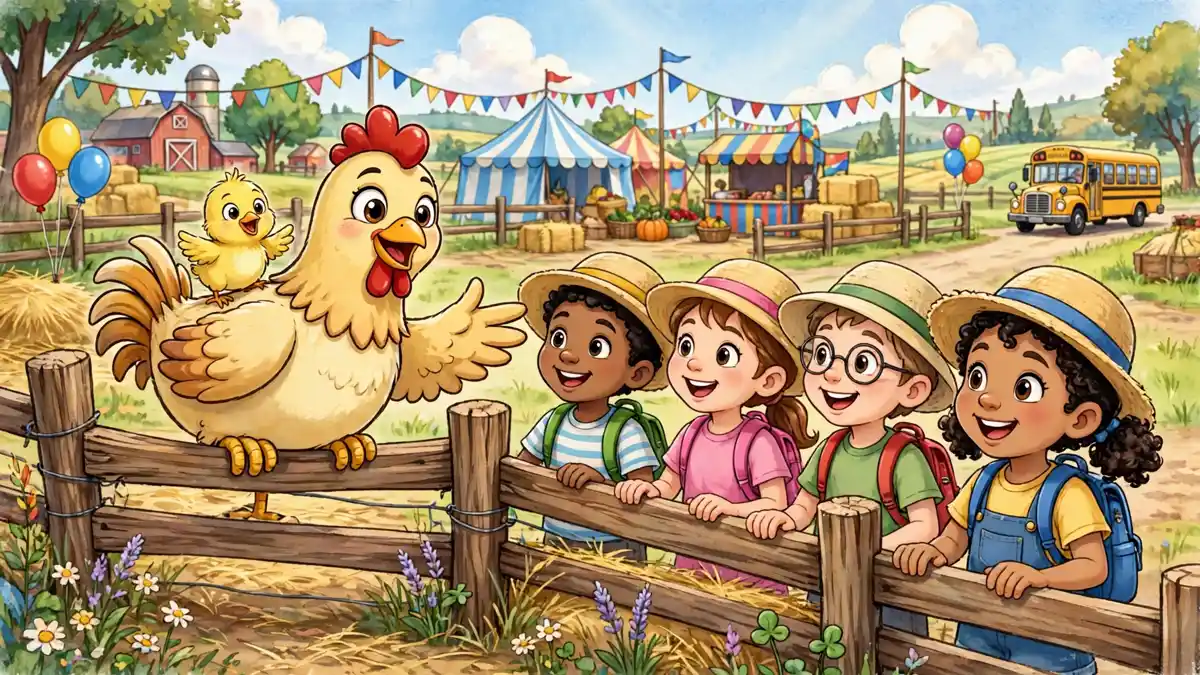
Classroom farm units: keep it clean, short, and proud. The Kids and School sets were built for teachers — hatching charts, farm weeks, and spelling-bee warnings — and the Q&A jokes double as quiz material, since half of them teach a real chicken fact on the way to the punchline.
Birthday and farm-party invites: the Kids, School & Parties section was written at the fence, not at a desk. Drop one line in the group chat when the party gate opens, save another for the dusk photograph of the roost lineup, and let the Party set handle the “best fence spot on the whole farm” debate.
Morning texts and wake-up greetings: lead with the crow, not the calendar. The Early Mornings & Rooster Life set was written for dawn people and the friends they lovingly wake — one line in a 6 a.m. message tells the whole crew exactly what kind of farm day has started, and the Texts set keeps it short enough for any lock screen.
Thank-you notes for farm hosts and egg-sharing neighbors: the household that opened their gate, walked you through chick season, and sent you home with a warm basket deserves more than a plain thanks. A Cute line about saving someone the porch step makes a fine closer for a card, and it tells that host their whole system was noticed.
How to Deliver a Chicken Pun
A good chicken pun is like a good farm morning: set up at first light, timed to the crow, and never forced on a crew that is still lacing its boots. Three small rules from the keeper’s handbook will keep your timing straight and your audience grinning.
1. Match the pun to the yard
Chicken puns land best in chicken company. Drop one as the gate opens in the morning, when the first chick parade crosses the yard, or at the fence as the flock files in for the evening count. The setting does half the work, and the same line sounds twice as good with the smell of fresh straw in the air.
2. Keep it kind, keep it yard-warm
The best chicken jokes laugh at melting schedules, ambitious gardens, and our own six-fence setups — never at a person’s keeping skills, drawings, or egg luck. Every flock is the right flock on its own farm. Aim for the laugh that makes the whole fence line grin, not the one person squint.
3. Timing beats quantity
One well-timed “first crow, full house” as the yard wakes up beats ten puns before the coffee is even poured. Say it, let it land, then pass the thermos. Farm people understand this rule — it is why the best flock story gets told once, properly, over the evening lemonade.
Ethan Parker is the Lead Humor Strategist at Easy Puns, where he writes and fact-checks pun collections for readers of all ages. Every line on this page was written originally for Easy Puns — researched against top-ranking pages for topic coverage, then written from scratch so no joke is copied from anywhere. The chicken facts above reflect widely shared farm and animal knowledge — including where chickens come from, how hens lay, and why roosters crow at dawn — and the whole collection is kept family-friendly.
Chicken Puns FAQs
What are the most popular chicken puns?
The favorites grow from a few sound pairs: cluck and luck, beak and peak, yolk and joke, plus the dawn crow every farm morning starts with. Fresh versions of each run through this page — start with the Classic One-Liners and pick your favorites for the caption, the card, and the fence-line group chat.
Why do roosters crow at dawn?
Their bodies run on an internal clock tuned to the first light of morning, so the crow goes up just before the sun does. Dawn is the rooster’s main show, but he may also crow at midday bustle, strange noises, or nothing at all — announcing himself is simply his job.
How many eggs does a hen lay?
In her prime, a healthy hen can lay close to one egg a day, and she does it whether or not a rooster is around. Laying slows with shorter days, older age, and molting season — a hen’s calendar is written in light, not in our schedules.
What is a pecking order?
It is the flock’s real social ranking, first described by scientists studying chickens. The order settles who eats first at the feeder, who takes the best spot on the roost, and whose cluck ends an argument — every chicken knows exactly where she stands in it.
Can chickens fly?
Only a little. Chickens are built heavy with short wings, so their best flight is a fluttering hop — enough to reach a fence top, a low branch, or the roost bar at bedtime. They are yard birds through and through, and honestly, the yard is where the show is.
How can I write my own chicken puns?
Start with a real farm detail — the crow that beat your alarm, the hen who inspects the nest boxes twice, the chick parade crossing at dawn — then bend a matching everyday word toward it: a cluck becomes good luck, and a roost becomes home base. Short, kind, and built on a true detail is the whole recipe.